
In early 2025, several FMCG importers and D2C brands assumed their existing EPR registration was sufficient. But when they updated packaging artwork without embedding the required QR-linked disclosure details, their annual return reconciliation did not match CPCB’s category-wise obligation system.
Some faced portal queries. Others struggled with certificate shortfall before 30 June filing. A few import consignments were held up pending compliance clarification.
EPR for Plastic Packaging 2026 is not just registration — it is data alignment, category accuracy, and annual obligation management.
If you manufacture, import, or sell products with plastic packaging in India, this directly impacts your operations.
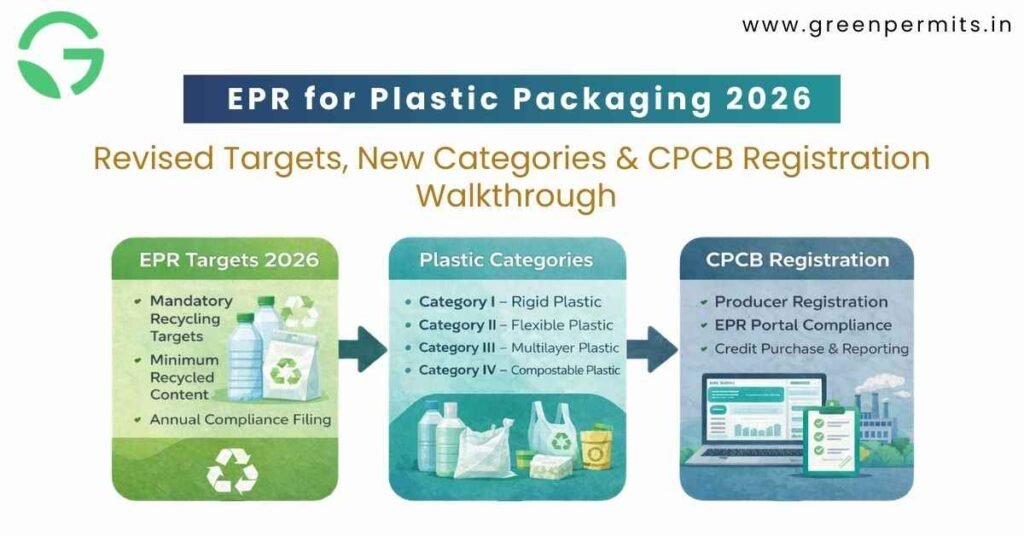
India’s plastic EPR structure operates under:
From 01 July 2025 onward, barcode/QR-based traceability requirements were introduced for plastic packaging. This means:
The regulatory direction is clear: traceability + measurable targets + digital reconciliation.
Under EPR for Plastic Packaging 2026, packaging must be declared under the correct category. Misclassification is one of the top reasons for CPCB portal objections.
Examples:
Examples:
Examples:
Requires:
Why this matters numerically:
If a company introduces:
The EPR obligation will be calculated separately for each category. A 5–10% category error can create a shortfall of 50–150 MT, leading to environmental compensation exposure.
Under EPR for Plastic Packaging 2026, targets are linked to:
Typical compliance structure includes:
For example:
If a brand introduces 2,000 MT packaging annually and recycling obligation is 75%, then:
2,000 × 75% = 1,500 MT recycling certificates required.
If only 1,300 MT certificates are purchased, then 200 MT shortfall exists.
Even a ₹5,000–₹8,000 per MT environmental compensation could mean ₹10–16 lakh exposure.
From July 2025 onward:
This creates operational consequences:
A mismatch between declared packaging (2,500 MT) and invoiced packaging (2,650 MT) during audit can trigger portal queries.
| Regulation | Key Requirement | Deadline | Applicable To | Risk if Ignored |
|---|---|---|---|---|
| PWM Rules | EPR Registration | Before product sale | Producers / PIBOs | Sales restriction |
| 2025 Amendment | QR/Barcode traceability | From 01 July 2025 | Producers / Importers | Product non-compliance |
| Annual Obligation Declaration | Packaging quantity declaration | 30 April | All registered entities | Shortfall calculation |
| Annual Return Filing | Recycling reconciliation | 30 June | Producers | Environmental compensation |
| EPA Section 15 | Penalty provision | Continuous | Violators | Fine + prosecution |
Interpretation:
The risk is no longer theoretical. The system now links packaging quantity, certificate purchase, and digital declaration.
Many businesses assume registration is simple. In reality, documentation accuracy determines approval speed.
Documents required:
Incorrect GST mapping can delay application by 15–30 working days.
You must declare:
Numerical Accuracy Tip:
If monthly average packaging is 210 MT,
Annual declared value should approximate:
210 × 12 = 2,520 MT (not rounded to 2,000 MT)
Portal auto-calculates:
Example:
Declared packaging = 3,000 MT
Recycling target = 80%
Obligation = 2,400 MT certificates
Certificates must be:
Price volatility example:
Certificate rates may range from ₹4,000 to ₹12,000 per MT depending on demand.
If you delay procurement until Q4, prices may rise by 15–25%.
Deadline: 30 June
Required:
Late filing can trigger:
Under Section 15 of the Environment Protection Act:
Non-compliance may lead to:
Mini Example:
A food brand introducing 1,800 MT packaging annually:
At ₹7,000 per MT compensation:
200 × 7,000 = ₹14,00,000 exposure.
That excludes legal, consultant, and operational costs.
A Gurgaon-based D2C cosmetics company expanded from 600 MT to 1,400 MT packaging in 12 months.
They:
Early structured compliance would have reduced cost by nearly 30%.
When businesses:
They reduce:
EPR for Plastic Packaging 2026 is about planning, not panic buying certificates in March.
EPR for Plastic Packaging 2026 is now:
If your packaging volume crosses 500 MT annually, structured compliance planning becomes critical.
If your packaging volume crosses 2,000 MT annually, EPR strategy directly impacts working capital and profitability.
Early registration, accurate declaration, and quarterly certificate procurement can reduce compliance cost by 15–25% compared to last-minute filing.
Book a Consultation with Green Permits