
In 2025, multiple plastic recycling units across India experienced delays of 60–120 days because their installed recycling capacity (for example, 25 MT/day) did not match the capacity declared in their Consent to Establish (CTE). In other cases, Consent to Operate (CTO) was withheld because the Effluent Treatment Plant (ETP) was not installed before inspection.
With the Plastic Waste Management (Amendment) Rules, 2025 effective from 23 January 2025, and additional disclosure requirements applicable from 1 July 2025, enforcement has become more structured, digital, and data-backed.
If you are planning to start or expand a plastic waste processing unit, obtaining proper SPCB Authorization for Plastic Waste Processing Units is no longer a procedural step — it is a regulatory checkpoint that directly affects your ability to operate, invoice, and remain EPR-compliant.
This guide explains the regulatory structure, timelines, technical requirements, costs, and risks in 2026.
Plastic recycling plants operate under multiple environmental laws simultaneously. Ignoring even one can lead to operational suspension.
| Regulation | Key Requirement | Deadline | Applicable To | Risk if Ignored |
|---|---|---|---|---|
| Plastic Waste Management (Amendment) Rules, 2025 | Barcode/QR declaration & disclosure | From 1 July 2025 | Producers, Recyclers, PIBOs | Portal suspension |
| Environment (Protection) Act, 1986 | Section 15 penalty provision | Continuous | All entities | Fine + imprisonment |
| Water Act, 1974 | Consent to Establish & Operate | Before installation & operation | Units using water | Closure direction |
| Air Act, 1981 | Emission compliance | Before operation | Units with boiler/extruder | Refusal of CTO |
| Hazardous & Other Waste Rules, 2016 | Handling sludge, oil, residue | Before operation | Washing units | Environmental compensation |
A 20 MT/day plastic washing and granulation unit must simultaneously comply with:
Failure in any one area can stop commercial production.
SPCB Authorization is formal approval granted by the State Pollution Control Board (SPCB) or Pollution Control Committee (PCC) allowing a unit to:
It typically includes:
To make compliance realistic, here are practical technical benchmarks used by SPCBs:
If your declared capacity is 25 MT/day but installed capacity is 35 MT/day, inspection teams may issue objections.
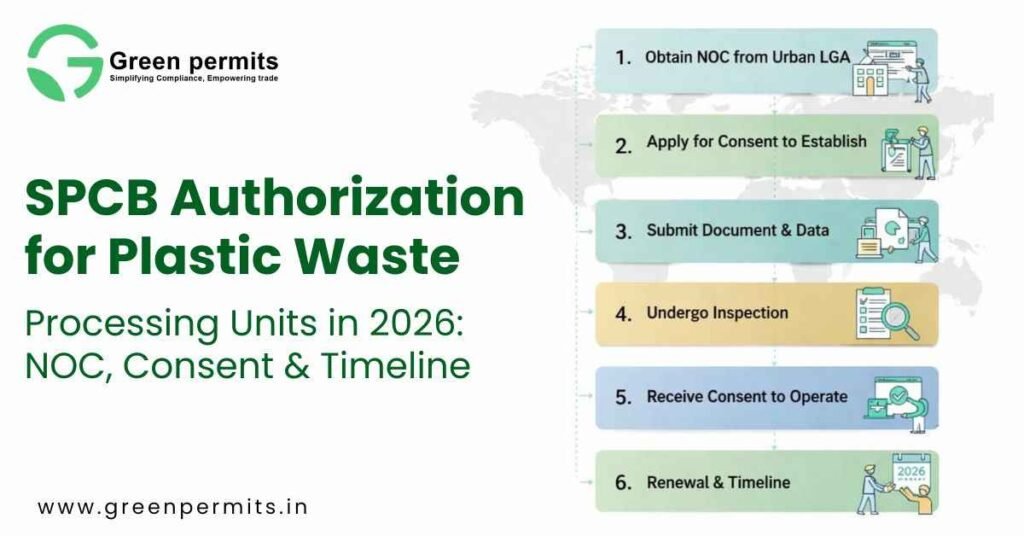
Setting up a plastic waste processing plant involves structured sequencing.
| Step | Authority | Timeline | Documents Required | Risk Area |
|---|---|---|---|---|
| Land acquisition & zoning | Local Authority | 30–45 days | Land records | Industrial zoning mismatch |
| DPR preparation | Consultant | 15–30 days | Capacity & pollution plan | Incorrect load calculation |
| Apply for CTE | SPCB | 30–60 working days | Layout, ETP design | Query notice |
| Installation of machinery | Unit | 60–120 days | Machinery invoice | Capacity deviation |
| Apply for CTO | SPCB | 30–45 days | Trial run data | Inspection failure |
| Plastic Waste Authorization | SPCB | 15–30 days | Storage & fire NOC | Fire safety non-compliance |
| EPR portal integration | CPCB/SPCB | Before operation | GST, PAN, capacity | Portal rejection |
During inspection, SPCB typically checks:
| Infrastructure | Approx Cost (₹) |
|---|---|
| ETP (10 KL/day) | 15–40 lakhs |
| Air pollution control | 5–20 lakhs |
| Fire system | 5–15 lakhs |
| Laboratory testing setup | 3–10 lakhs |
| Total compliance infra | 30 lakhs–1.5 crore |
Investment varies depending on 5 MT/day vs 50 MT/day plant.
From 1 July 2025, producers and related entities must:
Recyclers must maintain:
Depending on plastic category:
Annual return filing deadline generally falls around 30 June of the following financial year.
Operating without SPCB Authorization for Plastic Waste Processing Units can result in:
A 30 MT/day recycling unit in Western India faced a 4-month delay because its washing line generated 12 KL/day effluent, while the approved ETP was designed for 6 KL/day. The CTO was withheld until the ETP was upgraded.
Another unit lost export orders because the Pollution Control Board suspended its authorization during renewal.
Avoiding these errors can reduce approval time by 30–45 days.
Delays increase:
For a 25 MT/day unit with ₹3–5 crore investment, a 3-month delay can increase project cost by 5–8%.
Structured documentation before applying for CTE can significantly reduce objections.
In 2026, SPCB Authorization for Plastic Waste Processing Units is a multi-layer compliance framework combining:
Regulatory scrutiny is now capacity-driven and documentation-based.
The businesses that succeed are those that:
The cost of delay is measurable. The cost of compliance planning is predictable.
Green Permits Consulting LLC provides end-to-end support for:
📞 +91 78350 06182
📧 wecare@greenpermits.in