
In 2026, battery producers in India are facing stricter environmental compliance requirements than ever before. The rapid growth of electric vehicles, renewable energy storage systems, telecom backup batteries, and consumer electronics has significantly increased the volume of batteries entering the market each year.
For example, if a company sells 5,000 tonnes of batteries annually, it must now demonstrate that a defined percentage of those batteries are collected and recycled through authorized recycling facilities. Even a minimum compliance target of 8 percent recycling obligation would require verified recycling of 400 tonnes of battery waste.
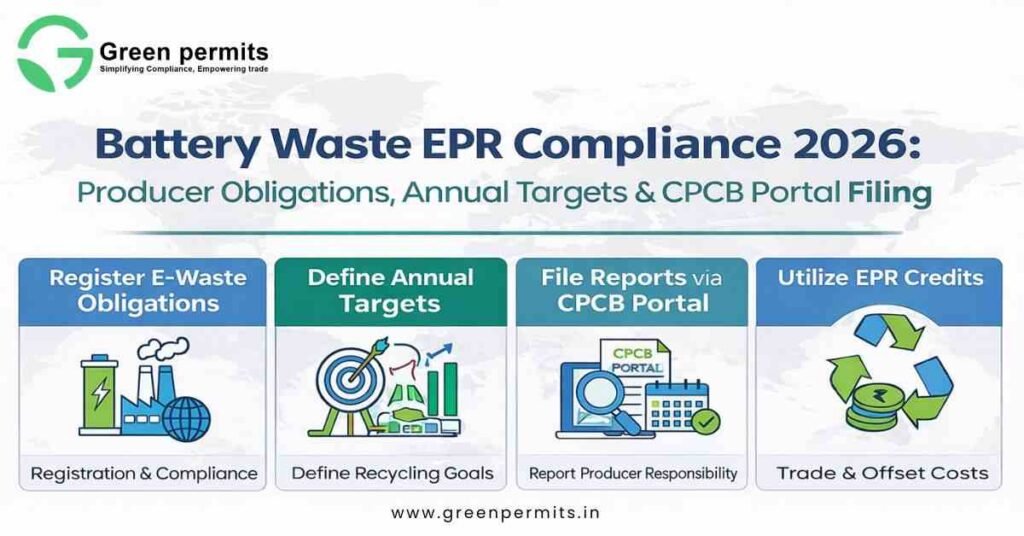
Under the Battery Waste EPR Compliance 2026 framework, manufacturers, importers, and brand owners must track battery sales volumes, purchase recycling certificates from registered recyclers, and submit compliance returns through the CPCB centralized EPR portal.
Without valid recycling certificates and proper annual filings, companies may face portal suspension, environmental compensation, and regulatory enforcement under the Environment Protection Act, 1986.
Battery waste compliance in India operates under the Environment (Protection) Act, 1986, which empowers the government to regulate environmentally hazardous waste streams.
Under this legal framework, the Battery Waste Management Rules introduced Extended Producer Responsibility to ensure batteries are collected, recycled, and disposed of safely.
The regulation applies to several categories of batteries used across industries, including:
Under the EPR system, the responsibility of managing battery waste shifts from municipalities to producers who introduce batteries into the market.
Producers must track how many batteries they sell in India and ensure that a specific percentage of those batteries are recycled through authorized facilities.
For example, if a company introduces 5,000 tonnes of lithium-ion batteries into the market in a financial year, the company must ensure that the required recycling percentage is achieved through registered recyclers.
The compliance mechanism is implemented through the CPCB centralized EPR portal, where producers must register, declare sales volumes, and submit recycling evidence.
The rules define producers broadly so that responsibility is not limited only to battery manufacturers.
A producer under the battery EPR framework may include:
This means a wide range of industries are covered by the regulation, including:
For example, if a solar inverter manufacturer imports 2,000 units of lithium battery storage systems each year, that company becomes responsible for managing the waste generated from those batteries.
Similarly, if a consumer electronics brand imports 500 tonnes of batteries annually, the EPR obligation applies even if the batteries were manufactured outside India.
| Regulation | Key Requirement | Deadline | Applicable To | Risk if Ignored |
|---|---|---|---|---|
| Battery Waste Management Rules | Mandatory EPR obligations | Continuous | Producers, Importers | Compliance penalties |
| CPCB EPR Portal Registration | Online registration before market entry | Before product sale | Battery producers | Product restriction |
| Annual Return Filing | Declaration of recycling compliance | 30 June every year | Producers | Portal suspension |
| Recycling Target Fulfilment | Minimum percentage recycling obligation | Financial year basis | Producers | Environmental compensation |
| Environment Protection Act | Legal enforcement provisions | Continuous | All entities | Financial penalties |
Businesses that fail to register under the CPCB portal may face operational issues such as product distribution restrictions or delays in environmental approvals.
Once a company qualifies as a producer under the battery rules, several compliance obligations become mandatory.
The most important responsibility is ensuring that batteries introduced into the market are eventually recycled through authorized recyclers.
Producer responsibilities typically include:
The compliance process also requires companies to maintain documentation such as:
Failure to maintain accurate documentation can delay portal approval by 30 to 60 days.
The battery EPR system follows a progressive compliance model, where recycling targets gradually increase over time.
The purpose of this approach is to allow the recycling industry to develop capacity while increasing environmental recovery rates.
Typical compliance milestones include:
To understand how this works in practice, consider the following example.
If a battery manufacturer sells 12,000 tonnes of batteries in India during a financial year, even an 8 percent recycling target would require verification of 960 tonnes of recycled batteries.
If the recycling obligation increases to 13 percent, the same company would need recycling evidence for 1,560 tonnes.
As battery consumption grows due to EV adoption and renewable energy expansion, the government is expected to increase recovery targets gradually.
The Central Pollution Control Board manages a centralized digital platform where battery producers must complete all compliance processes.
The portal serves multiple purposes:
The portal is designed to create transparency in the battery recycling ecosystem.
Every EPR certificate generated by recyclers corresponds to a verified quantity of battery waste processed at an authorized recycling facility.
Producers purchase these certificates to demonstrate compliance with their recycling targets.
The portal also allows regulators to track recycling activities and ensure that companies meet their environmental responsibilities.
The registration process on the CPCB portal generally involves several stages.
First, companies must create an account on the portal using their business credentials.
Information required during account creation includes:
After the account is created, companies must upload compliance documentation.
These documents typically include:
Once the documents are uploaded, producers must declare information related to their battery products.
This includes:
The application is then reviewed by CPCB officials.
If documentation is accurate, approval is typically granted within 20 to 45 working days.
| Step | Authority | Timeline | Documents Required | Risk Area |
|---|---|---|---|---|
| Portal registration | CPCB | Before introducing batteries into market | GST, PAN, CIN | Application rejection |
| Product declaration | CPCB Portal | Annual update | Sales and import data | Incorrect target calculation |
| Recycling certificate purchase | Authorized recyclers | Financial year | Recycling contracts | Target shortfall |
| Quarterly reporting | CPCB Portal | Every quarter | Recycling records | Compliance delay |
| Annual return filing | CPCB | Before 30 June | EPR declaration | Environmental compensation |
Companies often face compliance challenges when recycling certificates are not purchased early in the financial year.
Waiting until the end of the year may lead to certificate shortages.
Failure to comply with battery waste EPR regulations can create serious operational and financial risks.
Some of the most common compliance issues include:
Registration rejection
Incomplete or inaccurate registration applications may result in rejection by CPCB, delaying market entry for new products.
Portal suspension
If producers fail to submit annual returns or update sales data, their portal accounts may be temporarily suspended.
Environmental compensation
Authorities may impose financial penalties for unmet recycling targets.
These penalties are calculated based on the quantity of unfulfilled recycling obligations.
Import restrictions
Importers without valid EPR registration may face customs clearance delays.
Legal liability
Environmental violations can attract penalties under Section 15 of the Environment Protection Act, 1986, which allows regulators to impose monetary fines and initiate prosecution.
A battery distributor in Gujarat imported approximately 3,200 tonnes of lithium batteries in FY 2024–25.
However, the company underestimated its recycling obligations and purchased certificates for only 140 tonnes.
When the company attempted to file its annual return, the CPCB portal flagged a compliance gap.
The company was required to:
The entire process delayed compliance approval by nearly 50 days.
This example illustrates why planning recycling certificate purchases early in the financial year is essential.
Battery Waste EPR Compliance 2026 is becoming one of the most important environmental responsibilities for companies dealing with batteries in India.
Manufacturers, importers, and brand owners must now track battery sales volumes, calculate recycling obligations, and verify compliance through authorized recyclers.
The centralized CPCB portal has transformed battery waste management into a transparent digital system where regulators can monitor compliance in real time.
Businesses that prepare early and maintain proper documentation can avoid compliance delays and operational disruptions.
Those who ignore the regulation risk facing environmental penalties, product distribution restrictions, and potential legal action.
For companies dealing with battery products, building a structured EPR compliance strategy is now essential for long-term regulatory security.
📞 +91 78350 06182
📧 wecare@greenpermits.in