
In early 2025, an electronics refurbishing company in Bengaluru planned to install a small 3 MT/day e-waste recycling facility to process discarded laptops and telecom equipment. The promoters purchased machinery worth ₹2.8 crore, but the project remained idle for nearly 4 months because the plant had not secured SPCB Consent to Establish before installing equipment.
Situations like this are increasingly common as environmental regulations governing electronic waste become stricter. India’s E-Waste Management Rules, 2022 introduced a fully digital compliance system through the CPCB portal, requiring recyclers, producers, and refurbishers to register and report waste processing data.
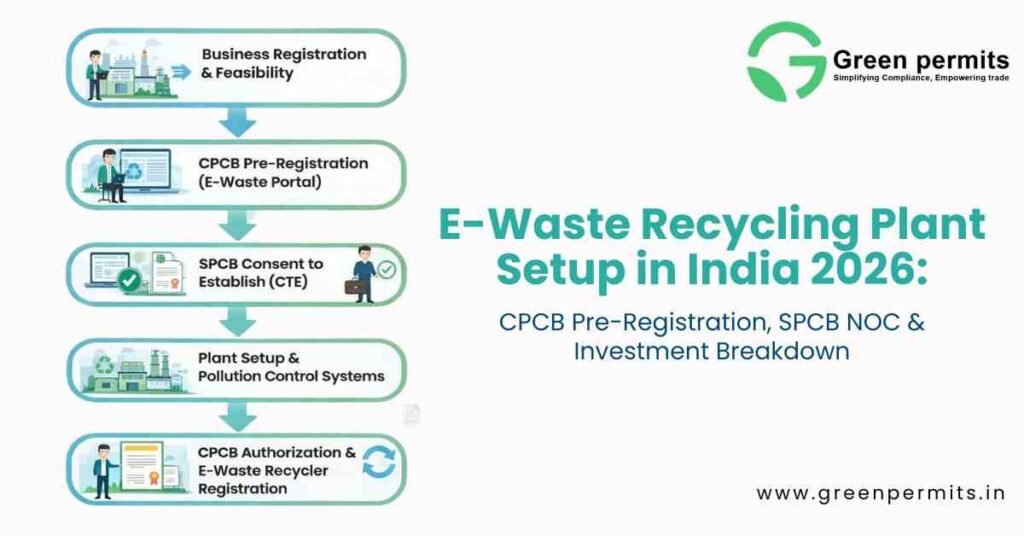
For entrepreneurs planning an E-Waste Recycling Plant Setup in India in 2026, understanding the regulatory sequence—CPCB registration, SPCB NOC, pollution control requirements and capital investment planning—is critical before committing funds to infrastructure.
India has emerged as one of the world’s fastest growing electronic markets. With rising consumption of smartphones, laptops, telecom devices and consumer electronics, the volume of discarded electronic equipment is increasing every year.
Key indicators driving recycling infrastructure demand:
To address these gaps, the government introduced E-Waste Management Rules, 2022, strengthening Extended Producer Responsibility (EPR) and mandating recycling through authorized facilities.
As a result, demand for registered recycling plants with capacities ranging from 1 MT/day to 50 MT/day is steadily increasing across industrial states.
| Regulation | Key Requirement | Deadline | Applicable To | Risk if Ignored |
|---|---|---|---|---|
| E-Waste Management Rules, 2022 | Mandatory CPCB registration for recyclers | Before plant operation | Recycling companies | Application rejection |
| SPCB Consent to Establish | Environmental approval before construction | Prior to installation | Plant developers | Project halt |
| SPCB Consent to Operate | Required before starting recycling operations | Before production | Operational recyclers | Plant closure |
| Hazardous Waste Rules 2016 | Safe storage and disposal of hazardous components | Continuous | Recycling facilities | Environmental compensation |
| Environment Protection Act 1986 | Pollution control compliance | Continuous | All industries | Penalties under Section 15 |
Without these approvals, recycling plants cannot legally process electronic waste or issue recycling certificates to producers.
| Step | Authority | Timeline | Documents Required | Risk Area |
|---|---|---|---|---|
| Business incorporation | MCA | 7–10 days | PAN, CIN, GST | Administrative delay |
| Land acquisition and zoning | State authorities | 1–3 months | Land title, industrial zoning | Location rejection |
| SPCB Consent to Establish | State Pollution Control Board | 60–90 days | DPR, layout, pollution control plan | Application rejection |
| CPCB Recycler Registration | Central Pollution Control Board | 45–60 days | GST, PAN, technical capacity | Portal rejection |
| Plant construction and machinery installation | Internal | 6–10 months | Equipment invoices | Compliance inspection |
| SPCB Consent to Operate | SPCB | 30–45 days | Inspection report | Production halt |
Most recycling projects take 9–18 months from planning to commercial operation.
All recycling plants must register with the Central Pollution Control Board (CPCB) before handling electronic waste.
The registration process is conducted through the CPCB online compliance portal.
Applicants must create login credentials and submit company information including:
The following documents are typically required:
Recyclers must provide details of:
CPCB evaluates the application and may request clarifications before approval.
The portal also enables recyclers to:
Typical processing timeline: 45–60 days.
Before installing machinery, plant developers must obtain environmental clearance from the State Pollution Control Board (SPCB).
Two approvals are mandatory.
Required before construction or installation.
Typical documents required:
Processing timeline: 60–90 days.
Issued after plant installation and inspection.
SPCB verifies:
Typical validity: 5 years.
Land requirements vary depending on processing capacity and storage needs.
Industrial zoning approval is required before construction.
Recycling plants typically include multiple mechanical and manual processing lines.
Key equipment includes:
Advanced facilities may also include automated sorting systems for printed circuit boards.
Electronic waste contains hazardous substances including lead, mercury and lithium compounds.
To prevent environmental contamination, recycling plants must install pollution control systems.
Typical systems include:
Hazardous residues must be transported to authorized disposal facilities under Hazardous Waste Rules, 2016.
The capital investment depends on plant capacity and automation level.
| Component | Estimated Cost |
|---|---|
| Land and infrastructure | ₹1–2 crore |
| Machinery | ₹1.5–2 crore |
| Pollution control systems | ₹40–60 lakh |
| Licensing and compliance | ₹15–25 lakh |
Total investment: ₹2–4 crore
| Component | Estimated Cost |
|---|---|
| Land development | ₹3–4 crore |
| Machinery | ₹5–7 crore |
| Pollution control systems | ₹1–2 crore |
| Storage infrastructure | ₹50–80 lakh |
Total investment: ₹8–15 crore
| Component | Estimated Cost |
|---|---|
| Land acquisition | ₹10–20 crore |
| Automated machinery | ₹30–40 crore |
| Pollution control infrastructure | ₹5–7 crore |
| Licensing and compliance | ₹1–2 crore |
Total investment: ₹40–70 crore
Electronic waste contains several recoverable materials.
Typical recovery percentages include:
These recovered materials are supplied to manufacturing industries for reuse.
Failure to follow regulatory requirements can lead to serious operational and legal consequences.
Common risks include:
Under Section 15 of the Environment Protection Act, 1986, violations may result in fines and imprisonment.
A recycling startup in Gujarat planned a 5 MT/day plant with an investment of ₹6.5 crore.
However, the promoters began installing machinery before receiving SPCB Consent to Establish. During inspection, the state pollution board halted construction until regulatory approval was obtained, delaying the project by three months.
This highlights why compliance planning must begin before equipment procurement.
Setting up an E-Waste Recycling Plant in India in 2026 involves far more than purchasing shredders and dismantling equipment.
Successful projects must carefully plan:
Businesses that prepare regulatory documentation early can significantly reduce approval timelines and start operations faster.
With India’s electronic consumption expanding rapidly, professionally managed recycling plants will play a crucial role in building a circular economy for electronics.
Yes. Under the E-Waste Management Rules 2022, recyclers must obtain CPCB registration before handling electronic waste.
Approval typically takes 45–60 days, depending on document completeness and technical evaluation.
Small recycling units generally require ₹2–4 crore, while large industrial facilities may require ₹40–70 crore.
Yes. Both Consent to Establish and Consent to Operate are mandatory before recycling operations begin.
Facilities typically process 1 MT/day to 50 MT/day depending on scale and automation.
Operating without CPCB registration or SPCB approval may lead to plant closure and penalties under the Environment Protection Act, 1986.
📞 +91 78350 06182
📧 wecare@greenpermits.in
Book a Consultation with Green Permits