
In FY 2024–25, many Indian manufacturers and brand owners discovered during CPCB portal verification that their plastic recycling numbers were lower than their declared market introduction.
For several FMCG companies, the compliance gap ranged between 10% to 25% of total plastic packaging introduced into the market. In real numbers, that meant shortfalls of 200 MT to 3,000 MT of plastic waste recycling obligations.
With stricter digital monitoring on the CPCB EPR portal, businesses can no longer rely only on informal collection networks. If recycling targets are not met through physical collection, the law allows companies to offset their obligations through EPR Offset Certificates issued by registered recyclers.
Under the Plastic Waste Management Rules, 2016, producers must ensure that plastic packaging introduced in the market is recycled or processed through authorized systems. By 2026, enforcement is expected to be significantly stricter, especially for companies introducing more than 1,000 MT of plastic packaging annually.
Understanding how EPR offset certificates work, how they are generated, and how they are purchased on the CPCB portal has now become a core compliance requirement for manufacturers, importers, and brand owners operating in India.
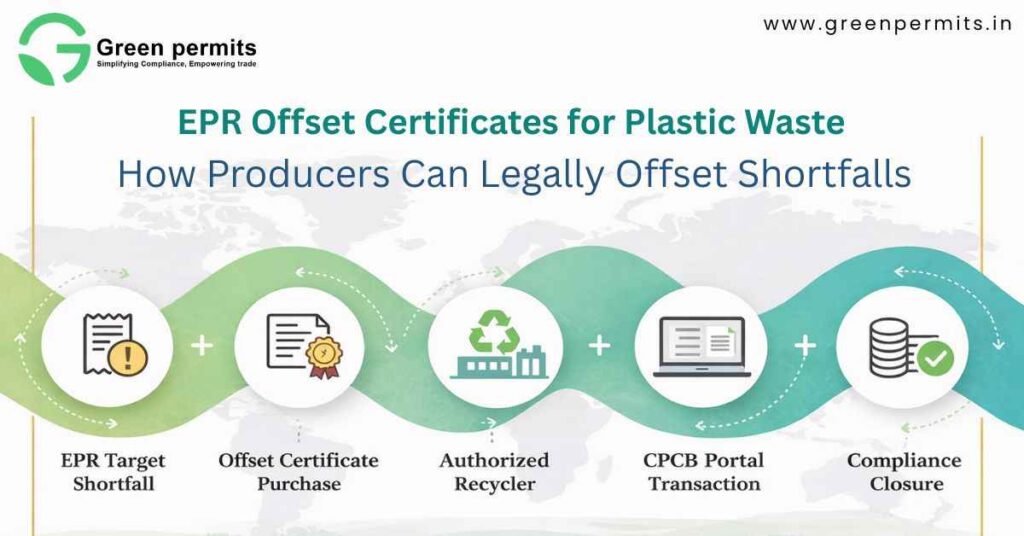
Extended Producer Responsibility (EPR) is a regulatory framework where companies introducing plastic packaging into the market must take responsibility for managing that waste after use.
If producers cannot collect and recycle enough plastic waste through their own network, they can legally purchase EPR certificates from registered plastic waste recyclers.
Each certificate represents verified recycling of plastic waste by an authorized facility.
Key characteristics include:
For large companies introducing 5,000 MT to 50,000 MT of plastic packaging annually, certificates have become a critical compliance tool.
India’s plastic waste management system operates under the Plastic Waste Management Rules, 2016, issued under the Environment Protection Act, 1986.
These rules introduced Extended Producer Responsibility to ensure that producers remain responsible for the environmental impact of their packaging.
The regulatory system requires:
Failure to comply can lead to registration suspension, environmental compensation penalties, and operational disruptions.
| Regulation | Key Requirement | Deadline | Applicable To | Risk if Ignored |
|---|---|---|---|---|
| Plastic Waste Management Rules, 2016 | Mandatory EPR for plastic packaging | Continuous | Producers, Importers, Brand Owners | Registration cancellation |
| CPCB EPR Portal System | Online reporting and certificate trading | Annual compliance cycle | Producers & Recyclers | Portal suspension |
| Annual Plastic Waste Return | Plastic packaging reporting | 30 June each year | Registered companies | Environmental compensation |
| CPCB Registration | Mandatory before selling products | Before market entry | Importers and manufacturers | Customs clearance delays |
For companies operating in sectors such as FMCG, electronics, pharmaceuticals, cosmetics, and food packaging, EPR compliance has now become a routine regulatory responsibility.
Plastic packaging is divided into four categories for compliance reporting.
Each category has different recycling challenges and recovery rates.
Examples include:
Typical recycling rates in India reach 65% to 75% due to strong recycling markets.
Includes:
Recycling rates usually range between 30% and 45%, depending on the polymer type.
Used in:
Recycling efficiency is often below 25%, making compliance difficult.
Includes plastic materials certified as compostable under approved standards.
Companies must declare packaging category during CPCB portal registration and annual return filing.
Incorrect category declarations frequently cause portal rejection and compliance delays.
EPR targets are calculated based on the quantity of plastic packaging introduced in the previous financial year.
Typical compliance percentages include:
These percentages represent the minimum plastic waste that must be recycled each year.
Example calculation:
A company introducing 6,000 MT of plastic packaging annually may have the following obligation:
The 260 MT shortfall can be legally offset through EPR certificates.
EPR certificates are created by registered plastic waste recyclers after processing plastic waste.
The process includes:
Recycling facilities vary widely in capacity.
Typical processing capacities include:
Once waste processing is verified, the recycler receives digital certificates equivalent to the quantity recycled.
These certificates are then made available for purchase.
The CPCB EPR portal functions as the national compliance system where recyclers generate certificates and producers purchase them.
The typical purchase process includes several steps.
| Step | Authority | Timeline | Documents Required | Risk Area |
|---|---|---|---|---|
| CPCB Registration | CPCB | 15–30 days | GST, PAN, CIN, IEC | Registration rejection |
| Plastic Packaging Declaration | CPCB Portal | Annual cycle | Sales data and packaging category | Incorrect reporting |
| Target Calculation | CPCB System | Automated | Market introduction data | Under-reporting |
| Certificate Purchase | CPCB Portal | Before annual filing | Purchase agreement | Certificate shortage |
| Annual Return Filing | CPCB | By 30 June | Recycling certificates | Portal penalties |
Many companies start purchasing certificates between January and May, just before the annual filing deadline.
Waiting until the last month often leads to certificate price increases of 20% to 40% due to demand spikes.
Companies must submit several statutory documents when registering on the CPCB portal.
Typical documentation includes:
Incomplete documentation often leads to registration delays of 20 to 45 days.
Failure to meet EPR obligations can create serious regulatory risks.
Key consequences include:
CPCB Registration Suspension
Companies may lose authorization to introduce plastic packaging into the market.
Environmental Compensation
Financial penalties may be imposed based on the quantity of recycling shortfall.
State Pollution Control Board Restrictions
SPCBs may restrict plant operations until compliance is restored.
Customs Clearance Issues
Importers may face delays in clearing plastic-packaged goods.
Annual Return Rejection
Incorrect reporting can cause portal rejection and compliance delays.
Under the Environment Protection Act, 1986, violations may attract financial penalties and operational restrictions.
A snack food company in Gujarat introduced approximately 14,500 MT of plastic packaging during FY 2023–24.
During compliance verification:
To avoid penalties and portal suspension, the company purchased 465 EPR certificates from registered recyclers.
The transaction was completed within 12 days before the annual filing deadline.
For most businesses, EPR certificates provide a practical compliance mechanism.
They allow companies to:
Companies introducing more than 10,000 MT of plastic packaging annually usually plan certificate procurement 6 to 9 months before annual filing.
Late procurement increases both compliance risk and certificate costs.
India’s plastic waste compliance system is moving toward fully digital monitoring and stricter enforcement.
Producers must now treat EPR obligations as a core part of their regulatory strategy. When internal collection systems fall short, EPR offset certificates provide a legally recognized mechanism to bridge compliance gaps.
However, businesses should not rely on last-minute certificate purchases.
Companies that maintain accurate packaging data, register early on the CPCB portal, and plan certificate procurement well before the 30 June annual filing deadline will face fewer regulatory disruptions.
As enforcement intensifies in 2026 and beyond, structured EPR compliance planning will be essential for manufacturers, importers, and brand owners across India.
📞 +91 78350 06182
📧 wecare@greenpermits.in