
More than 380 product categories in India now require mandatory BIS certification before they can be imported, sold, or distributed in the market. These regulations are enforced through Quality Control Orders (QCOs) issued by the Government of India across sectors such as electrical appliances, steel products, construction materials, pressure equipment, and consumer goods.
For foreign manufacturers exporting products to India, compliance with the Foreign Manufacturers Certification Scheme (FMCS) administered by the Bureau of Indian Standards (BIS) is a legal requirement. Without FMCS certification, regulated products cannot legally enter the Indian market.
Under the Bureau of Indian Standards Act, 2016, overseas manufacturing facilities must obtain BIS approval and complete a factory inspection before they can apply the ISI mark on products exported to India. In most cases, the certification process involves 4–6 regulatory stages, including product testing, factory audit, and licensing approval.
Manufacturers exporting regulated products without BIS certification often face shipment detention of 30–60 days at Indian ports, along with import rejection, warehousing charges, and operational delays.
This guide explains the FMCS certification process in India for 2026, including eligibility criteria, documents required, factory inspection procedures, approval timelines, and compliance risks for foreign manufacturers entering the Indian market.
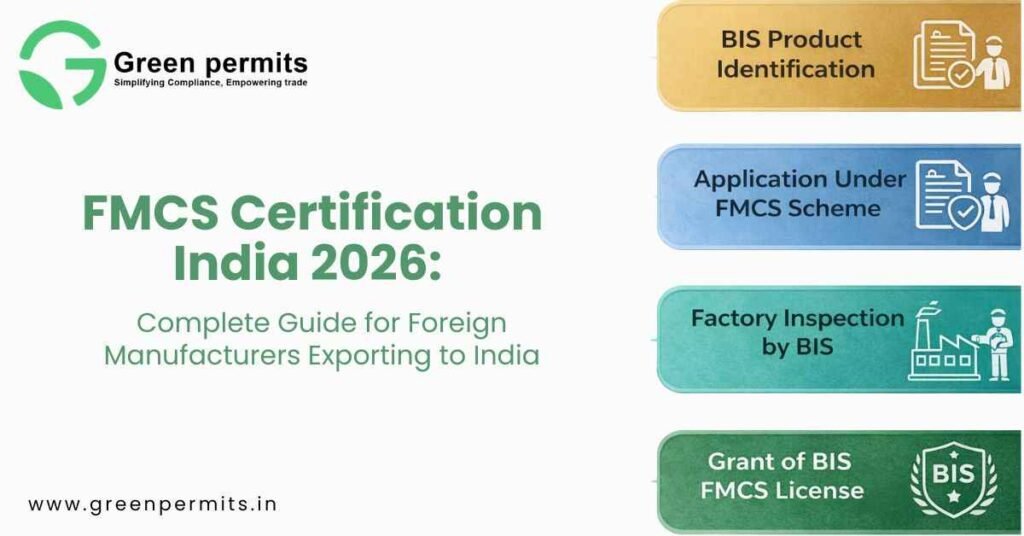
The Foreign Manufacturers Certification Scheme (FMCS) is a product certification system operated by the Bureau of Indian Standards (BIS) that allows manufacturers located outside India to obtain permission to use the Standard Mark (ISI mark) on products exported to India.
The scheme is regulated under the Bureau of Indian Standards Act, 2016 and the BIS Conformity Assessment Regulations, 2018.
Under FMCS, BIS verifies that the manufacturing facility has the capability to consistently produce products that comply with applicable Indian Standards (IS).
Key characteristics of FMCS certification include:
India has expanded mandatory certification through QCO notifications across 20+ industrial sectors, covering more than 380 regulated products.
| Regulation | Key Requirement | Deadline | Applicable To | Risk if Ignored |
|---|---|---|---|---|
| BIS Act, 2016 | Product certification and Standard Mark licensing | Before import | Foreign manufacturers | Import prohibition |
| BIS Conformity Assessment Regulations, 2018 | Certification procedures and inspection requirements | During application | Manufacturing facilities | License rejection |
| Quality Control Orders | Mandatory BIS certification for specified products | Continuous compliance | Importers and exporters | Shipment detention |
For companies exporting regulated goods to India, BIS certification must be obtained before the product enters the supply chain.
Failure to obtain certification may result in customs hold, product seizure, or market prohibition.
FMCS certification is required for foreign manufacturers exporting regulated products to India.
This applies to companies engaged in:
Industries commonly requiring FMCS certification include:
Several of these sectors are regulated through mandatory Quality Control Orders issued between 2019 and 2025.
Some of the commonly regulated product categories include:
India currently maintains hundreds of mandatory BIS standards, and the list continues to expand as part of the national product quality policy.
Obtaining FMCS certification typically involves six regulatory stages.
Foreign manufacturers must submit an application to BIS providing details about the company and the manufacturing facility.
The application must include:
Incomplete applications are one of the most common causes of processing delays during certification review.
Foreign manufacturers must appoint an Authorized Indian Representative who acts as the legal liaison between the manufacturer and BIS.
Responsibilities of the AIR include:
Without appointing an AIR, the FMCS certification process cannot proceed.
Product samples must be tested to verify compliance with the applicable Indian Standard.
Testing can be conducted in:
Typical testing timelines range between:
depending on product complexity.
BIS officials conduct a physical inspection of the overseas manufacturing facility.
During the inspection, officers verify:
Factory inspections usually take 1–2 working days.
After successful inspection and satisfactory test results, BIS grants a license allowing the manufacturer to use the Standard Mark (ISI mark) on the product.
Typical approval timeline:
depending on inspection scheduling and document verification.
Once the license is issued, manufacturers must maintain compliance with BIS requirements.
This includes:
Failure to maintain compliance may result in license suspension or cancellation.
| Step | Authority | Timeline | Documents Required | Risk Area |
|---|---|---|---|---|
| Application submission | BIS | 1–2 weeks | Company documents | Incomplete application |
| Product testing | BIS laboratory | 15–30 days | Product samples | Test failure |
| Factory inspection | BIS inspection team | 1–2 days | Manufacturing records | Non-compliant facility |
| License approval | BIS HQ | 30–45 days | Inspection report | Documentation gaps |
| License issuance | BIS | 1 week | Fee payment | Delayed payment |
Most manufacturers complete the certification process within 4–6 months.
Businesses planning exports to India should start the process at least 6 months before product launch.
Manufacturers must provide several documents during the application process.
Key documents include:
Documents for the Authorized Indian Representative include:
Incomplete documentation is a major reason for BIS application rejection.
Foreign manufacturers exporting regulated products without FMCS certification face multiple regulatory risks.
Indian customs authorities may detain shipments for 30–60 days until compliance verification is completed.
Products without BIS certification may be refused entry into India.
Authorities may seize products already distributed in the market.
Companies may incur additional costs including:
Under the Bureau of Indian Standards Act, 2016, misuse of the Standard Mark or sale of uncertified regulated products may result in financial penalties and legal action.
A foreign manufacturer exporting electric water heaters attempted to enter the Indian market without BIS certification in 2024.
Because the product category required mandatory certification, the shipment was detained at Mumbai port for 47 days.
The manufacturer eventually had to:
Early certification would have prevented these operational losses.
India continues to expand mandatory product certification across multiple industries.
This means:
Foreign manufacturers planning to enter the Indian market must therefore integrate BIS certification into their product launch strategy.
Early compliance helps avoid:
The Foreign Manufacturers Certification Scheme (FMCS) is an essential regulatory requirement for overseas companies exporting regulated products to India.
The process includes:
Although certification typically takes 4–6 months, completing the process early ensures smooth entry into the Indian market and reduces the risk of shipment delays or regulatory penalties.
For companies planning exports to India in 2026, obtaining FMCS certification remains a critical step in achieving regulatory compliance and long-term market access.
📞 +91 78350 06182
📧 wecare@greenpermits.in