
In early 2025, several electronics importers faced shipment delays at Indian ports because their wireless devices lacked the required regulatory approvals. Products such as Wi-Fi routers, Bluetooth speakers, and IoT gateways were held by customs because companies had completed only one certification while ignoring the others.
India regulates wireless and telecom devices through multiple compliance frameworks. A single product may require approval from WPC for spectrum use, TEC for telecom compliance, and BIS for product safety.
For manufacturers, importers, and brand owners launching wireless products in India in 2026, understanding how these approvals integrate is critical to avoid customs holds, market bans, and regulatory penalties.
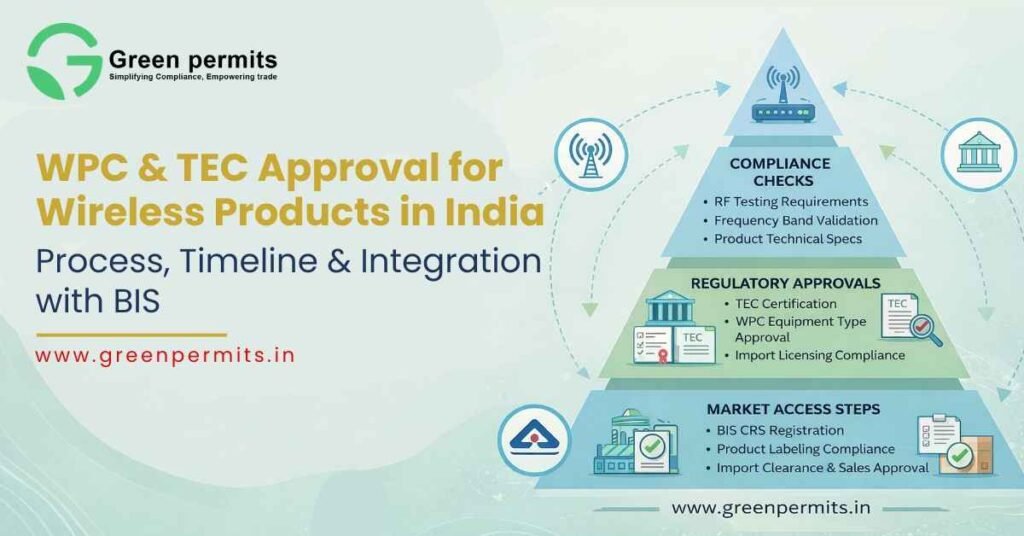
Wireless products transmit signals using radio frequency spectrum. To ensure safe use of spectrum and telecom networks, India regulates such devices under several legal frameworks.
The primary regulatory authorities include:
Common wireless devices requiring regulatory approvals include:
Depending on the device category, companies may need 2 or 3 approvals simultaneously before importing or selling the product in India.
Wireless equipment compliance in India is governed by telecom and electronics safety laws.
| Regulation | Key Requirement | Deadline | Applicable To | Risk if Ignored |
|---|---|---|---|---|
| Wireless Telegraphy Act, 1933 | WPC approval for RF devices | Before import or sale | Manufacturers and importers of wireless devices | Customs seizure |
| Indian Telegraph Act, 1885 | Telecom equipment regulation | Before sale | Telecom network equipment manufacturers | Market ban |
| BIS Act, 2016 | Compulsory Registration Scheme | Before product launch | Electronics manufacturers | Sales prohibition |
These frameworks ensure that wireless devices:
Businesses launching wireless products must obtain approvals before importing or distributing products in the Indian market.
The Wireless Planning & Coordination Wing (WPC) regulates radio frequency spectrum in India.
Devices that transmit radio signals must obtain Equipment Type Approval (ETA) when operating in license-exempt frequency bands.
Common frequency bands permitted for license-exempt devices include:
Products requiring ETA approval typically include:
Typical ETA approval timeline ranges between 10 and 20 working days once RF test reports are submitted.
ETA approval generally remains valid for the approved module model indefinitely, unless design changes occur.
TEC certification applies to telecom equipment that connects to communication networks.
The Mandatory Testing and Certification of Telecom Equipment (MTCTE) framework requires telecom devices to be tested and approved before sale or import.
Products requiring MTCTE certification include:
Certification involves testing in TEC-designated laboratories to ensure devices comply with Essential Requirements defined by TEC.
Typical MTCTE certification timelines:
Total approval duration usually ranges between 5 and 8 weeks.
Many wireless products also require BIS registration under the Compulsory Registration Scheme (CRS).
The scheme operates under the BIS Act, 2016 and ensures product safety for electronic goods.
As of 2026, more than 70 product categories fall under BIS CRS.
Wireless devices commonly covered include:
Manufacturers must obtain BIS registration before selling products in the Indian market.
Typical BIS CRS timelines:
| Process | Timeline |
|---|---|
| product testing | 10–15 days |
| documentation review | 10–20 days |
| license issuance | 5–10 days |
Total approval timeline generally ranges between 20 and 30 days.
A major compliance challenge for manufacturers is the overlap between regulatory authorities.
Many wireless products require approvals from multiple authorities simultaneously.
| Product | WPC ETA | TEC MTCTE | BIS CRS |
|---|---|---|---|
| Wi-Fi Router | Required | Required | Required |
| Bluetooth Speaker | Required | Not Required | Required |
| IoT Gateway | Required | Required | Required |
| Wireless Keyboard | Required | Not Required | Sometimes |
Companies must plan certifications carefully to avoid delays in product launch.
| Step | Authority | Timeline | Documents Required | Risk Area |
|---|---|---|---|---|
| RF Testing | Accredited Lab | 7–10 days | RF test report | Incorrect frequency bands |
| ETA Application | WPC | 10–20 days | test reports, authorization letter | Application rejection |
| Telecom Testing | TEC Lab | 3–5 weeks | product samples | test failure |
| TEC Certification | TEC | 2–3 weeks | compliance documents | launch delay |
| BIS Registration | BIS | 20–30 days | test reports, factory details | sales restriction |
Companies that plan certifications early can reduce launch delays by 30–40%.
Typical documentation required includes corporate, technical, and manufacturing information.
Corporate documents
Technical documents
Manufacturing details
These documents must be uploaded through regulatory portals for approval processing.
Failure to obtain required approvals can lead to serious regulatory consequences.
Possible risks include:
Non-compliance may attract enforcement action under Section 15 of the Environment Protection Act, 1986, which allows authorities to impose penalties for regulatory violations.
A consumer electronics importer in Mumbai planned to launch a smart Wi-Fi camera in 2025.
The product required:
Because the company started the TEC certification process late, the approval took 9 weeks instead of the expected 6 weeks, delaying the product launch by nearly two months.
This situation highlights the importance of planning regulatory approvals before product import.
Businesses launching wireless products should adopt a structured certification strategy.
Recommended compliance planning includes:
Start approvals 3–4 months before product import.
Certification sequence should generally follow:
Parallel processing of approvals can significantly reduce product launch timelines.
Wireless device compliance in India requires navigating a complex regulatory environment involving spectrum regulation, telecom certification, and electronics safety standards.
Manufacturers and importers must understand the integration between WPC ETA approval, TEC MTCTE certification, and BIS CRS registration to successfully launch wireless products in the Indian market.
Early compliance planning reduces the risk of customs delays, regulatory penalties, and product launch disruptions.
Companies that prepare documentation and certification timelines in advance can reduce regulatory delays by 30–50%, ensuring faster entry into India’s rapidly growing electronics market.
📞 +91 78350 06182
📧 wecare@greenpermits.in