
In early 2025, several Indian brand owners and importers discovered a frustrating issue while filing their annual EPR returns. Their CPCB EPR portal submissions were rejected due to certificate mismatches, incorrect packaging data, or incomplete recycler transactions. In many cases, companies had already purchased EPR certificates but were unable to reconcile them with portal obligations before the annual filing deadline of 30 June.
As environmental compliance systems become fully digitized, the CPCB EPR Portal has become the central platform for monitoring waste management obligations across plastic waste, battery waste, e-waste, and vehicle recycling sectors.
Recent regulatory changes—including the Plastic Waste Management (Amendment) Rules, 2025 notified on 23 January 2025—have introduced additional reporting requirements such as QR-code-based product traceability and enhanced producer disclosures.
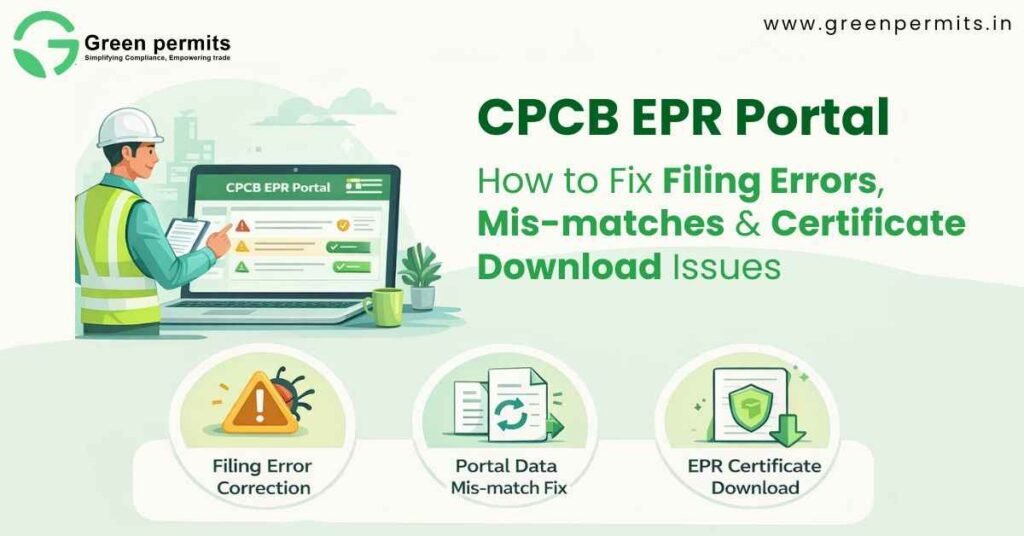
For businesses in 2026, the challenge is no longer just registration. The real challenge lies in:
This guide explains the most common CPCB portal issues and how businesses can resolve them before compliance deadlines.
The Central Pollution Control Board (CPCB) developed centralized digital portals to implement Extended Producer Responsibility across multiple waste streams.
The portal enables the following functions:
For example, under the Environment Protection (End-of-Life Vehicles) Rules, 2025, CPCB created a centralized portal to manage registration of producers, registered vehicle scrapping facilities (RVSFs), and bulk consumers. The portal also facilitates generation and transaction of EPR certificates and filing of compliance returns.
Because all obligations are digitally tracked, any mismatch in uploaded data can trigger portal rejection or filing errors.
| Regulation | Key Requirement | Deadline | Applicable To | Risk if Ignored |
|---|---|---|---|---|
| Plastic Waste Management Rules 2016 (Amended 2025) | EPR registration and waste recycling obligation | Annual filing by 30 June | Producers, Importers, Brand Owners | CPCB rejection and penalties |
| Battery Waste Management Rules 2025 | Battery recycling and EPR certificate purchase | Quarterly and annual reporting | Battery producers and importers | Environmental compensation |
| E-Waste Management Rules | EPR obligation for electronics recycling | Annual reporting | Electronics manufacturers | Registration suspension |
| Environment Protection Act 1986 | Enforcement and penalties | Continuous compliance | All industries | Financial penalties and legal action |
Failure to comply with EPR obligations may attract penalties under Section 15 of the Environment Protection Act, 1986.
For businesses, this means that a simple portal error can escalate into compliance violations if not corrected before submission deadlines.
| Step | Authority | Timeline | Documents Required | Risk Area |
|---|---|---|---|---|
| Portal Registration | CPCB | 15–30 days | GST, PAN, CIN, IEC | Incorrect documentation |
| Profile Verification | CPCB officers | 7–20 days | Authorization letters | Profile rejection |
| Quarterly Data Filing | CPCB Portal | End of quarter | Sales data, recycler data | Data mismatch |
| Certificate Purchase | Recyclers | Before annual filing | Transaction records | Certificate mismatch |
| Annual Return Filing | CPCB | 30 June | Recycling proof | Portal rejection |
Businesses should treat this timeline as a compliance workflow rather than a one-time filing exercise.
The majority of CPCB portal errors fall into five operational categories.
This occurs when producers upload incorrect packaging quantities or categories.
Common causes include:
Typical discrepancies observed during audits range between 3% and 18% of reported packaging quantities.
One of the most frequent CPCB portal errors involves mismatches between:
Possible reasons include:
In several cases, companies purchase certificates worth 500–2000 MT of recycling credits, but the portal only reflects partial quantities due to recycler upload delays.
The CPCB portal automatically calculates obligations based on the quantity of packaging introduced into the market.
If incorrect data is uploaded during registration or quarterly filing, the portal may calculate inflated obligations.
Example scenario:
A packaged food manufacturer reported 1200 MT of plastic packaging introduced in FY 2024-25, but incorrectly classified multilayer packaging as rigid plastic.
The portal recalculated obligations using higher recycling targets, increasing compliance requirements by over 300 MT.
Businesses sometimes face issues downloading EPR certificates due to:
Certificates generally become downloadable after recycler approval and CPCB validation.
Operational issues also occur due to incorrect user profile configuration.
Typical examples include:
Since many portal fields auto-populate using GST data, even minor discrepancies can trigger submission errors.
Resolving CPCB portal errors requires a structured troubleshooting approach.
Start by reviewing company profile details.
Check the following:
The CPCB registration process requires uploading documents such as GST certificate, PAN card, IEC certificate, and CIN documents in PDF format, usually under 2 MB file size.
Incorrect documents often cause verification delays.
Businesses must reconcile:
Reconciliation should cover:
A typical FMCG company introducing 5000 MT of packaged goods annually may generate 300–600 MT of plastic packaging waste obligations.
Before filing returns, companies should confirm the following with recyclers:
Under the EPR framework, recyclers generate certificates based on the quantity of waste processed, which producers purchase to meet their obligations. Producer_Sop
If mismatches appear, corrections should be made before the annual filing deadline.
Actions include:
Once the annual return is submitted, correcting data becomes significantly more complex.
After corrections:
Processing of revised returns may take 7–21 working days depending on CPCB review workload.
A cosmetics brand owner operating in Maharashtra reported 850 MT of plastic packaging introduced during FY 2024-25.
However:
Because of this mismatch, the CPCB portal blocked annual return submission.
After coordinating with recyclers and correcting certificate allocation, the company completed filing within 10 working days.
Ignoring CPCB portal issues can create serious regulatory risks.
Potential consequences include:
Environmental violations may also attract penalties under Section 15 of the Environment Protection Act, 1986, which includes fines and possible prosecution.
With digitized compliance monitoring, CPCB now tracks:
New regulatory updates, including traceability requirements under the Plastic Waste Management (Amendment) Rules, 2025, require producers to disclose product identification information such as barcodes or QR codes for packaging traceability.
This means that future compliance audits will rely heavily on portal data accuracy.
The CPCB EPR Portal has transformed environmental compliance in India from a paper-based process into a centralized digital system.
While the portal simplifies regulatory oversight, it also introduces operational challenges such as:
For businesses introducing products into the Indian market, the cost of non-compliance can include registration suspension, financial penalties, and disruption of operations.
Companies that adopt structured compliance practices—maintaining accurate sales data, coordinating with recyclers, and validating portal submissions before filing deadlines—can avoid most CPCB portal issues.
Early preparation and systematic documentation remain the most effective strategies for maintaining EPR compliance in 2026.
📞 +91 78350 06182
📧 wecare@greenpermits.in
Book a Consultation with Green Permits