
India is entering a new phase of regulated vehicle recycling. With millions of aging vehicles expected to reach end-of-life in the coming decade, the government has introduced a structured system to dismantle and recycle them through Registered Vehicle Scrapping Facilities (RVSFs).
Under the Environment Protection (End-of-Life Vehicles) Rules, 2025, vehicle manufacturers must fulfill recycling obligations through authorized scrapping facilities. This shift has transformed vehicle recycling from an informal scrap activity into a regulated industrial sector governed by environmental compliance and digital tracking systems.
For investors and recycling businesses in Rajasthan, setting up an RVSF is no longer just a scrap yard operation. It is a licensed recycling infrastructure project involving transport regulations, pollution control approvals, CPCB portal registration and compliance monitoring.
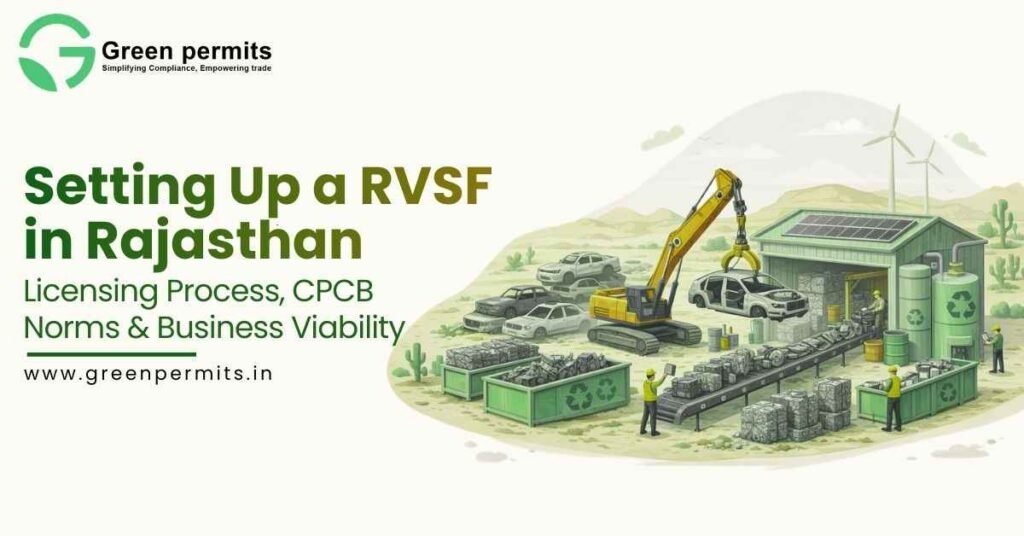
This article explains the complete licensing process, CPCB norms, environmental requirements, plant capacity standards and business viability of establishing a Registered Vehicle Scrapping Facility (RVSF) in Rajasthan in 2026.
Vehicle scrapping operations are governed by a combination of transport regulations and environmental laws designed to ensure safe dismantling and material recovery.
These authorities regulate licensing, environmental approvals and EPR compliance for vehicle recycling facilities.
| Regulation | Key Requirement | Deadline | Applicable To | Risk if Ignored |
|---|---|---|---|---|
| Environment Protection (End-of-Life Vehicles) Rules, 2025 | Mandatory vehicle recycling through EPR | Effective 01 April 2025 | Vehicle manufacturers and RVSFs | Environmental penalties |
| Motor Vehicles (Registration and Functions of Vehicle Scrapping Facility) Rules, 2021 | Registration of scrapping facilities | Before plant operation | RVSF operators | License cancellation |
| Environment Protection Act, 1986 | Environmental compliance and monitoring | Continuous | Industrial facilities | Penalty under Section 15 |
| Hazardous Waste Management Rules, 2016 | Handling of oils, fluids and hazardous waste | Continuous | Recycling plants | Environmental compensation |
| CPCB ELV Portal Registration | Digital compliance and EPR certificate generation | Before operations | RVSFs and vehicle producers | Portal suspension |
Businesses planning an RVSF project must comply with both transport licensing rules and environmental regulations simultaneously.
A Registered Vehicle Scrapping Facility (RVSF) is a licensed industrial facility authorized to dismantle, recycle and process end-of-life vehicles through environmentally sound procedures.
An RVSF performs five primary functions:
Vehicle manufacturers must purchase EPR recycling certificates generated by RVSFs to meet regulatory recycling targets.
The ELV regulatory framework introduced recycling obligations based on the amount of steel used in vehicles introduced into the market in earlier years.
| Financial Year | Minimum Recycling Target | Vehicles Covered |
|---|---|---|
| 2025-26 to 2029-30 | 8% | Vehicles manufactured between 2005-2015 |
| 2030-31 to 2034-35 | 13% | Vehicles manufactured between 2010-2019 |
| 2035-36 onwards | 18% | Vehicles manufactured after 2015 |
These targets create continuous demand for scrapping facilities capable of processing vehicles and generating EPR certificates.
India is estimated to generate more than 1 million end-of-life vehicles annually, and the number is expected to grow significantly as older diesel and commercial vehicles are phased out.
Establishing a scrapping facility involves approvals from multiple regulatory agencies.
| Step | Authority | Timeline | Documents Required | Risk Area |
|---|---|---|---|---|
| Land acquisition and zoning | State government | 30-90 days | Land records and site layout | Zoning rejection |
| Consent to Establish | SPCB | 60-90 days | DPR, plant layout | Environmental objections |
| RVSF registration | Transport authority | 45-60 days | Equipment details | Inspection delay |
| CPCB portal registration | CPCB | 30-45 days | GST, PAN, CIN | Portal rejection |
| Consent to Operate | SPCB | 45-60 days | Pollution control report | Operational restrictions |
In most cases, obtaining all approvals takes 6 to 12 months.
All RVSFs must register on the centralized CPCB ELV portal, which manages the national vehicle recycling compliance system.
The portal enables:
Without portal registration, a facility cannot generate EPR certificates or legally participate in the recycling ecosystem.
The application typically requires:
All documents must be uploaded in PDF format during application submission.
Vehicle scrapping facilities require specialized infrastructure to safely dismantle vehicles and process materials.
Typical land requirements depend on plant capacity.
| Plant Size | Land Requirement |
|---|---|
| Small facility | 3-5 acres |
| Medium facility | 6-10 acres |
| Large facility | 12-15 acres |
Common plant capacities include:
Large automated facilities may process over 25,000 vehicles annually.
Vehicle scrapping operations involve hazardous materials that must be handled under strict environmental regulations.
These rules regulate the safe handling, storage and disposal of hazardous components generated during vehicle dismantling.
Examples include:
Improper handling of these materials can cause environmental contamination and lead to regulatory penalties.
Vehicle dismantling follows a structured industrial process designed to maximize recycling and minimize environmental impact.
Hazardous materials removed from the vehicle include:
Reusable components removed include:
Recovered materials include:
The vehicle body is crushed and shredded to recover metals.
Typical vehicle composition:
Recycling 1 ton of steel saves approximately 1,134 kg of iron ore and 635 kg of coal, making ELV recycling a key part of the circular economy.
Vehicle scrapping plants require moderate to high capital investment depending on automation and processing capacity.
| Plant Capacity | Estimated Investment |
|---|---|
| 15 vehicles/day | ₹8-12 crore |
| 50 vehicles/day | ₹15-25 crore |
| 100 vehicles/day | ₹35-50 crore |
Revenue streams include:
Steel scrap recovered from vehicles is widely used in secondary steel manufacturing, making it a stable commodity market.
Operating a scrapping facility without proper approvals can lead to serious regulatory consequences.
Under Section 15 of the Environment Protection Act, 1986, violations may result in:
Businesses must therefore design projects with proper environmental infrastructure and documentation.
A logistics company in western India planned to establish a vehicle scrapping facility capable of processing 30 trucks per day.
However, the project was delayed by 3 months because the initial proposal lacked:
After revising the project design and installing additional pollution control equipment costing ₹1.5 crore, the facility received regulatory approval.
This example highlights the importance of compliance planning during the project design stage.
India’s vehicle recycling sector is transitioning into a regulated industrial ecosystem driven by environmental compliance and digital monitoring.
The End-of-Life Vehicles Rules 2025 have created a formal system where vehicle recycling must occur through licensed scrapping facilities.
For investors and recycling companies in Rajasthan, establishing an RVSF offers strong long-term potential due to:
However, success depends on proper licensing, environmental compliance, CPCB portal registration and structured documentation.
Businesses that secure approvals early and build technically compliant facilities are best positioned to benefit from the expanding vehicle recycling industry.
📞 +91 78350 06182
📧 wecare@greenpermits.in