
A small food products manufacturer in Gujarat introduced 14 metric tonnes (MT) of flexible plastic packaging into the market during FY 2024–25. The company assumed environmental compliance requirements applied only to large FMCG companies.
However, in April 2025, their distributor requested CPCB EPR registration proof before renewing supply agreements. Without the registration certificate, the distributor refused to accept shipments.
This situation is becoming increasingly common across India.
Thousands of MSMEs using plastic packaging are now facing compliance pressure due to stricter implementation of Extended Producer Responsibility (EPR) requirements under the Plastic Waste Management framework.
For businesses dealing in packaged goods, 2026 will be a critical year for EPR compliance, particularly as recycling targets increase and portal monitoring becomes stricter.
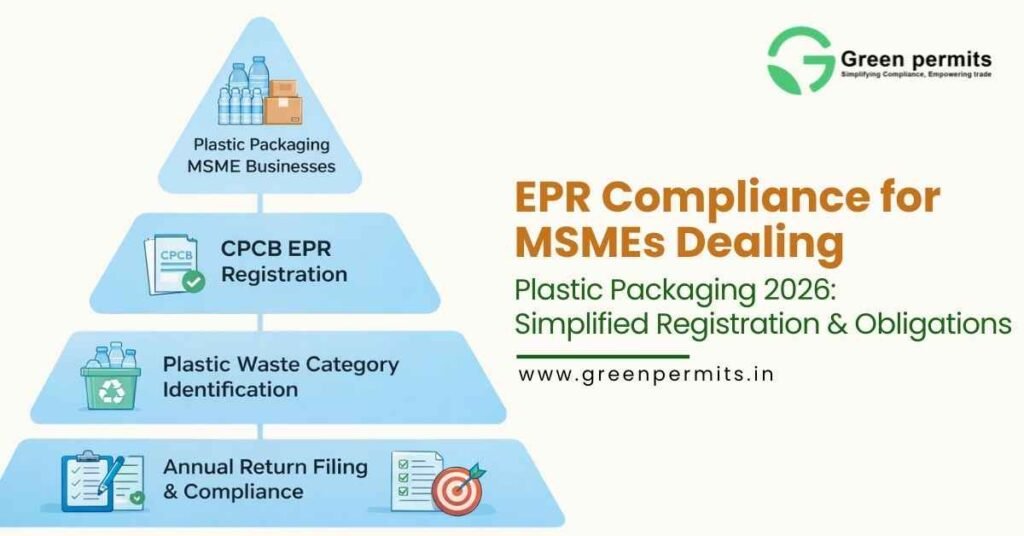
Extended Producer Responsibility (EPR) is an environmental policy mechanism that makes producers responsible for managing the post-consumer plastic waste generated from their products.
Under this framework, businesses introducing plastic packaging must ensure that an equivalent quantity of plastic waste is collected and recycled.
Entities required to comply include:
Even if a business introduces as little as 1 MT of plastic packaging annually, EPR registration may be required.
For MSMEs, this effectively means that plastic packaging introduced into the market must be offset through recycling obligations.
Plastic packaging is divided into four regulatory categories based on its structure and recyclability.
Common examples include:
Industries frequently using rigid plastic packaging include:
Rigid plastic packaging represents approximately 35–40% of recyclable plastic waste streams in India.
Examples include:
Flexible plastic packaging accounts for nearly 45–50% of plastic packaging used by FMCG companies.
Examples include:
Multi-layer packaging is difficult to recycle because it combines 2–5 different materials such as plastic, aluminium and polymer films.
Examples include:
These materials must be certified by CPCB before being introduced into the market.
Recycling targets under the EPR framework increase progressively each year.
| Financial Year | Recycling Target | Applicable Packaging Introduced |
|---|---|---|
| FY 2024–25 | 70% | Packaging introduced in FY 2023–24 |
| FY 2025–26 | 80% | Packaging introduced in FY 2024–25 |
| FY 2026–27 | 100% | Packaging introduced in FY 2025–26 |
Example:
If a MSME introduces 10 MT plastic packaging during FY 2024–25, the company must ensure that 8 MT of plastic waste is recycled during FY 2025–26.
If recycling obligations are not met, the producer must purchase additional EPR certificates from registered recyclers.
All entities introducing plastic packaging must register on the Central Pollution Control Board EPR portal before selling their products in India.
Businesses that require registration include:
Registration is mandatory even if packaging production is outsourced.
During portal registration, businesses must upload key verification documents.
Typical documents include:
The CPCB portal verifies business details using GST-linked databases before issuing approval.
| Regulation | Key Requirement | Deadline | Applicable To | Risk if Ignored |
|---|---|---|---|---|
| Plastic Waste Management Rules | Mandatory EPR compliance for plastic packaging | Continuous | Producers / Importers / Brand Owners | Environmental penalties |
| CPCB EPR Registration | Mandatory registration before introducing packaging | Before market entry | All packaging businesses | Registration rejection |
| Annual EPR Filing | Annual compliance reporting | 30 June each year | Registered entities | Portal suspension |
| Recycling Target Compliance | Achieve annual recycling targets | Based on financial year | Plastic packaging producers | Environmental compensation |
Businesses failing to comply may face supply chain disruption, distributor refusal and regulatory penalties, particularly if packaging data is incorrectly reported.
MSMEs must complete several steps to obtain EPR registration.
Businesses must submit:
Documents required include:
Businesses must declare:
Incorrect packaging declarations are among the most common reasons for application rejection.
Fees vary depending on:
Typical processing time ranges between:
15 to 30 working days
After approval, businesses receive a CPCB EPR registration certificate.
| Step | Authority | Timeline | Documents Required | Risk Area |
|---|---|---|---|---|
| EPR Registration | CPCB | 15–30 days | GST, PAN, CIN | Incorrect documents |
| Packaging Declaration | CPCB Portal | During registration | packaging data | misreporting |
| EPR Certificate Purchase | Registered recyclers | During FY compliance | recycler agreements | certificate shortage |
| Annual Return Filing | CPCB Portal | 30 June | recycling records | filing rejection |
Many MSMEs face compliance delays because packaging quantities are incorrectly calculated or reported in the portal.
The CPCB portal operates through a certificate-based recycling compliance mechanism.
The system works as follows:
Example:
If a company introduces 20 MT plastic packaging, it must purchase recycling certificates equivalent to:
16 MT recycling obligation (80%) for FY 2025–26
A snack manufacturing company in Maharashtra introduced 18 MT multi-layer plastic packaging during FY 2024–25.
During compliance filing, the company faced portal rejection because:
To meet compliance requirements, the company had to purchase additional 4.4 MT recycling certificates, delaying approval by nearly 6 weeks.
Failure to comply with EPR obligations can trigger multiple regulatory actions.
Common enforcement measures include:
Businesses may also face liability under the Environment Protection Act, 1986, which allows authorities to impose financial penalties and initiate legal action.
Many compliance failures occur due to operational errors.
Typical mistakes include:
These mistakes often lead to compliance delays of 30–90 days.
Businesses that obtain EPR registration early benefit in several ways.
Advantages include:
Companies introducing plastic packaging without registration may face supply chain rejection or distributor refusal.
EPR compliance for plastic packaging is no longer limited to large corporations. MSMEs introducing plastic packaging into the market must now comply with recycling targets, portal registration requirements and annual reporting obligations.
With recycling targets expected to reach 80% in FY 2025–26 and 100% in FY 2026–27, businesses must establish structured compliance systems covering:
Ignoring these obligations can result in financial penalties, supply chain disruption and regulatory action.
Early compliance and accurate documentation remain the most effective strategies for managing EPR obligations in India’s evolving environmental regulatory landscape.
📞 +91 78350 06182
📧 wecare@greenpermits.in