
A medium-sized appliance manufacturer in Noida recently prepared a shipment of 12,000 electric immersion heaters for distribution across North India. The packaging displayed the ISI mark, but the company had only completed product testing and had not yet received the Bureau of Indian Standards (BIS) licence approval.
During a routine compliance check, the shipment was flagged and distribution was halted. The company had to wait 47 additional days for BIS inspection clearance before the licence was granted.
Situations like this are increasingly common because regulatory enforcement around product certification has strengthened significantly after 2023. Many manufacturers still underestimate the legal importance of ISI Mark Certification.
In India, hundreds of products cannot legally be manufactured, sold or imported without BIS certification. Understanding which products require ISI certification, how to apply and how long approval takes has become essential for manufacturers, importers and brand owners operating in the Indian market.
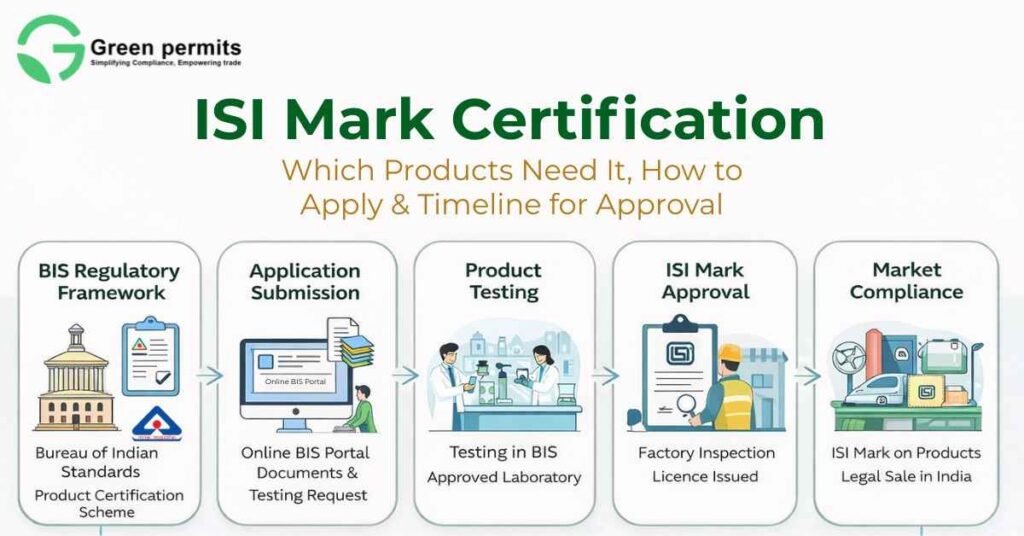
ISI Mark Certification is a product conformity licence issued by the Bureau of Indian Standards (BIS) under the Bureau of Indian Standards Act, 2016.
The certification confirms that a product complies with the relevant Indian Standard (IS Code) and has passed testing and inspection procedures conducted or supervised by BIS.
The certification process verifies multiple aspects of product safety and manufacturing quality.
Key compliance requirements include:
Businesses must understand several key numerical facts about the ISI certification system:
The certification mark is commonly referred to as the Standard Mark or ISI Mark, and it indicates that the product has been manufactured according to the applicable Indian standard.
ISI certification becomes mandatory when the Government of India issues Quality Control Orders (QCOs) for specific products.
These orders are issued by various ministries such as:
The purpose of these orders is to ensure:
The Indian market has seen a sharp increase in regulatory enforcement.
For example:
This means businesses must treat ISI certification as a legal requirement rather than a voluntary quality label.
The list of mandatory BIS certified products continues to expand. The government has already notified hundreds of products under Quality Control Orders.
Major product categories include construction materials, electrical appliances, household products, automotive components and metal products.
Construction materials form one of the largest regulated product categories.
Examples of products requiring ISI certification include:
India consumes enormous quantities of these materials.
For example:
Because these materials affect structural safety, BIS certification ensures that manufacturers meet strength and durability standards defined in Indian Standards such as IS 269 and IS 1786.
Electrical safety products are another major category regulated by BIS.
Examples include:
Electrical accidents remain a significant safety concern.
According to industry safety data:
BIS standards for electrical appliances include strict requirements related to:
Manufacturers must demonstrate compliance with these safety parameters before certification is granted.
Several everyday consumer products require mandatory ISI certification.
Examples include:
These products affect daily household safety.
For instance:
BIS standards ensure that pressure vessels and cooking appliances meet safety parameters such as:
Failure to comply with these standards may lead to product recalls or accidents.
The automotive sector also includes several components regulated under BIS standards.
Examples include:
India produces more than 26 million vehicles annually, and safety standards are essential to prevent component failure.
BIS certification ensures automotive components meet durability and safety standards required by Indian regulations.
Metal products form another large segment under mandatory BIS certification.
Examples include:
Steel is a critical material used across industries including infrastructure, automotive and engineering.
The Ministry of Steel introduced quality control orders to prevent substandard imports and ensure that steel used in construction and manufacturing meets Indian quality standards.
| Regulation | Key Requirement | Deadline | Applicable To | Risk if Ignored |
|---|---|---|---|---|
| BIS Act 2016 | Mandatory product certification | Ongoing | Manufacturers | prosecution |
| Quality Control Orders | Mandatory ISI mark | product specific | manufacturers/importers | product seizure |
| BIS Licensing Scheme | factory inspection and testing | before approval | manufacturers | licence rejection |
| BIS Surveillance | periodic inspection | post approval | licence holders | licence suspension |
For businesses this means manufacturing regulated products without certification can immediately trigger enforcement action.
The BIS certification process follows several regulatory stages. Each stage must be completed successfully before the licence is granted.
The first step involves identifying the relevant Indian Standard (IS code) for the product.
Examples include:
Incorrect identification of the applicable standard is responsible for nearly 20–25% of application rejections.
Manufacturers must carefully verify the correct product standard before initiating the certification process.
The product must be tested in a BIS recognized or NABL accredited laboratory.
Testing verifies several parameters including:
Typical testing timelines include:
If a product fails testing, manufacturers must modify the design and submit new samples for evaluation.
After successful testing, the manufacturer must submit an application through the BIS online portal.
The application requires detailed documentation including:
Incomplete documentation is one of the most common reasons applications are delayed.
Industry data suggests over 35% of BIS applications require additional clarification due to documentation gaps.
Once the application is reviewed, BIS schedules a factory inspection audit.
During inspection, BIS officers verify:
Product samples are also collected during inspection for independent testing.
The inspection stage usually takes 10 to 20 days depending on inspection scheduling.
If the product passes both laboratory testing and factory inspection, BIS grants the licence allowing use of the Standard Mark (ISI mark).
Typical licence validity includes:
Licence holders must also comply with periodic surveillance audits conducted by BIS.
| Step | Authority | Timeline | Documents Required | Risk Area |
|---|---|---|---|---|
| product testing | accredited lab | 7-30 days | product samples | failed tests |
| application filing | BIS portal | 3-5 days | company documents | incomplete filing |
| factory inspection | BIS officer | 10-20 days | production records | inspection rejection |
| verification testing | BIS lab | 7-15 days | collected samples | non compliance |
| licence grant | BIS | 30-90 days total | approvals | delayed approval |
In most practical situations the total approval timeline ranges between 30 and 90 days depending on product category and inspection scheduling.
Manufacturers must prepare several technical and regulatory documents.
Business documents include:
Technical documents include:
Quality control documentation includes:
Preparing these documents before application can reduce approval timelines significantly.
Businesses that manufacture regulated products without ISI certification may face significant legal and financial consequences.
Common enforcement actions include:
Licence rejection
If products fail testing or inspection, BIS may reject the application.
Product seizure
Authorities can confiscate products sold without certification.
Customs hold
Imported products may be stopped at ports if BIS certification is required.
Production halt
State authorities may suspend manufacturing operations until compliance is achieved.
Legal penalties
Violations may lead to prosecution and financial penalties under regulatory laws governing product certification and environmental protection.
A small electrical appliance manufacturer in Gujarat applied for certification for electric immersion heaters.
During factory inspection, BIS officers found that the company did not have the temperature endurance testing equipment required under IS 302 standards.
The manufacturer had to purchase new testing equipment and undergo another inspection.
This resulted in:
Such delays are common when companies apply without preparing for BIS inspection requirements.
Manufacturers can significantly reduce approval timelines by following structured compliance preparation.
Recommended practices include:
Companies that prepare properly often receive BIS licences within 30 to 45 days, compared with 60 to 90 days for unprepared applications.
ISI certification does more than ensure regulatory compliance. It also strengthens business credibility and market access.
Key benefits include:
Legal compliance
Manufacturers can legally sell regulated products across India.
Market trust
Consumers often prefer products displaying the ISI mark.
Government procurement eligibility
Many public sector tenders require BIS certified products.
Import clearance
Customs authorities clear regulated products faster when BIS licences are available.
For manufacturers entering regulated sectors such as construction materials or electrical appliances, certification is essential for long-term business operations.
ISI Mark Certification is one of the most important regulatory approvals required for manufacturing regulated products in India.
With more than 370 products currently notified under mandatory BIS certification, manufacturers and importers must ensure compliance before launching products into the market.
Failure to obtain certification can result in:
Businesses that prepare early by conducting proper testing, maintaining documentation and preparing for factory inspection can obtain certification smoothly and avoid costly delays.
In a market where product safety and regulatory enforcement are becoming stricter each year, ISI certification is not just a regulatory requirement but a critical component of responsible manufacturing in India.
📞 +91 78350 06182
📧 wecare@greenpermits.in