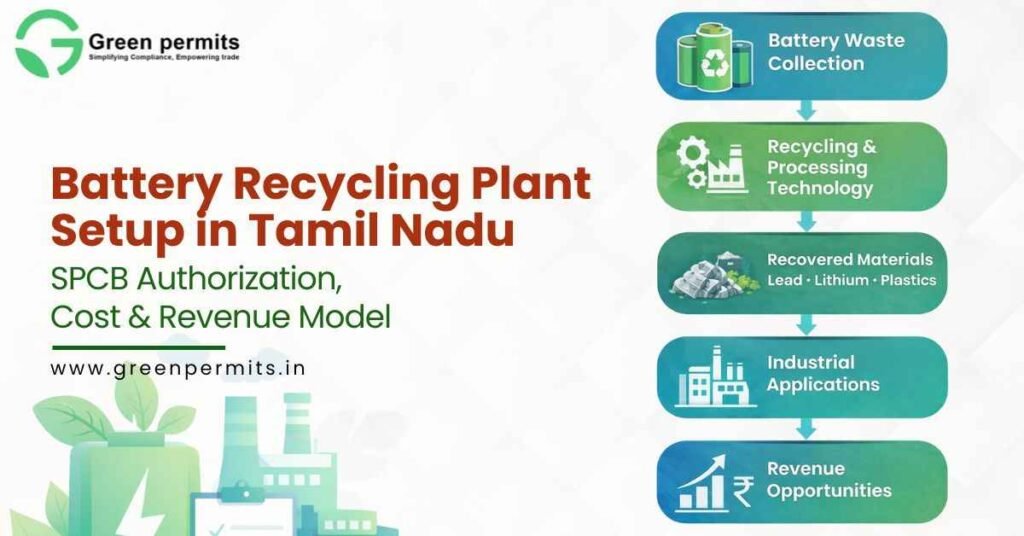
Battery Recycling Plant Setup in Tamil Nadu 2026: SPCB Authorization, Cost & Revenue Model
In early 2025, a battery recycling unit near Hosur invested nearly ₹6.5 crore in plant setup but faced a 90-day delay in commissioning because its Hazardous Waste Authorization application was returned twice due to incorrect waste category classification and underreported storage capacity.
The delay increased project costs by approximately 12–15% due to interest burden, idle manpower, and rework in compliance documentation.
This situation reflects a broader reality in 2026. Battery recycling is no longer just an industrial activity—it is a regulated compliance ecosystem driven by CPCB and SPCB controls.
With the enforcement of Battery Waste Management (Amendment) Rules, 2025, Tamil Nadu has emerged as both a high-opportunity and high-compliance state for recycling infrastructure.
Why Battery Recycling Plants Are Growing Rapidly in 2026
The growth of battery recycling is directly linked to regulatory pressure and market demand.
Key Market Drivers
India’s EV market is growing at approximately 30–35% CAGR, increasing battery waste volumes annually
Lithium-ion battery waste is expected to cross 1.5–2 million tonnes annually by 2030
Lead-acid battery recycling demand remains stable at 70–80% recovery levels
Scrap value of lithium and cobalt has increased by 18–25% between 2023–2025
Regulatory Push
Mandatory EPR obligations for producers across all battery categories
Recycling targets linked to financial year compliance (FY 2025–26 onwards)
CPCB portal-based tracking of recycling certificates and obligations
Increased inspections by SPCBs including Tamil Nadu
Business Implication
Battery recycling is not optional anymore for producers. This creates a guaranteed demand pipeline for recyclers, especially those registered under CPCB.
Regulatory Framework for Battery Recycling Plants in India
Battery recycling plants are governed by a combination of environmental laws, waste management rules, and SPCB approvals.
Core Legal Structure Applicable
Regulation
Key Requirement
Deadline
Applicable To
Risk if Ignored
Battery Waste Management Rules, 2025
CPCB registration + EPR compliance
Before operations
Recyclers, Producers
Registration rejection
Environment Protection Act, 1986
Pollution control compliance
Continuous
All industries
Fine + imprisonment
Hazardous Waste Rules
Waste storage and disposal authorization
Before operation
Recyclers
SPCB closure
Water Act, 1974
Effluent discharge approval
Before CTE
Plant owners
Consent delay
Air Act, 1981
Emission control approval
Before CTO
Plant owners
Operations stop
Practical Interpretation
A battery recycling plant requires 100% regulatory alignment. Even a single missing approval can delay operations by 60–120 days, impacting revenue and increasing project cost by 10–20%.
SPCB Authorization Process in Tamil Nadu (TNPCB)
Tamil Nadu Pollution Control Board follows a structured but strict approval system.
Detailed Approval Flow
Consent to Establish (CTE)
CTE is the first regulatory checkpoint before construction.
Key evaluation factors:
Land zoning (industrial classification mandatory)
Distance from residential zones (typically 500–1000 meters)
Pollution load calculation (air + water + hazardous waste)
Water consumption (KL/day basis)
Typical timeline:
30–60 days for small plants
60–90 days for medium plants
Consent to Operate (CTO)
CTO is granted after installation and trial runs.
Inspection includes:
Verification of installed machinery capacity
Pollution control equipment functionality
Effluent discharge parameters
Air emission levels
Typical timeline:
45–75 days (if documents are correct)
90–120 days (if inspection observations are raised)
Hazardous Waste Authorization
Battery recycling falls under hazardous waste category.
Mandatory disclosures:
Waste type (lead, lithium, acid residue)
Storage capacity (in MT)
Disposal mechanism
Typical timeline:
30–45 days
CPCB EPR Registration for Recyclers
This is critical for revenue generation.
Key requirements:
GST, PAN, CIN
Installed capacity (MT/day)
Recycling process details
Annual processing capability
Processing timeline:
15–30 days
Compliance Timeline for Battery Recycling Plant Setup
Step
Authority
Timeline
Documents Required
Risk Area
Land finalization
Local authority
15–30 days
Land deed
Zoning rejection
DPR preparation
Consultant
20–45 days
Technical report
Incomplete data
CTE approval
TNPCB
30–90 days
DPR, layout
ETP mismatch
Construction
Internal
4–8 months
NA
Budget overrun
CTO approval
TNPCB
45–120 days
Trial report
Inspection failure
CPCB registration
CPCB
15–30 days
GST, PAN
Portal rejection
Interpretation
Total project setup time ranges from 180 days to 360 days, depending on plant size and compliance readiness.
Technical Requirements of a Battery Recycling Plant
A compliant plant must be designed based on environmental load and processing capacity.
Standard Plant Configuration
Processing capacity: 5–20 MT/day
Annual capacity: 1,500–6,000 MT
Land requirement: 1–3 acres
Water consumption: 20–100 KL/day
Power requirement: 200–800 kW
Hazardous waste storage: 50–500 MT
Pollution Control Infrastructure
Mandatory systems include:
Effluent Treatment Plant (ETP)
Air Pollution Control Device (APCD)
Acid neutralization tanks
Hazardous waste storage shed
Tamil Nadu enforces strict compliance:
ZLD requirement for medium/large plants
Stack emission monitoring
Periodic sampling and reporting
Investment Cost for Battery Recycling Plant (2026)
Detailed CAPEX Analysis
Component
Estimated Cost (₹)
Land (1–3 acres)
₹50 lakh – ₹2 crore
Machinery
₹1.5 – ₹5 crore
Pollution control systems
₹50 lakh – ₹1.5 crore
Civil construction
₹1 – ₹3 crore
Licensing & compliance
₹10 – ₹25 lakh
Total Investment
₹3 – ₹12 crore
Cost Insights
Pollution control systems account for 15–25% of total project cost
Licensing delays can increase cost by 5–10%
Machinery cost varies based on battery type (lead vs lithium)
Revenue Model of Battery Recycling Business
Revenue is generated from both material recovery and regulatory mechanisms.
Primary Revenue Streams
Metal Recovery
Lead recovery efficiency: 60–75%
Lithium recovery efficiency: 40–60%
Cobalt and nickel recovery provide high-margin output
EPR Certificate Revenue
Producers must meet recycling targets annually
Certificates are purchased from recyclers
Market rate: ₹8–₹40 per kg equivalent
Scrap Processing Margin
Purchase cost vs recovered material value
Margin range: 15–35%
Example Revenue Model
For a 10 MT/day plant:
Annual processing: ~3,000 MT
Average realization: ₹25,000 per MT
Annual revenue: ₹7–8 crore
EBITDA margin: 18–30%
Compliance Risks and Penalties
Battery recycling is strictly monitored under environmental laws.
Key Risks
Registration Rejection
Incorrect data submission
Capacity mismatch
SPCB Non-Approval
Inadequate pollution systems
Improper hazardous storage
Environmental Compensation
Fine up to ₹1,00,000
Additional ₹5,000 per day
Possible plant closure
Operational Risks
Suspension of CPCB registration
Loss of EPR certificate revenue
Production halt due to inspection failure
Practical Business Scenario
A recycler in Coimbatore applied for CTO with a declared capacity of 12 MT/day but installed pollution control systems designed for only 8 MT/day.
Outcome:
CTO rejected during inspection
60-day delay
Additional ₹35 lakh spent on system upgrade
Key Challenges in Tamil Nadu
Strict TNPCB inspections
High compliance cost (15–25% of CAPEX)
Industrial land zoning restrictions
Mandatory ZLD in many industrial clusters
How to Ensure Smooth Approval
Businesses can reduce delays by focusing on compliance accuracy.
Practical Checklist
Match plant capacity with pollution control systems
Ensure 90-day hazardous waste storage compliance
Prepare accurate DPR with numerical data
Validate all documents before CPCB submission
Plan buffer time of 60–90 days for approvals
Conclusion
Battery recycling plant setup in Tamil Nadu in 2026 offers strong revenue potential but requires high regulatory discipline.
Businesses must evaluate:
Investment: ₹3–12 crore
Timeline: 6–12 months
ROI: 18–30%
The real risk lies in compliance gaps, not in market demand.
Early planning and structured execution can reduce approval delays by 40–60%, significantly improving project viability.