
In early compliance reviews across industrial clusters in Gujarat and Tamil Nadu, several manufacturers faced unexpected authorization delays despite having valid approvals.
The issue was not operational inefficiency — it was regulatory misalignment. Units failed to update waste categories, storage data, and disposal agreements as per the latest amendment requirements.
As a result, approvals were delayed by 30–60 days, and in some cases, SPCBs issued notices for revalidation.
This reflects a larger shift — hazardous waste compliance in India is moving toward real-time tracking, stricter verification, and data-based authorization systems.
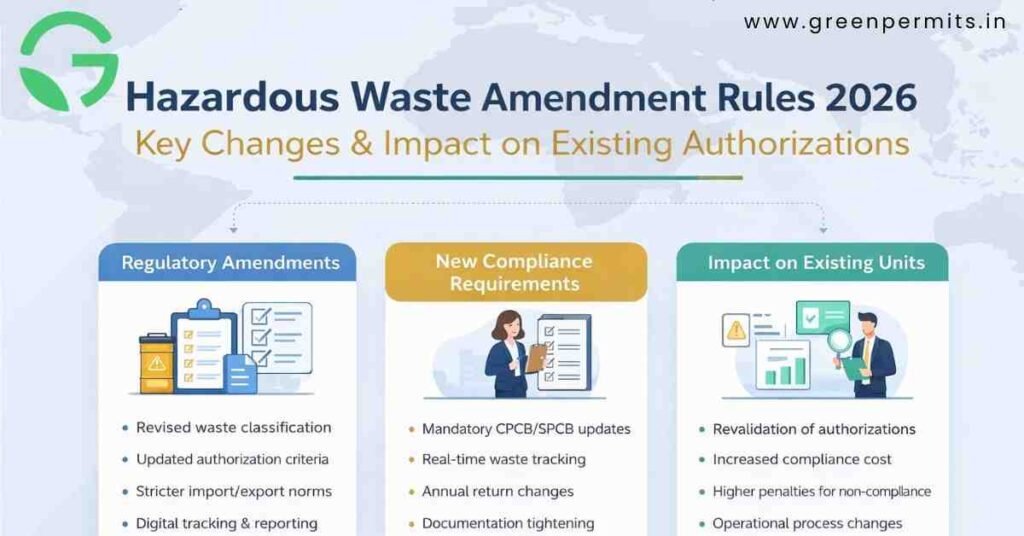
The Hazardous Waste Amendment Rules 2026 build upon the Hazardous and Other Wastes (Management and Transboundary Movement) Rules, 2016, notified under the Environment (Protection) Act, 1986.
These amendments focus on:
Authorization continues to be governed under:
Hazardous waste classification has become more data-driven and technically validated.
Incorrect categorization can lead to:
The amendment direction clearly emphasizes digital compliance.
Sequential filing is mandatory — applications and returns must follow structured submission order
Timelines:
Storage norms are strictly enforced with measurable limits.
Mandatory infrastructure:
Violation leads to:
Transportation compliance now includes traceability and accountability.
Non-compliance results in:
Applicable for:
Failure leads to:
| Regulation | Key Requirement | Deadline | Applicable To | Risk if Ignored |
|---|---|---|---|---|
| Rule 6 | SPCB Authorization | Before operations | All generators | Closure notice |
| Rule 8 | Storage limit (90 days) | Continuous | Manufacturers | Penalty + seizure |
| Rule 9 | Manifest tracking | Per shipment | Transporters & generators | Legal liability |
| Annual Return | Waste reporting | 30 June | All units | Portal suspension |
| Amendment 2026 | Digital compliance | Immediate | Medium & large industries | Rejection |
Business Insight:
Industries with outdated authorization data face approval delays of 30–60 days, impacting production continuity and compliance ratings.
Existing authorization holders must:
Typical authorization validity:
Renewal must be filed 90–120 days before expiry.
Mandatory compliance documents include:
Incomplete documentation is the #1 cause of rejection.
Inspection frequency has increased significantly:
Focus areas:
Hazardous waste must be handled only through authorized facilities under environmental rules
| Step | Authority | Timeline | Documents Required | Risk Area |
|---|---|---|---|---|
| Application submission | SPCB | Day 0 | Form + attachments | Missing documents |
| Scrutiny | SPCB | 15–30 days | Clarifications | Delay |
| Inspection | SPCB | 30–45 days | Site readiness | Non-compliance |
| Approval/Rejection | SPCB | 45–60 days | Final verification | Rejection |
| Renewal | SPCB | Before expiry | Updated records | Expiry risk |
Interpretation:
Most delays occur due to incorrect waste categorization and incomplete data submission, not regulatory backlog.
Failure to comply with Hazardous Waste Rules leads to:
A specialty chemical unit in Maharashtra generating 25 MT/month hazardous sludge faced:
Reason:
The Hazardous Waste Amendment Rules 2026 represent a fundamental shift in India’s environmental compliance landscape.
Key takeaways:
Businesses that proactively update their authorizations, documentation, and reporting systems will benefit from:
Early compliance is no longer optional — it is a strategic necessity.
Book a Consultation with Green Permits