
Across India, traditional vehicle scrapping businesses are undergoing a rapid transition. What was once an unorganized scrap trade is now being regulated under a digital EPR framework. Recyclers who fail to align with CPCB registration requirements are finding themselves excluded from OEM partnerships and formal recycling supply chains.
With the introduction of ELV Rules 2025, the government has created a system where recycling performance is measurable, reportable, and directly linked to financial outcomes. For 2026, recyclers are not just processing scrap—they are participating in a regulated compliance market.
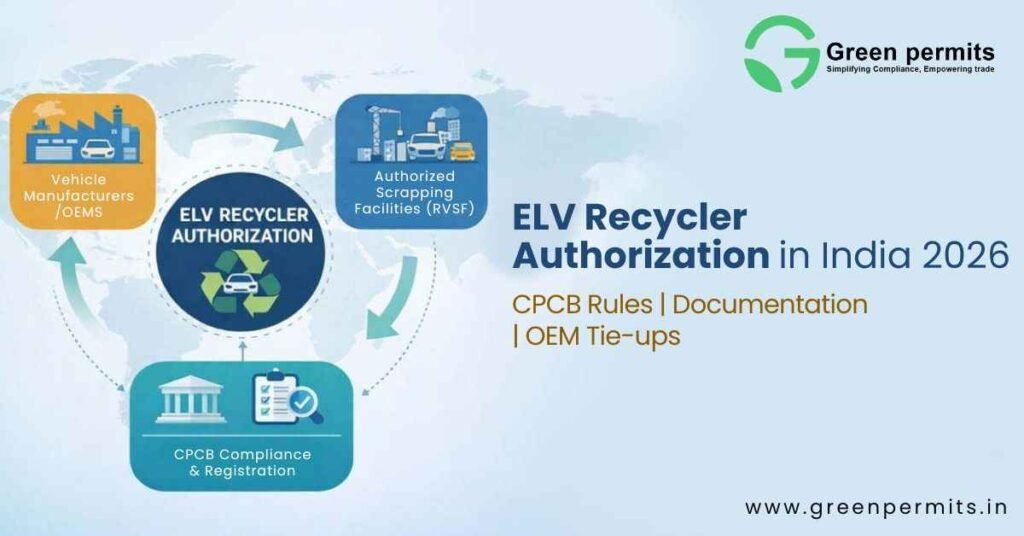
The ELV recycling sector is now structured under a layered regulatory framework that combines environmental law, waste management rules, and automotive policy. The shift is not cosmetic—it fundamentally changes how recyclers operate, report, and earn.
At its core, the ELV Rules 2025 bring Extended Producer Responsibility (EPR) into the automobile sector, making recyclers part of a national compliance obligation rather than standalone scrap operators.
From a material and environmental perspective, vehicles are high-value recyclable assets. A standard passenger vehicle typically contains 900–1,200 kg of material, of which a significant portion is recoverable.
Key regulatory implications include:
Typical material recovery profile per 1,000 vehicles:
This creates a structured opportunity where environmental compliance and resource recovery are aligned.
The new framework clearly defines that any entity involved in dismantling or recycling vehicles must obtain CPCB authorization as a Registered Vehicle Scrapping Facility (RVSF). This removes ambiguity that previously existed in the scrap sector.
Many recyclers underestimate this requirement, assuming that local municipal or SPCB approvals are sufficient. However, under the new regime, CPCB registration is the primary legal requirement for ELV operations.
You must obtain authorization if your operations include:
Typical capacity distribution in India:
Without CPCB registration:
This effectively divides the market into compliant and non-compliant players.
The CPCB registration process is fully digital but requires detailed technical disclosures. Most delays occur not due to complexity, but due to incomplete or poorly prepared documentation.
The application is designed to evaluate both compliance readiness and operational capability.
The registration process is divided into multiple sections that assess the facility holistically:
A complete application generally includes 10–12 documents. Missing even one document can trigger rejection or delay.
Key documents include:
The actual timeline depends heavily on documentation quality.
Typical timelines observed:
However, incomplete applications can extend timelines to:
Most rejections are due to operational gaps rather than legal issues.
Frequent issues include:
A well-prepared application can reduce approval time by up to 40%.
The most critical business shift under ELV Rules 2025 is the direct linkage between recyclers and automobile manufacturers. This relationship is no longer optional—it is the backbone of the EPR system.
Recyclers are now part of a performance-based compliance mechanism where their output directly supports OEM obligations.
The EPR model operates through a structured digital flow:
The targets are progressive and increase over time:
For example:
An OEM selling 1,00,000 vehicles annually must ensure:
The financial model is dual-layered—material recovery and compliance trading.
Typical revenue streams:
For a recycler processing 10,000 vehicles annually:
This means compliance is not a cost center—it is a revenue driver.
| Regulation | Key Requirement | Deadline | Applicable To | Risk if Ignored |
|---|---|---|---|---|
| ELV Rules 2025 | EPR-based recycling system | From April 2025 | OEMs, Recyclers | Shutdown |
| CPCB Registration | Mandatory authorization | Before operations | RVSFs | Rejection |
| EPR Targets | 8% → 13% → 18% | Annual | Producers | Penalty |
| Waste Rules | Safe waste disposal | Continuous | Recyclers | SPCB closure |
| Annual Filing | Compliance reporting | 30 April | All entities | Portal block |
The key takeaway is that regulatory compliance now directly impacts both operational permission and financial outcomes.
The ELV compliance ecosystem is strictly timeline-driven. Missing even one milestone can disrupt the entire business cycle.
| Step | Authority | Timeline | Documents Required | Risk Area |
|---|---|---|---|---|
| CPCB Registration | CPCB | 30–60 days | Legal + technical docs | Delay |
| SPCB Consent | SPCB | 60–90 days | Pollution control systems | Rejection |
| EPR Activation | CPCB Portal | Immediate post approval | Recycling data | Revenue loss |
| Quarterly Filing | CPCB | Every 3 months | Operational data | Portal restriction |
| Annual Filing | CPCB | By 30 April | Compliance report | Penalty |
A delay of 60 days can result in missing one complete EPR cycle, affecting both compliance and revenue.
ELV recycling involves multiple technical processes that must be environmentally controlled. This is where most informal recyclers fail to transition into compliant operations.
Each vehicle processed generates multiple waste streams, including hazardous and non-hazardous materials.
The recycling process typically includes:
On average, each vehicle generates:
To handle this safely, facilities must include:
Facilities without these systems are typically rejected during inspection.
The ELV compliance system is enforcement-heavy, and non-compliance leads to immediate and measurable consequences.
Many recyclers underestimate the financial impact of regulatory failure.
Common risks include:
Under environmental law:
For a medium-sized recycler, even a 20-day delay can lead to:
A recycler in Gujarat operating at 18 MT/day applied for CPCB authorization without including proper wastewater treatment and hazardous waste storage plans.
Outcome:
This highlights that compliance readiness directly affects market participation.
The ELV recycling industry is entering a structured, compliance-driven phase where only organized players will survive.
Key insights for businesses:
Businesses that align early will dominate the organized recycling market over the next 5–10 years.
ELV Recycler Authorization in India is not just a regulatory requirement—it is a transformation of the entire recycling ecosystem. It introduces accountability, digital monitoring, and measurable targets that redefine how recyclers operate.
For businesses, this creates a clear divide. Those who adopt structured compliance, invest in proper infrastructure, and build OEM partnerships will benefit from both regulatory stability and new revenue streams.
Those who delay will face operational restrictions, financial penalties, and exclusion from the formal recycling economy.
📞 +91 78350 06182
📧 wecare@greenpermits.in