
In early FY 2025–26, a Noida-based electronics importer introduced 18,000 units of smart devices into the Indian market. Each unit contained a lithium-ion battery and electronic circuitry.
While the company completed its E-Waste EPR registration on time, it delayed Battery EPR registration by just 20 days.
The result was immediate and measurable:
By 2026, such regulatory gaps are no longer minor mistakes. They directly impact supply chains, revenue cycles, and compliance ratings.
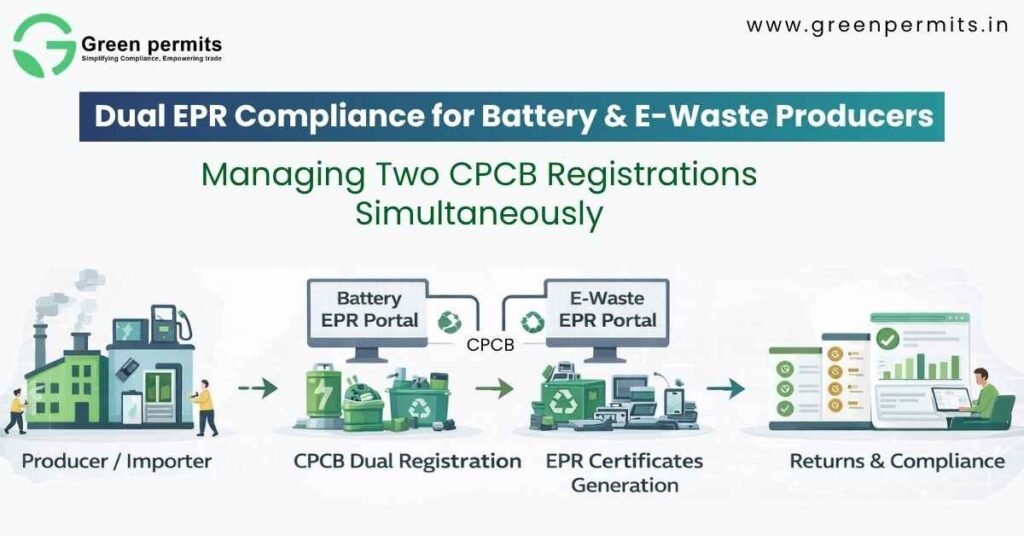
India’s waste management framework is now product-component based, not product-category based. This means that compliance is triggered by what the product contains, not just what the product is.
If a product includes:
This creates a dual regulatory obligation for thousands of businesses across sectors such as:
In FY 2025–26 alone, more than 35% of CPCB EPR applications involved dual-category products, especially in electronics and mobility sectors.
| Regulation | Key Requirement | Deadline | Applicable To | Risk if Ignored |
|---|---|---|---|---|
| E-Waste Rules 2022 | CPCB registration + EPR targets | 30 June (annual filing) | Electronics producers/importers | Registration rejection |
| Battery Waste Rules 2025 | Metal recovery-based EPR targets | Annual cycle | Battery producers/importers | Portal suspension |
| CPCB Portal System | Separate registration per role | Before market entry | All entities | Business restriction |
| Environment Protection Act 1986 | Legal penalty under Section 15 | Immediate | All stakeholders | ₹1 lakh/day penalty |
In practical terms, companies must now treat compliance as a parallel operational function, similar to finance or logistics.
CPCB has structured EPR compliance in a way that each waste stream is independently monitored and audited.
This means a company dealing with both electronics and batteries must maintain two active registrations, even if both are under the same brand or product line.
For example:
In 2025, CPCB reported that over 42% of rejected applications were due to incorrect category mapping or missing parallel registrations.
Each registration requires separate submission of:
A delay in either registration can delay full compliance activation.
Battery EPR is calculated based on the weight of batteries introduced in the market during a financial year.
For example:
These targets increase progressively depending on battery category and regulatory updates.
Battery EPR is also linked to:
E-Waste targets are based on electronic product categories and metal recovery rates.
Key measurable targets include:
For a company placing 10,000 units of IT equipment annually, this translates into:
The CPCB compliance system is now fully digitized, with strict data matching between:
Each compliance cycle follows a fixed financial-year timeline.
| Step | Authority | Timeline | Documents Required | Risk Area |
|---|---|---|---|---|
| Registration | CPCB | 30–45 days | GST, PAN, IEC | Incorrect data |
| Target declaration | CPCB | April | Sales/import data | Under-reporting |
| Certificate purchase | Recycler | Quarterly | Agreements | Invalid certificates |
| Annual return filing | CPCB | By 30 June | EPR data | Rejection risk |
Companies managing more than 5,000 units/month sales typically require:
The certificate mechanism is the core of EPR compliance, and it differs significantly between battery and e-waste.
For example:
A strong documentation system reduces approval time by 20–30%.
Companies handling multi-product portfolios may require 10–15 document sets across categories.
Dual EPR increases compliance exposure significantly. Most penalties arise from data mismatch or delayed filings.
A Bengaluru-based EV charger importer handled:
Compliance gap:
Outcome:
Businesses must now treat EPR compliance as a continuous operational process, not a one-time registration.
Dual EPR compliance in 2026 defines how responsibly a company operates in India’s regulated market.
The cost of non-compliance is measurable:
The benefit of structured compliance is equally clear:
Companies that invest early in structured systems gain a long-term advantage in both compliance and business continuity.
📞 +91 78350 06182
📧 wecare@greenpermits.in