
A growing IT hardware distributor entered 2025 with aggressive expansion plans. Their inventory pipeline included routers, adapters, and networking devices sourced from overseas manufacturers.
However, one missed compliance step changed everything.
Without a valid CRS registration, their shipment was stopped at customs. The delay of 25–35 days resulted in:
In 2026, such situations are increasingly common, as CRS certification has become a mandatory entry gate for electronics in India.
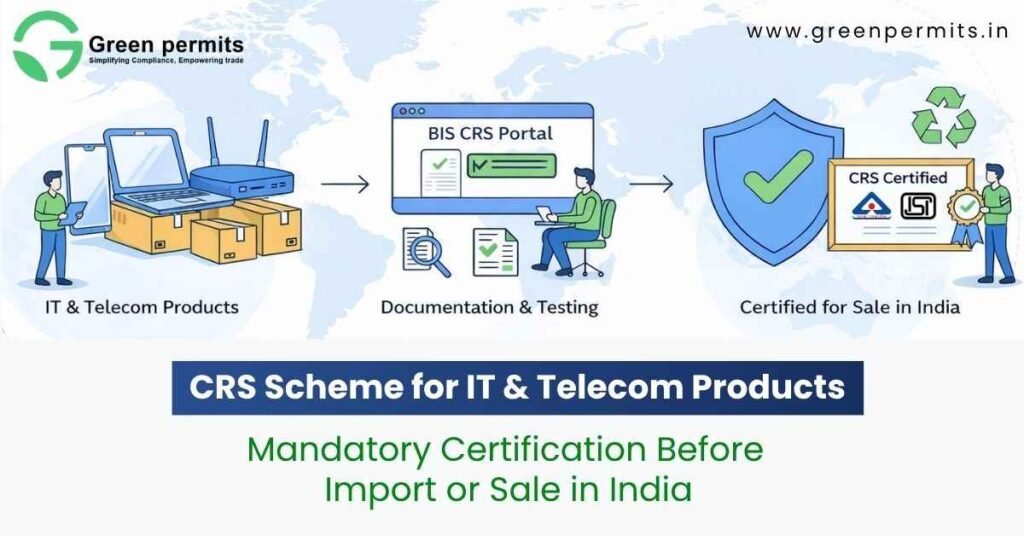
The Compulsory Registration Scheme (CRS) is implemented under the Electronics and IT Goods (Requirement for Compulsory Registration) Order, 2012, issued by MeitY and enforced by BIS.
The primary objective is to ensure that electronic and telecom products meet minimum safety and quality standards before entering the Indian market.
From a regulatory and business perspective, CRS has become a pre-import compliance requirement, not a post-market formality.
In 2026, the importance of CRS has increased due to:
Key compliance facts:
For businesses, this means CRS planning must begin at least 45–60 days before import dispatch.
CRS applies to a wide range of electronics and telecom equipment, especially products with direct consumer usage.
The coverage includes both finished goods and essential components.
In practical terms, CRS impacts:
Incorrect product classification is one of the most common compliance failures, often leading to application rejection or delays of 20–30 days.
| Regulation | Key Requirement | Deadline | Applicable To | Risk if Ignored |
|---|---|---|---|---|
| BIS Act, 2016 (Section 17) | Certification mandatory before sale/import | Before import | Manufacturers, Importers | Product seizure |
| Electronics & IT Goods Order, 2012 | CRS registration required | Continuous | Electronics sector | Customs hold |
| BIS Conformity Assessment Rules | Testing and marking compliance | Before sale | All entities | License cancellation |
| Environment Protection Act, 1986 | Enforcement backing | Ongoing | Businesses | Penalty under Section 15 |
CRS operates alongside customs systems and BIS databases, making compliance verification almost instantaneous at the port level.
A single missing registration number can result in immediate shipment detention.
The CRS registration process involves technical testing, documentation, and regulatory approval. While structured, it requires accuracy at each stage.
The process begins with product testing in BIS-recognized laboratories. This ensures compliance with Indian safety standards such as electrical safety and thermal performance.
After testing, the manufacturer or importer submits the application on the BIS portal along with test reports and supporting documents.
BIS then evaluates the submission and may raise queries before granting registration.
Businesses that prepare documentation in advance typically reduce approval timelines by 20–25%.
| Step | Authority | Timeline | Documents Required | Risk Area |
|---|---|---|---|---|
| Product Testing | BIS Lab | 15–25 days | Sample, specs | Test failure |
| Application Filing | BIS Portal | 1–3 days | GST, IEC, PAN | Incorrect data |
| Document Review | BIS | 15–30 days | Test report | Query delays |
| Registration Grant | BIS | Within 30 days | Final approval | Rejection risk |
| Import Clearance | Customs | Immediate | BIS number | Shipment hold |
The highest risk phase is product testing. A failed test can add 10–15 days and increase costs due to re-testing and logistics.
CRS certification requires structured documentation similar to other regulatory frameworks, where identity, operational, and product-level details must be verified.
Incomplete or inconsistent documentation is one of the leading causes of rejection.
CRS non-compliance has both operational and legal consequences, especially with increased enforcement in 2026.
For high-volume importers, a single compliance failure can impact quarterly revenue cycles by 10–20%.
A networking equipment importer in Delhi planned to import 8,000 routers for a large retail contract.
However, due to incorrect product classification under CRS:
This highlights that CRS compliance is not just regulatory—it directly affects business profitability and supply chain reliability.
In 2026, successful companies treat compliance as part of their supply chain planning.
A structured approach helps minimize risk and improve operational efficiency.
CRS certification in 2026 is a mandatory gateway for electronics and telecom businesses entering the Indian market.
With stricter enforcement:
Businesses that adopt early and structured CRS compliance benefit from:
Those who delay face operational delays, penalties, and loss of competitive advantage.
📞 +91 78350 06182
📧 wecare@greenpermits.in