
Biomedical Waste Authorization from SPCB 2026: Process, Documents & Renewal Timeline

In early 2025, a multi-location diagnostic chain operating across Delhi NCR continued operations assuming their biomedical authorization renewal was “in process.” During a routine inspection, SPCB officials identified that the authorization had expired 18 days earlier, leading to a temporary shutdown of sample collection across 3 branches.

The business lost nearly ₹8–10 lakh in revenue within a week and had to undergo re-inspection before restarting operations.

This is no longer an isolated case. In 2026, regulatory enforcement has become stricter, digital tracking has improved, and Biomedical Waste Authorization from SPCB is now a core operational requirement for healthcare businesses.
Why Biomedical Waste Authorization Matters in 2026

India currently generates approximately 800–900 tonnes of biomedical waste per day, with urban healthcare hubs contributing over 60–70% of total waste.

With increasing environmental risks, SPCBs have intensified compliance monitoring, focusing on:

  • Segregation accuracy above 95%
  • Waste traceability through barcode systems
  • Daily reporting of waste generation
  • Strict adherence to disposal timelines

For businesses, authorization ensures:

  • Legal permission to operate healthcare facilities
  • Protection from penalties up to ₹1 lakh per violation
  • Eligibility for accreditations such as NABH
  • Reduced risk of operational disruption

Failure to comply directly affects patient services, licensing, and reputation.

Biomedical Waste Authorization from SPCB – Complete Process (2026)

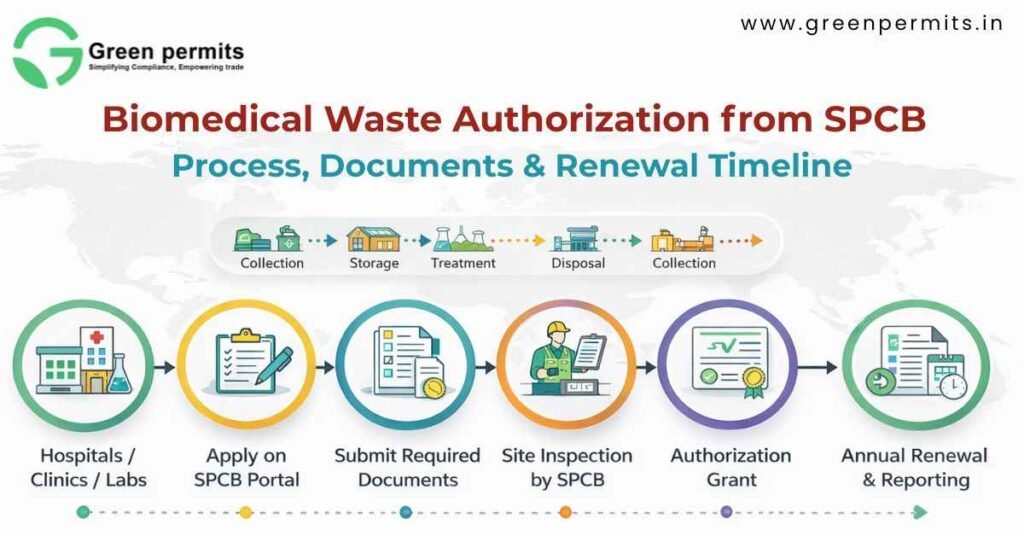
The authorization process in 2026 is structured, time-bound, and documentation-heavy. It involves both online submission and physical verification.

Process Overview

The process typically includes:

  • Submission of application in Form II
  • Upload of required documents
  • Scrutiny by SPCB
  • Query resolution
  • Physical inspection
  • Grant of authorization

Timeline Breakdown

  • Application review: 15–20 days
  • Query response: 7–15 days
  • Inspection scheduling: 20–30 days
  • Final approval: 45–60 days total

Ground Reality

  • Around 30–40% applications receive queries
  • Nearly 20–25% cases are delayed due to inspection issues
  • Fully compliant applications get approval within 30–40 days

Key Practical Insight

Facilities generating more than 100 kg/day waste are inspected more rigorously, often requiring additional documentation and operational proof.

Documents Required for Biomedical Waste Authorization

Documentation accuracy directly impacts approval timelines. Even small errors can delay approvals by 15–30 days.

Mandatory Documents

  • PAN, GST, CIN of the entity
  • Consent to Establish (CTE)
  • Consent to Operate (CTO)
  • Layout plan with designated waste storage area
  • Waste generation details (kg/day)
  • Agreement with authorized CBWTF

Operational Documents

  • Waste segregation plan
  • Staff training records
  • Barcoding system details
  • Authorization letter of responsible officer

Technical Requirements

  • Waste must be quantified in kg/day or MT/month
  • Storage time must not exceed 48 hours
  • Segregation compliance should exceed 90–95%

Common Mistakes

  • Underreporting waste by 20–30%
  • Missing CBWTF agreement
  • Expired CTO
  • Incorrect facility layout

Categories of Biomedical Waste & Segregation Requirements

Proper segregation is the backbone of biomedical waste compliance.

Biomedical waste is divided into four major categories, and incorrect handling can result in rejection or penalties.

Waste Categories

  • Yellow category – infectious waste
  • Red category – recyclable contaminated waste
  • White category – sharps
  • Blue category – glassware

Segregation Standards

  • Segregation must be done at source
  • 100% compliance is expected during inspection
  • Mixing waste increases disposal cost by 20–30%

Operational Requirement

Hospitals generating 200–300 kg/day waste typically need:

  • Multiple segregation points per floor
  • Dedicated storage area
  • Daily log records

Table 1 — Regulatory Overview

Regulation Key Requirement Deadline Applicable To Risk if Ignored
BMW Rules 2016 Rule 10 Authorization required Before operation Healthcare units Closure notice
Rule 4 Waste handling & segregation Daily All occupiers Penalty
Rule 13 Annual return filing 30 June Authorized units Suspension
EP Act Sec 15 Penalty provisions Immediate All entities ₹1 lakh+ fine

Business Interpretation:
Non-compliance is not just a regulatory issue — it directly impacts business continuity, especially for facilities handling 50–500 kg/day waste.

Compliance Timeline for Biomedical Waste Authorization

Authorization is a time-sensitive process where delays usually occur at inspection or document stages.

Lifecycle Timeline

  • Application submission → Day 0
  • Scrutiny → Day 15–30
  • Inspection → Day 30–45
  • Approval → Day 45–60

Renewal Timeline

  • Apply at least 90–120 days before expiry
  • Delayed renewal leads to compliance violation

Annual Compliance Requirements

  • Annual return submission → 30 June
  • Record maintenance → minimum 5 years

Table 2 — Compliance Timeline

Step Authority Timeline Documents Required Risk Area
Application SPCB Day 0 Form II Incorrect data
Scrutiny SPCB 15–30 days Documents Query
Inspection SPCB 30–45 days Facility readiness Rejection
Approval SPCB 45–60 days Compliance verified Delay
Renewal SPCB Before expiry Updated records Expiry risk

Interpretation:
Facilities prepared for inspection reduce approval time by up to 25–30%.

Validity & Renewal of Authorization

Authorization is issued for a limited duration and must be renewed on time.

Validity Period

  • Generally 3–5 years
  • Depends on facility size and risk category

Renewal Requirements

  • Updated waste data
  • Compliance reports
  • Inspection readiness

Critical Numbers

  • Renewal window → 90 days before expiry
  • Missed deadline → Immediate violation

Industry Insight

Nearly 35–40% healthcare units miss renewal timelines, leading to penalties and re-application.

Compliance Risks & Penalties

Non-compliance is treated seriously under environmental law.

Major Risks

  • Authorization rejection
  • SPCB portal suspension
  • Environmental compensation charges
  • Facility shutdown
  • Legal proceedings

Penalty Framework

  • Fine up to ₹1,00,000 per violation
  • Additional ₹5,000 per day
  • Imprisonment up to 5 years

Operational Impact

  • Loss of business continuity
  • Increased regulatory scrutiny
  • Delays in licensing

Practical Business Scenarios

Scenario 1

A 100-bed hospital generating 250 kg/day waste faced a 20-day delay due to missing CBWTF agreement.

Scenario 2

A clinic underreported waste by 30%, leading to rejection and re-inspection.

Scenario 3

A diagnostic lab missed renewal by 15 days, resulting in temporary shutdown.

Best Practices for Faster Approval

A structured compliance approach significantly reduces delays and risks.

Recommended Practices

  • Maintain accurate waste logs
  • Ensure valid CTO/CTE
  • Conduct internal audits every 6–12 months
  • Implement barcode tracking
  • Train staff regularly

Performance Insight

  • Proper documentation reduces queries by 40–50%
  • Inspection success rate improves by 30%

Conclusion

Biomedical Waste Authorization from SPCB is no longer a procedural requirement — it is a critical compliance license that directly impacts healthcare operations in 2026.

Businesses that comply early benefit from:

  • Faster approvals
  • Lower compliance costs
  • Zero operational disruption

Whereas non-compliance leads to:

  • Financial penalties
  • Operational shutdown
  • Legal consequences

A structured, proactive approach ensures long-term regulatory stability.

CTA

📞 +91 78350 06182
📧 wecare@greenpermits.in

Book a Consultation with Green Permits


Book a Technical Call with Expert