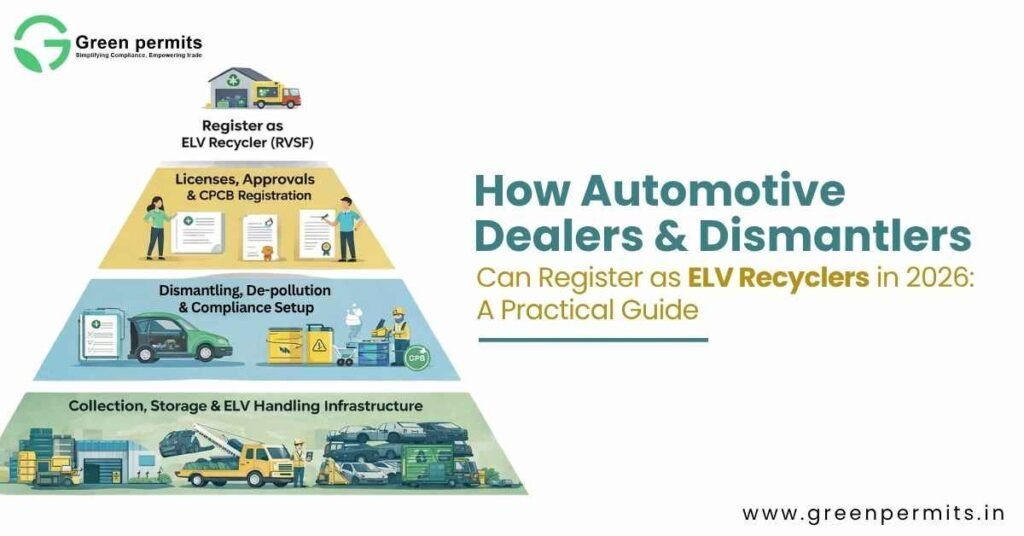
How Automotive Dealers & Dismantlers Can Register as ELV Recyclers in 2026: A Practical Guide
The automotive scrap ecosystem in India underwent a structural shift. Many informal dismantlers and dealers who were operating for years suddenly found themselves outside the legal framework. Several units reported operational disruptions of 30–60 days due to non-registration under the new ELV compliance regime.
The introduction of the End-of-Life Vehicles (ELV) Rules, 2025, effective from 01 April 2025, has made it mandatory for every recycler, dismantler, and scrap operator to enter a formal compliance ecosystem.
This is not just a regulatory requirement. It directly impacts:
Your ability to legally operate scrap or dismantling units
Your eligibility to work with OEMs and large corporates
Your access to EPR certificate revenue streams
Your long-term business sustainability
India generates an estimated 8–10 million end-of-life vehicles annually, and over 70% of this scrap was previously handled by the informal sector. The 2026 framework is designed to formalize this entire value chain.
Understanding the ELV Regulatory Framework
The ELV compliance system is built on a structured regulatory backbone that integrates environmental law, EPR obligations, and CPCB digital monitoring.
Mandatory registration for recyclers and dismantlers
Digital tracking of vehicle scrapping
Introduction of EPR certificate-based compliance
Defined recovery targets linked to steel usage
Annual and quarterly reporting obligations
The system now ensures that every ELV is tracked from collection → dismantling → recycling → reporting, reducing leakages and environmental risks.
Who Needs to Register as an ELV Recycler
The law does not limit registration only to large recycling plants. Even small dismantlers and automotive dealers entering scrap operations must comply.
Entities required to register:
Automobile dealers expanding into scrapping
Vehicle dismantlers operating scrap yards
Recycling plant operators
Scrap aggregators and collection centers
Bulk vehicle fleet owners (100+ vehicles)
Classification insight:
Small unit: 2–5 vehicles per day
Medium unit: 10–25 vehicles per day
Large facility: 50–100+ vehicles per day
Even a small dismantler handling 50–100 vehicles per month must register to avoid enforcement risk.
ELV EPR Targets and Their Business Impact
The ELV ecosystem is driven by measurable recovery targets, primarily based on steel content in vehicles. These targets directly impact recyclers because they determine how many EPR certificates can be generated.
Phased targets for compliance:
2025–2030: Minimum 8% steel recovery
2030–2035: Minimum 13% steel recovery
2035 onwards: Minimum 18% steel recovery
Why these numbers matter:
A passenger car typically contains 65–70% steel by weight
Recovering 1 ton of steel saves:
1,100+ kg iron ore
600+ kg coal
50+ kg limestone
Business implication:
Higher recovery efficiency = more EPR certificates
More certificates = higher revenue
Low recovery = compliance gap and penalties
For a medium recycler processing 10 vehicles per day, even a 5% efficiency improvement can increase annual revenue by ₹20–30 lakh through certificate generation.
Step-by-Step ELV Recycler Registration Process
The registration process is fully digital and structured through the CPCB portal. However, many applications get rejected due to incomplete documentation or incorrect data submission.
Step 1: Portal Registration
Create login credentials using GST-linked details
Provide PAN, CIN, and business information
Validate email and mobile credentials
Step 2: Application Filing
The application is divided into multiple sections:
General company details
Facility location and infrastructure
Processing capacity (vehicles/day or MT/day)
Pollution control systems
Waste handling and disposal plan
Step 3: Document Submission
You must upload:
GST certificate
PAN and CIN
IEC (if importing vehicles/components)
Consent to Establish (CTE)
Consent to Operate (CTO)
Plant layout and machinery details
Step 4: Application Review
Initial review within 30 working days
Query raised (if any) must be resolved within 7–15 days
Final approval timeline: 30–45 days
Step 5: Post-Approval Compliance
Facility inspection (physical or virtual)
Start operations under compliance
Begin EPR certificate generation
Compliance Timeline for ELV Recycler Registration
Step
Authority
Timeline
Documents Required
Risk Area
Portal Sign-up
CPCB
1–2 days
GST, PAN
Incorrect data
Application Filing
CPCB
3–7 days
Full documents
Missing details
Review Stage
CPCB/SPCB
30 days
Clarifications
Delay
Approval
CPCB
30–45 days
Verified data
Rejection
Inspection
SPCB
Post approval
Facility setup
Non-compliance
Interpretation
Most businesses underestimate the total approval cycle, which can extend to 45–60 days if documentation is weak. Planning registration at least 2 months before operations is critical.
Infrastructure Requirements for ELV Recycling Facility
Setting up a compliant ELV recycling facility requires both environmental and operational infrastructure.
Core operational components:
Depollution system (fluid, battery, oil removal)
Dismantling area with safety measures
Segregated storage zones for waste
Hazardous waste handling system
Environmental compliance setup:
Effluent treatment system
Air pollution control devices
Spill containment systems
Fire safety and worker protection systems
Typical land and capacity metrics:
Small facility: 1,000–2,000 sq. meters
Medium facility: 5,000–10,000 sq. meters
Large facility: 20,000+ sq. meters
Material output per vehicle:
65–70% steel
7–8% aluminum
20–25% plastic, rubber, glass
Revenue Model for ELV Recyclers in 2026
The ELV framework transforms recyclers from scrap sellers into structured compliance partners.
Revenue streams include:
Sale of recovered metals
Sale of reusable parts (engines, batteries, components)
EPR certificate generation
OEM and producer partnerships
Financial insight:
Average scrap value per vehicle: ₹15,000–₹40,000
EPR certificate revenue potential: ₹2,000–₹8,000 per vehicle
Monthly processing of 300 vehicles can generate ₹15–25 lakh revenue
Compliance Risks and Penalties
Non-compliance is no longer a minor issue. Enforcement has become stricter with digital tracking and CPCB oversight.
Major risks include:
CPCB registration rejection
SPCB refusal of consent
Portal suspension
Environmental compensation
Operational shutdown
Legal liability:
Penalty under Section 15 of Environment Protection Act, 1986
Fines ranging from ₹1 lakh to ₹1 crore
Possible imprisonment for severe violations
Real-world impact:
A dismantler operating without registration faced:
45-day plant shutdown
₹18 lakh compliance penalty
Loss of OEM contract
Practical Business Scenario
A Delhi-based automotive dealer planned to enter ELV recycling in 2025 but delayed registration by 60 days.
Outcome:
Project delay: 2 months
Investment idle: ₹1.2 crore
Additional compliance cost: ₹10–12 lakh
Key learning:
Early registration reduces risk
Proper documentation speeds approval
Compliance planning should start before plant setup
Key Documents Required for ELV Recycler Registration
PAN, GST, CIN
IEC (for importers)
Consent to Establish (CTE)
Consent to Operate (CTO)
Plant layout and machinery details
Waste management plan
Pollution control system details
Conclusion
ELV recycler registration in 2026 is no longer just a regulatory checkbox. It is the foundation of operating in India’s formal automotive recycling ecosystem.
Businesses must understand:
Registration is mandatory from April 2025
EPR targets directly affect revenue
CPCB portal drives compliance and reporting
Delays can result in financial and operational losses