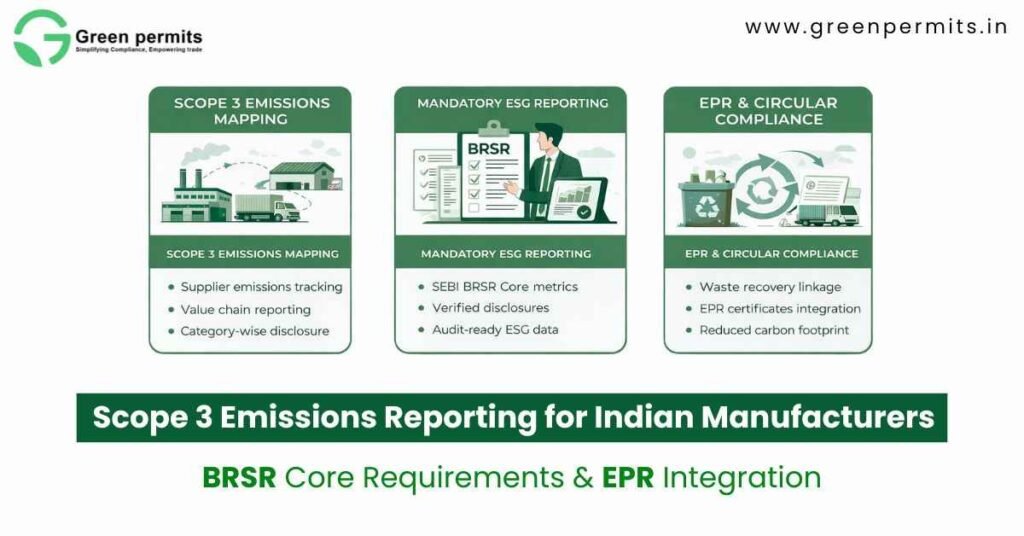
In early 2025, several listed manufacturing companies in India faced ESG reporting delays because their Scope 3 emissions data was incomplete. While Scope 1 and Scope 2 emissions were disclosed correctly, companies failed to integrate waste-related emissions linked to EPR compliance on CPCB portals.
As BRSR Core moves towards mandatory assurance in FY 2025–26, this gap is no longer acceptable.
Scope 3 reporting is now directly linked to regulatory compliance under EPR rules, making it a compliance issue—not just a sustainability metric.
Why Scope 3 Emissions Reporting India Is Critical in 2026
Scope 3 emissions represent indirect emissions across the value chain and typically account for:
70% to 90% of total emissions in manufacturing sectors
15 defined categories under global frameworks
3–5 priority categories required in initial BRSR reporting
With SEBI’s BRSR Core framework:
Mandatory for top 1000 listed companies
Assurance required from FY 2025–26
ESG disclosures aligned with financial reporting
Key Business Impact Areas
Vendor emissions (supply chain)
Waste generation and recycling
Product lifecycle emissions
Logistics and distribution
Scope 3 Categories Relevant for Indian Manufacturers
Indian manufacturers must focus on operational categories that directly align with compliance:
Purchased goods and services
Capital goods
Waste generated in operations
Transportation and distribution
End-of-life treatment of products
Practical Insight
Waste-related emissions under Scope 3 are now regulated through EPR frameworks under multiple rules notified by MoEFCC.
How EPR Compliance Directly Impacts Scope 3 Emissions
Under Indian regulations, EPR creates measurable data for:
Waste generated (MT/year)
Waste processed via recyclers
Recovery efficiency (%)
Certificates generated (kg-based)
For example:
Battery EPR certificates are calculated based on kg of key metals recovered from recycling
Producers must purchase these certificates to meet obligations
This creates a quantifiable emission reduction pathway in Scope 3 reporting.
Manufacturers must comply with centralized digital systems:
Mandatory EPR registration before operations
Upload of:
GST, PAN, CIN, IEC
SPCB consents
Filing requirements:
Quarterly returns (sequential)
Annual return by 30 June
Failure to comply can result in:
Portal suspension
Application rejection
Environmental compensation
Numerical Compliance Targets Across EPR Frameworks
Manufacturers must track:
ELV recycling targets:
8% (2025–30)
13% (2030–35)
18% (2035 onwards)
E-waste metal recovery:
20% initial → 100% by 2028–29
Plastic compliance:
Mandatory traceability from 01 July 2025
Filing deadlines:
30 April (EPR declaration)
30 June (annual return)
Common Compliance Failures in 2025
Incorrect waste category classification
Missing EPR certificates
No linkage between ESG and CPCB data
Vendor emissions not tracked
Real Case Example
A packaging manufacturer in Gujarat faced a 2-month CPCB approval delay due to incorrect reporting under flexible plastic category, impacting both EPR compliance and ESG reporting.
Compliance Risks & Penalties
Failure to align Scope 3 reporting with EPR compliance may lead to:
CPCB registration rejection
Portal suspension
SPCB authorization delays
Environmental compensation
Customs clearance issues (importers)
Production halt
Legal Exposure
Liability under Section 15 of Environment Protection Act, 1986
Financial penalties ranging from lakhs to crores depending on violation
Practical Compliance Strategy for Manufacturers
Step-by-Step Approach
Map all Scope 3 categories
Integrate EPR data from CPCB portal
Track vendor emissions
Purchase and reconcile EPR certificates
Maintain audit-ready documentation
Key Data Points to Track
Waste generated (MT/year)
Recycled quantity (MT/year)
EPR certificates (kg)
Compliance targets (%)
Filing timelines
Conclusion
Scope 3 emissions reporting in India has evolved into a regulation-driven compliance requirement backed by EPR frameworks across plastic, battery, e-waste, and ELV sectors.
Companies that fail to integrate:
ESG reporting
Waste compliance
CPCB portal systems
will face operational, financial, and regulatory risks.
On the other hand, early adopters will benefit from:
Faster approvals
Stronger ESG ratings
Reduced compliance cost
Improved investor confidence
FAQs
1. Is Scope 3 emissions reporting mandatory in India?
Yes, under BRSR Core for top 1000 listed companies from FY 2025–26.