
A mid-sized solar developer in North India was ready to commission a 30 MW plant. Panels were installed, grid connectivity was approved, and the investment had already crossed ₹120 crore. Yet, the plant could not start operations for nearly 72 days.
The reason was not technical failure—but a missing Consent to Operate (CTO) from the State Pollution Control Board.
This is no longer an isolated case. Across India, solar projects are increasingly facing delays of 30 to 90 days, not because of engineering gaps, but due to compliance oversight.
In 2026, setting up a solar power plant is not just about land, EPC, and investment. It is a regulated industrial activity, where approvals, documentation, and timelines directly impact profitability.
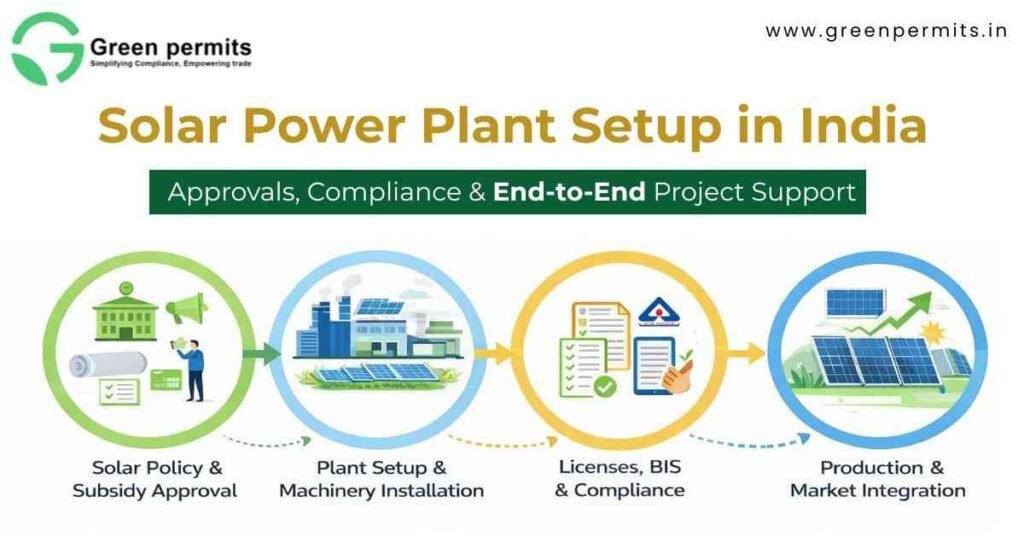
India’s renewable energy sector is scaling aggressively. The country is targeting 500 GW of renewable capacity by 2030, and solar alone is expected to contribute nearly 300 GW of this capacity.
With this scale, regulatory scrutiny has increased significantly.
Projects above 1 MW to 5 MW capacity are now treated as industrial infrastructure requiring multi-level approvals. Financial institutions, EPC contractors, and DISCOMs now assess compliance readiness before moving forward.
Even a delay of 45 days can increase project cost by 5% to 12%, especially in projects ranging between ₹50 crore to ₹250 crore.
In practical terms, compliance is now directly linked to:
A solar power plant requires approvals from multiple authorities, each governing a specific aspect of the project. The process is not linear and often runs in parallel.
For a typical utility-scale project, the following approvals are essential:
These approvals together define whether a plant can legally operate.
From a timeline perspective:
A delay in even one stage can cascade into project-level delays.
Solar energy is often considered “clean,” but the project itself still has environmental impact. This is where most developers underestimate regulatory requirements.
A solar plant interacts with the environment in three major ways:
For example, a 50 MW solar plant consumes approximately 250 to 350 KL of water per day, primarily for cleaning operations. Over a year, this becomes a significant regulatory concern in water-stressed regions.
Similarly, damaged solar panels and electrical components fall under controlled waste categories and must be handled carefully.
From a compliance standpoint, developers must ensure:
Ignoring these aspects often results in rejection at the CTO stage.
To understand compliance better, it helps to look at a real-world project scale.
These numbers highlight why regulators treat solar plants as serious industrial setups rather than simple installations.
The infrastructure involves:
Each component has compliance implications, especially in terms of safety, waste, and operational standards.
| Regulation | Key Requirement | Deadline | Applicable To | Risk if Ignored |
|---|---|---|---|---|
| Environment Protection Act, 1986 | Environmental compliance | Continuous | All plants | Penalty & closure |
| Water Act, 1974 | Water usage approval | Before operation | All plants | SPCB rejection |
| Air Act, 1981 | Dust & emission control | Construction phase | All plants | Stop-work notice |
| Electricity Act, 2003 | Grid compliance | Pre-commissioning | All plants | Grid disconnection |
| SPCB Consent | CTE & CTO approvals | Before setup & operation | All plants | Project halt |
In practical terms, this means a solar plant is governed by both environmental and power sector regulations, making compliance multi-dimensional.
| Step | Authority | Timeline | Documents Required | Risk Area |
|---|---|---|---|---|
| Land acquisition | State Govt | 15–30 days | Land records | Legal disputes |
| Consent to Establish | SPCB | 30–45 days | DPR, layout | Rejection |
| Grid approval | DISCOM | 30–60 days | Technical drawings | Delay |
| Installation | EPC | 90–180 days | Contracts | Cost escalation |
| Consent to Operate | SPCB | ~30 days | Compliance report | Operation hold |
When analyzed closely, approvals alone consume nearly 30% to 40% of the total project timeline.
Most compliance failures happen due to incomplete or incorrect documentation.
At a minimum, developers must prepare:
In many cases, even minor mismatches in documentation can delay approvals by 15 to 30 days.
The risks associated with non-compliance are often underestimated until they become costly.
From real project scenarios, the most common issues include:
In financial terms, these risks can lead to losses ranging from ₹10 lakh to ₹1.5 crore, depending on project size.
Legally, violations can attract penalties under the Environment Protection Act, 1986, including fines and operational restrictions.
A developer in Gujarat faced a 60-day delay due to incorrect environmental documentation. The delay resulted in cost escalation of nearly ₹1.2 crore.
In another case, a Maharashtra-based project experienced a 45-day grid delay due to incorrect load calculations, triggering penalty clauses in the PPA.
An importer handling solar panels saw shipments stuck at port for 18 days, leading to demurrage losses of around ₹12–15 lakh.
These are not rare incidents—they are increasingly common in compliance-driven projects.
Solar projects today require a structured and integrated approach. Developers who plan compliance early typically complete projects 30% faster than those who address it later.
An effective setup approach includes:
A fragmented approach often leads to delays, while a structured approach ensures predictable timelines.
Solar power plant setup in India has evolved into a compliance-intensive industrial process. While technology and investment remain critical, regulatory alignment now determines project success.
Developers who:
can reduce delays by 30% to 50% and significantly improve project returns.
On the other hand, ignoring compliance leads to:
In 2026, compliance is not an obstacle—it is a core part of project strategy.
 +91 78350 06182
 wecare@greenpermits.in