
When the 2026 regulatory changes started getting enforced, most businesses treated them as routine updates. It did not feel urgent at first.
Within a few months, the situation changed rapidly. Companies began facing application rejections within 30 working days, compliance notices for incomplete filings, and even shipment holds due to missing EPR registration details.
What looked like a procedural requirement quickly became an operational risk.
Between FY 2023–24 and FY 2025–26, India’s EPR ecosystem has shifted from a documentation-based system to a fully digital, certificate-driven compliance model. Today, compliance is not manually interpreted—it is system-validated.
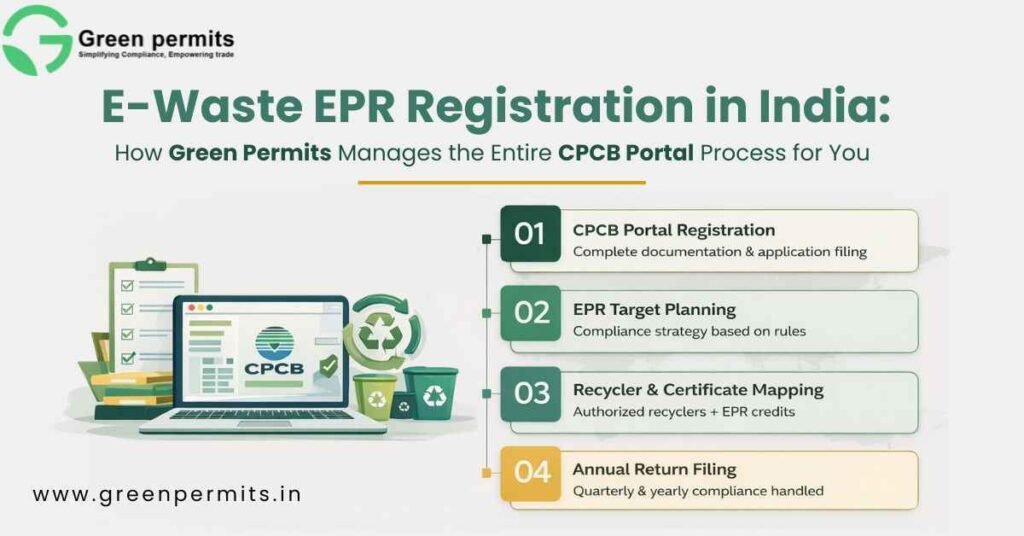
In 2026, if your EPR registration is not properly structured on the CPCB portal, it directly affects imports, sales, and production continuity.
E-Waste EPR Registration is a legal requirement under the E-Waste (Management) Rules, 2022, where producers are made responsible for the end-of-life disposal of their products.
This responsibility is not theoretical anymore. It is monitored through a centralized portal where every transaction, return, and certificate is recorded.
The regulation applies to manufacturers, importers, and brand owners who introduce electrical and electronic equipment into the Indian market. Even a small importer bringing in limited quantities must comply before starting operations.
From a business perspective, this requirement has become foundational. Without valid EPR registration:
Another important shift is that the system does not allow retrospective corrections easily. If compliance is not aligned from the beginning of the financial year, the gap continues to compound.
Key compliance realities businesses must understand:
The CPCB portal is not just an application interface. It is a compliance tracking system that integrates registration, reporting, and verification into one workflow.
When a company applies, the system captures structured data across multiple sections such as company details, product categories, and waste generation estimates. This data is then used to determine compliance obligations.
The approval process typically takes around 30 working days, provided the application is correctly filed. However, if CPCB raises a clarification, the applicant gets only 7 working days to respond. Missing this window often leads to rejection or delay.
One of the most common reasons for rejection is incorrect data structuring. Businesses often upload correct documents but map them incorrectly to categories or provide inconsistent information across sections.
The process becomes more critical when dealing with multiple product lines. For example, an importer dealing in both IT equipment and consumer electronics must correctly classify each category separately.
From a practical standpoint, businesses must focus on:
Even a small mismatch in data can delay approval by 20–30 days, which directly affects operations.
The documentation requirement is not extensive, but it must be precise and consistent across all entries.
The CPCB portal relies heavily on document validation, and inconsistencies are one of the top reasons for rejection.
At a basic level, companies must provide identity and business registration proof such as PAN, GST, and CIN. Importers must also provide IEC details, which are cross-verified with customs data.
Operational documents play an equally important role. These include consent approvals, product details, and waste generation estimates. The system expects logical alignment between these documents.
Another critical component is the authorized person’s details. The portal requires active communication through registered email and mobile number, as all updates and notices are sent digitally.
Key documentation checkpoints include:
In practice, more than 40% of applications face delays due to documentation mismatch rather than missing documents.
One of the biggest changes introduced in recent years is the shift to a certificate-based compliance system.
Earlier, compliance was largely documentation-driven. Now, it is based on actual recycling performance measured through EPR certificates.
Under this system, producers must purchase certificates from registered recyclers. These certificates are generated based on the quantity of e-waste processed and the recovery of key materials such as copper, aluminium, iron, and precious metals.
The entire system operates on measurable units. Certificates are issued in kilograms, and compliance is calculated based on the total obligation for a given financial year.
For example, if a company introduces a certain quantity of electronic products in FY 2025–26, its EPR obligation is calculated accordingly. The company must then purchase equivalent certificates to meet its target.
This creates a direct financial and operational linkage between production and recycling.
Important aspects businesses must consider:
In practical terms, companies that delay certificate procurement often face higher costs and compliance pressure towards the end of the financial year.
| Regulation | Key Requirement | Deadline | Applicable To | Risk if Ignored |
|---|---|---|---|---|
| E-Waste Rules 2022 | Mandatory EPR registration | Before operation | Producers/Importers | Business restriction |
| CPCB Portal System | Online compliance tracking | Continuous | All entities | Rejection |
| EPR Certificate Mechanism | Purchase certificates | Annual | Producers | Financial penalty |
| Annual Return Filing | Submit compliance data | 30 June | Producers | Suspension |
| EPA 1986 | Penalty for violations | Immediate | All entities | Legal action |
The regulatory framework is now tightly integrated. Each component—registration, certification, and reporting—feeds into the same system, leaving very little scope for manual adjustments.
| Step | Authority | Timeline | Documents Required | Risk Area |
|---|---|---|---|---|
| Registration Filing | CPCB | Immediate | GST, PAN, CIN | Data mismatch |
| Application Review | CPCB | 30 days | Full application | Rejection |
| Clarification | CPCB | 7 days | Additional details | Delay |
| Approval | CPCB | Post review | Final submission | Operational halt |
| Annual Return | CPCB | 30 June | EPR data | Penalty |
In real scenarios, delays usually happen during the clarification stage. A delay of even 7 days can extend approval timelines by 2–3 weeks.
Most businesses approach EPR registration as a documentation task, while it is actually a data accuracy exercise.
Incorrect category selection is one of the most common issues. Many companies misclassify their products, which leads to incorrect obligation calculation.
Another frequent issue is inconsistency in company details. Even minor differences between GST records and portal entries can trigger rejection.
Some businesses also fail to prepare a proper EPR action plan, which is now a critical requirement.
Typical mistakes observed include:
In multiple cases, these errors have delayed approvals by 30–60 days, impacting both imports and sales cycles.
The enforcement framework has become significantly stricter in recent years.
Non-compliance is no longer limited to warnings. It leads to direct operational and financial consequences.
Companies without valid EPR registration may face shipment holds, which can last between 10 to 20 days depending on the case. In addition, environmental compensation can be imposed based on the scale of non-compliance.
Regulators also have the authority to suspend portal access, which effectively halts further compliance activities.
Key risks businesses must be aware of:
The financial impact of non-compliance can easily cross ₹10–15 lakh in a single incident.
EPR compliance requires a structured approach that combines regulatory understanding with execution accuracy.
Green Permits works by aligning business data with regulatory expectations from the beginning. Instead of treating registration as a one-time task, the focus is on building a compliant system that works across the entire financial year.
The process starts with correct product classification and documentation alignment. This is followed by structured portal filing and continuous tracking of obligations.
Another critical aspect is managing EPR certificates. Businesses often struggle with timing and pricing, which can impact both cost and compliance status.
Green Permits ensures:
Companies that adopt this structured approach typically complete approvals within 30 days and avoid repeated rejection cycles.
E-Waste EPR Registration in India has evolved into a core operational requirement that directly impacts business continuity.
The system is now digital, time-bound, and data-driven. Even small errors can lead to delays, penalties, or operational disruption.
Businesses that delay compliance often face financial losses, shipment delays, and regulatory action. On the other hand, companies that approach compliance strategically gain faster approvals and smoother operations.
In 2026, EPR compliance is no longer a regulatory burden. It is a necessary system that supports long-term business stability and growth.
📞 +91 78350 06182
📧 wecare@greenpermits.in