
A Gujrat-based electronics refurbishing company invested ₹18 crore into setting up an e-waste recycling facility with a projected capacity of 10,000 MT/year. Machinery was installed, manpower hired, and supply contracts secured.
But operations never started.
The CPCB rejected their application within 30 working days due to missing hazardous waste authorization and incorrect capacity disclosure. The delay extended to 5 months, causing losses of over ₹1.2 crore in idle costs and missed EPR contracts.
This is the ground reality of E-Waste Recycling Plant Setup in India—projects fail not because of funding or technology, but because of compliance gaps.
India is currently among the top 5 e-waste generating countries, producing more than 1.6–2.2 million tonnes annually. However, less than 30% of this waste is processed through formal recycling channels, which creates both environmental risks and a massive business opportunity.
The E-Waste Management Rules, 2022 have transformed this sector from an informal activity into a structured compliance-driven ecosystem. Every recycler is now part of a digital system where waste flow, processing quantity, and output are monitored through the CPCB portal.
For businesses, this means recycling is no longer optional or loosely regulated. It is now directly linked to producer obligations, ESG compliance, and traceable environmental reporting.
From an operational standpoint, companies entering this space must understand that:
Setting up a recycling plant in India requires a combination of industrial planning, environmental compliance, and regulatory approvals. Unlike traditional manufacturing plants, recycling units must justify both input (waste) and output (recovered materials) with traceable data.
A typical e-waste recycling plant operates in the capacity range of 500 MT/year for small units to over 50,000 MT/year for large-scale industrial facilities. The land requirement varies between 1,000 to 5,000 square meters depending on capacity and process complexity.
Investment also varies significantly. Small dismantling units may start from ₹5–8 crore, while advanced metal recovery plants can require ₹25–50 crore depending on automation and recovery efficiency.
The plant must be designed to handle multiple categories of waste including:
At the same time, environmental safeguards must be embedded into the design itself.
Key technical considerations include:
Without proper planning at this stage, approval rejection rates increase significantly, especially during SPCB inspection.
Key Setup Requirements
CPCB registration is the most critical milestone in the entire plant setup process. Without this approval, the plant cannot legally operate or engage in any recycling activity.
The entire process is handled through a centralized online portal, where the regulator evaluates both technical and environmental compliance of the facility.
The process begins with entity registration, followed by submission of detailed plant-level information. This includes installed capacity, type of waste handled, recovery processes, and environmental safeguards.
The application is then reviewed within a defined timeline of approximately 30 working days. If discrepancies are identified, the applicant is given around 7 days to respond. Failure to respond within this window often results in rejection.
One of the most common reasons for rejection is inconsistency between declared capacity and actual infrastructure. Another major issue is incomplete documentation, especially related to pollution control approvals.
To ensure successful approval, the application must clearly demonstrate:
Mandatory Documents for CPCB Registration
Before approaching CPCB, every recycling plant must secure approvals from the State Pollution Control Board. These approvals validate whether the proposed facility meets environmental norms under the Water Act and Air Act.
The process usually starts with Consent to Establish, which is required before construction begins. This is followed by Consent to Operate after the plant is installed and ready for inspection.
In many cases, delays of 2–4 months occur because companies underestimate the importance of SPCB approvals. Even minor discrepancies in layout, emission control, or waste handling can lead to rejection or re-inspection.
Hazardous waste authorization is another critical approval, as e-waste contains toxic materials such as lead, mercury, and cadmium. Improper handling of these materials can lead to serious environmental violations.
From a regulatory standpoint, SPCB approvals act as the foundation on which CPCB registration is built. Without them, the application cannot proceed.
Key SPCB Approvals Required
A well-designed plant is not just about efficiency—it is about regulatory acceptance. CPCB and SPCB both evaluate whether the plant can safely process e-waste without causing environmental harm.
Utilities play a critical role in this assessment. A medium-scale plant with 10,000 MT/year capacity typically consumes around 100–300 kW of electricity and 10–30 KL of water per day. These numbers must be justified during the approval process.
Wastewater generated during recycling must be treated through appropriate systems, while air emissions from shredding and dismantling operations must be controlled using filtration units.
Another key requirement is segregation. Different components of e-waste must be handled separately, especially hazardous fractions such as batteries and circuit boards.
Improper plant design leads to:
Key Environmental Requirements
The introduction of Extended Producer Responsibility has fundamentally changed the economics of recycling plants. Earlier, recyclers depended only on scrap value. Now, they earn through EPR certificates.
Every recycler generates certificates based on the quantity of metals recovered from processed e-waste. These certificates are then sold to producers who are required to meet their annual recycling targets.
The system is highly structured. Metals are categorized into:
Targets for producers vary depending on material type. For example, non-ferrous and ferrous metals require 100% fulfillment, while precious metals like gold start from around 20% and gradually increase to 100% over a 5-year period.
For recyclers, this creates a dual revenue model:
This is why plants with better recovery efficiency can generate significantly higher returns.
Key Revenue Drivers
| Regulation | Requirement | Deadline | Applicable To | Risk |
|---|---|---|---|---|
| E-Waste Rules 2022 | CPCB Registration | Before operation | Recyclers | Plant shutdown |
| Water Act 1974 | CTE/CTO | Pre & Post setup | All plants | SPCB rejection |
| Hazardous Waste Rules 2016 | Authorization | Before operation | Recyclers | Penalty |
| EPR Framework | Certificate generation | Annual | Recyclers | Revenue loss |
A recycling plant operates under multiple regulatory layers. Missing even one approval can halt operations entirely, regardless of investment size.
| Step | Authority | Timeline | Documents | Risk |
|---|---|---|---|---|
| DPR & Planning | Consultant | 30–60 days | DPR | Wrong design |
| CTE Approval | SPCB | 30–90 days | Layout | Delay |
| Plant Setup | Internal | 6–12 months | Infra | Cost overrun |
| CPCB Registration | CPCB | 30 days | Full docs | Rejection |
| CTO Approval | SPCB | 30–60 days | Inspection | Delay |
In practice, most delays occur at the CPCB registration stage due to documentation gaps or inconsistencies in submitted data.
Non-compliance in e-waste recycling is treated as a serious environmental violation. Authorities have the power to suspend operations, cancel registrations, and impose financial penalties.
A single rejection can delay operations by 3–6 months, increasing project costs significantly. In severe cases, companies may face legal action under the Environment Protection Act.
Operational risks include:
Legal risks include fines starting from ₹1 lakh and potential imprisonment for continued violations.
A recycler in Gujarat installed a 12,000 MT/year plant but failed to align its hazardous waste storage system with regulatory standards. The SPCB rejected the CTO application, leading to a 4-month delay.
In another case, a company submitted incorrect metal recovery data during CPCB registration. The application was flagged, and approval was delayed by over 60 days.
There are also cases where recyclers became operational but failed to generate EPR certificates due to improper reporting. This resulted in loss of contracts worth ₹2–3 crore annually.
These examples highlight that compliance errors are not minor issues—they directly impact revenue and operations.
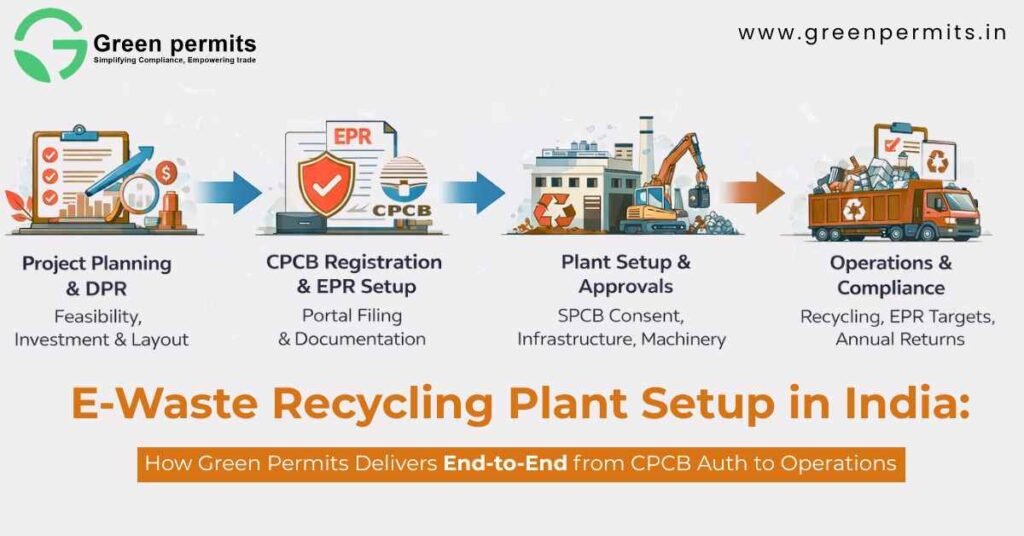
Green Permits approaches plant setup as a structured compliance project rather than a fragmented approval process. The focus is on aligning infrastructure, documentation, and regulatory requirements from day one.
The process includes feasibility assessment, land evaluation, regulatory approvals, CPCB registration, and EPR integration. This ensures that the plant is not only approved but also operationally ready.
Businesses working with structured compliance frameworks typically reduce delays by 30–50% and achieve faster market entry.
E-Waste Recycling Plant Setup in India is a compliance-intensive process where success depends on planning, documentation, and execution.
Investment alone does not guarantee operations. Regulatory alignment determines whether a plant starts on time or gets delayed by months.
Companies that understand the system—from SPCB approvals to CPCB registration and EPR integration—are better positioned to succeed in this sector.
📞 +91 78350 06182
📧 wecare@greenpermits.in