
A fast-growing D2C brand in India crossed ₹5 crore annual revenue within its first year. Their products were being shipped across 8 states, with nearly 22,000 monthly orders. Everything was scaling smoothly until a compliance audit flagged a major gap – the company had not completed its Plastic EPR registration.
Within 45 days, the situation escalated quickly. CPCB flagged the entity, the company’s application was put on hold, and their logistics partner raised compliance concerns. At the same time, a ₹10 lakh environmental compensation risk was triggered due to unfulfilled EPR obligations.
This is now a common situation. Plastic EPR compliance is no longer a backend legal task. It directly affects sales, imports, approvals, and overall business continuity.
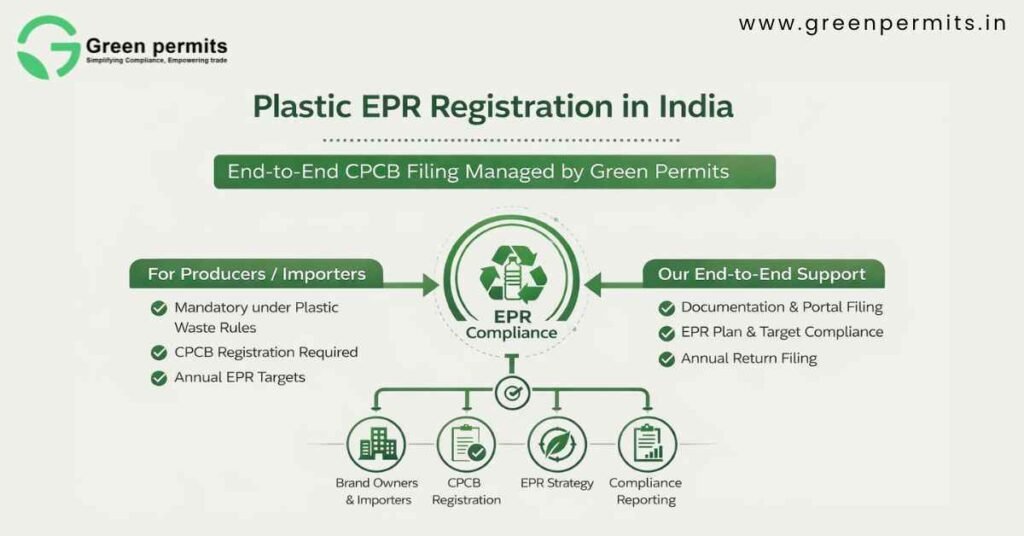
Plastic EPR Registration in India operates under the Plastic Waste Management Rules, 2016, with the latest amendment notified in January 2025. These rules make it mandatory for businesses to take responsibility for the plastic they introduce into the market.
In simple terms, if a company sells products using plastic packaging, it must ensure that a defined percentage of that plastic is recycled through authorized channels. This is not optional and is monitored through the CPCB’s centralized digital portal.
Today, compliance is fully data-driven. Every kilogram of plastic introduced, recycled, or reported is tracked. This has transformed EPR from a theoretical obligation into a measurable business responsibility.
Plastic EPR is essentially a shift in responsibility. Earlier, waste management was handled by municipalities. Now, the responsibility lies with the businesses generating that waste through their products.
This means companies must not only sell products but also ensure that a portion of the plastic used is collected and recycled. The compliance is validated through EPR certificates generated by authorized recyclers.
India generates more than 3.5 million tonnes of plastic waste annually, and regulators are tightening enforcement every year. As a result, businesses are now under continuous scrutiny.
From a practical standpoint, EPR compliance is directly tied to market operations. Companies without proper registration often face delays in approvals, import clearance issues, and objections during pollution control renewals.
| Regulation | Requirement | Deadline | Applicable To | Risk |
|---|---|---|---|---|
| PWM Rules 2016 | Mandatory EPR compliance | Ongoing | PIBOs | Business restriction |
| Amendment 2025 | Barcode/QR traceability | 1 July 2025 | Producers/Importers | Product non-compliance |
| CPCB Registration | Mandatory before operations | Immediate | All PIBOs | Rejection |
| EPR Targets | 8%, 13%, 18% phased | Annual FY | PIBOs | Penalty |
| EP Act 1986 | Legal penalty provision | Continuous | All entities | Legal action |
The regulatory environment has evolved significantly in the last 2–3 years. Earlier, compliance was largely documentation-driven. Now, it is digital, traceable, and continuously monitored.
The introduction of barcode-based traceability in 2025 marks a major shift. Regulators can now track products at the packaging level, making non-compliance visible in real time.
For businesses, this means compliance is no longer something that can be delayed or managed casually. It must be built into operations from the start.
Many businesses assume EPR applies only to large manufacturers. In reality, the scope is much broader and includes even small and mid-sized companies.
Any entity introducing plastic packaging into the market falls under this framework. This includes companies that do not manufacture plastic but use it in packaging.
For example, a brand selling cosmetics or electronics using plastic packaging is equally responsible under EPR rules.
In India, thousands of businesses across sectors such as FMCG, electronics, and e-commerce fall under this requirement. Even startups and D2C brands are now being monitored under CPCB systems.
EPR compliance is structured around measurable targets that increase over time. These targets are calculated based on the quantity of plastic introduced into the market in the previous financial year.
| Phase | Target |
|---|---|
| Initial | 8% |
| Intermediate | 13% |
| Advanced | 18% |
For instance, if a company introduces 1,000 MT of plastic packaging in a year, it must ensure that at least 80 MT is recycled initially. This obligation increases as the business grows and moves into higher compliance phases.
These targets are not flexible. They must be fulfilled within the same financial year, and any shortfall creates additional liability in subsequent years.
The CPCB portal is the central system through which all EPR compliance is managed. Every activity, from registration to certificate submission, happens through this digital platform.
| Step | Authority | Timeline | Documents | Risk |
|---|---|---|---|---|
| Registration | CPCB/SPCB | 15–45 days | GST, PAN, CIN, IEC | Rejection |
| Filing | CPCB Portal | Immediate | Full data | Query |
| Approval | CPCB | Case-based | Verified docs | Delay |
| Compliance | CPCB | Annual | Certificates | Penalty |
| Return Filing | CPCB | Year-end | Sales + EPR data | EC |
The process begins with creating an account on the CPCB portal. Once logged in, businesses must submit detailed information about their operations, plastic usage, and waste management plan.
Most delays occur due to incorrect or incomplete submissions. Even minor errors in GST details or plastic category classification can result in queries that delay approval by several weeks.
In practice, companies with accurate documentation can get approvals within 20–30 days, while incorrect filings can extend timelines beyond 60 days.
One of the most critical aspects of EPR compliance is the certificate mechanism. This is how companies prove that they have fulfilled their recycling obligations.
Instead of physically recycling plastic themselves, businesses can purchase certificates from registered recyclers. These certificates represent the quantity of plastic processed.
For example, if a company has a target of 50 MT, it must purchase certificates equivalent to 50 MT from approved recyclers.
This system creates a market-driven approach to compliance but also introduces cost variability depending on availability.
Documentation plays a crucial role in determining how quickly a company receives approval. Incomplete or incorrect documents are one of the biggest reasons for delays.
Businesses must ensure that all details are consistent across documents. Even small discrepancies between GST and company records can trigger queries.
On average, nearly 25–30% of applications face delays due to documentation issues.
Preparing documents correctly can reduce approval timelines by up to 40%.
The 2025 amendment introduces a significant change by making barcode or QR code traceability mandatory from 1 July 2025.
This requirement ensures that every product in the market can be linked back to the company’s EPR registration. It shifts compliance from backend reporting to front-end product verification.
For businesses, this means packaging design, printing, and supply chains must be updated to include traceability elements.
EPR compliance failures are now enforced strictly, with both financial and operational consequences.
Companies that fail to meet their obligations may face environmental compensation ranging from ₹5 lakh to ₹50 lakh depending on the scale of violation.
In addition, regulatory actions can disrupt business operations, including delays in approvals and restrictions on imports.
Non-compliance also falls under the Environment Protection Act, making it a legal risk beyond just financial penalties.
Plastic EPR compliance is not a one-time process. It requires continuous monitoring, accurate data handling, and coordination with multiple stakeholders.
Green Permits provides end-to-end support, covering everything from initial registration to annual compliance management.
With experience across multiple industries, the focus is on reducing delays, minimizing rejection risks, and optimizing compliance costs.
Plastic EPR Registration in India has become a core operational requirement for businesses dealing with plastic packaging.
With increasing regulatory scrutiny, digital tracking, and stricter penalties, companies must treat EPR compliance as an integral part of their business strategy.
Early compliance not only reduces risk but also ensures smoother operations and better cost control.
Businesses that delay or ignore compliance face disruptions that directly impact revenue and growth.
📞 +91 78350 06182
📧 wecare@greenpermits.in