
A Delhi-based recycler invested close to ₹2.2 crore in setting up a PET bottle recycling plant with a projected capacity of 5 TPD. Machinery was installed within 90 days, but operations never started. The reason was simple: SPCB consent was rejected twice and CPCB registration remained incomplete.
The plant remained idle for over 180 days, leading to financial losses of more than ₹35 lakh including rent, manpower, and EMI costs. This is not an isolated case. In India, most recycling projects fail not because of technology, but because of compliance gaps and approval delays.
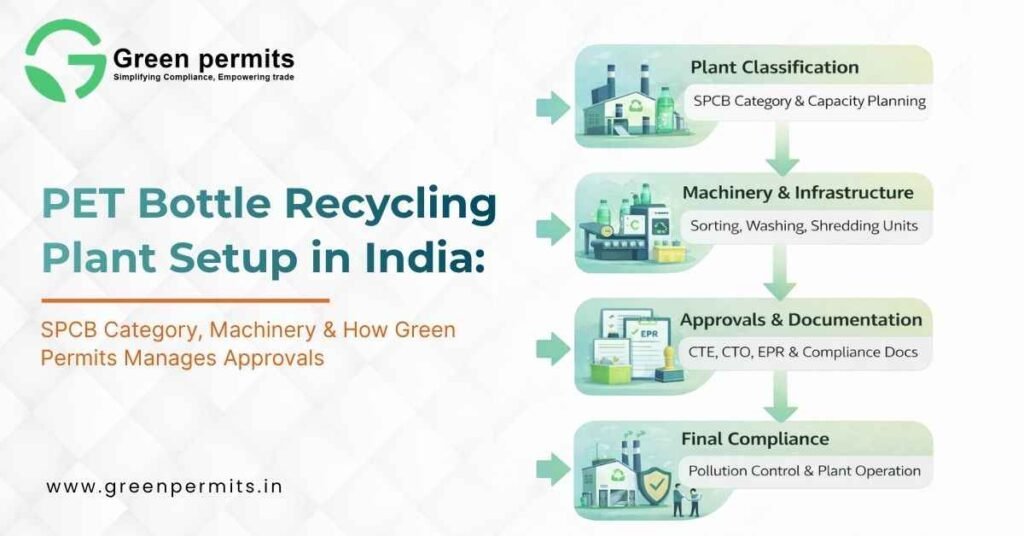
Setting up a PET Bottle Recycling Plant in India is now part of a regulated environmental ecosystem. It is governed primarily by the Plastic Waste Management Rules, 2016 along with the 2025 amendment, notified under the Environment Protection Act, 1986.
The regulatory framework has become stricter after 2025, with increased focus on:
This means a recycling plant is not just a manufacturing unit. It is a compliance-linked infrastructure project that must meet environmental, operational, and digital reporting standards before it can generate revenue.
| Regulation | Requirement | Deadline | Applicable To | Risk |
|---|---|---|---|---|
| PWM Rules 2016 (Amended 2025) | Mandatory recycler registration and reporting | Immediate | All recyclers | Penalty and shutdown |
| Environment Protection Act, 1986 | Enforcement under Section 15 | Continuous | All units | Fine and prosecution |
| SPCB Consent (CTE/CTO) | Approval before setup and operation | Before start | Plant owners | Project halt |
| CPCB EPR Portal | Registration and certificate tracking | Before operation | Recyclers | Suspension |
The regulatory framework is layered and sequential. A plant cannot legally operate unless all approvals are obtained in the correct order. Even a delay of 30 to 60 days in one stage can push the entire project timeline by 3 to 4 months.
Most businesses underestimate compliance timelines and overestimate ease of approvals. This mismatch leads to cost overruns of 15% to 25% in typical projects.
The classification of PET recycling plants depends on pollution load, water usage, and processing type. Most small to medium plants fall under the Orange Category, while larger plants with chemical washing or higher capacity may fall under the Red Category.
This classification directly impacts approval timelines, documentation requirements, and inspection frequency.
For example, a 2 TPD plant may get approval in 45 days, whereas a 10 TPD plant may require 90 to 120 days due to additional scrutiny.
Every recycling plant must obtain:
Without these approvals, even a fully installed plant cannot start production.
Most SPCB rejections happen due to:
Typical timelines observed across states:
A PET bottle recycling plant processes post-consumer plastic into reusable raw material such as flakes or granules. The quality of output depends heavily on machinery configuration and process design.
The standard process involves sorting, washing, shredding, drying, and extrusion.
For a typical SME-level plant:
The investment for such plants usually falls between ₹80 lakh to ₹3 crore, depending on automation level and capacity.
A typical PET recycling plant includes:
To meet regulatory requirements, plants must install:
Failure to install these systems leads to 100% rejection probability during SPCB inspection.
PET recycling plants operate within the Extended Producer Responsibility framework. This means recyclers are not just waste processors, but also part of a regulated supply chain that supports producers in meeting compliance targets.
Recyclers generate EPR certificates based on the quantity of plastic processed. These certificates are purchased by producers to meet their legal obligations.
This creates a direct revenue stream for recycling plants.
India follows a progressive compliance structure where recycling targets increase over time.
Typical target progression includes:
This ensures continuous demand for recycling capacity in the market.
All registration, reporting, and certificate transactions are managed through the CPCB portal.
The process includes:
The entire system is digital, and any mismatch in data can result in rejection or suspension.
Recyclers must comply with:
Non-compliance leads to:
| Step | Authority | Timeline | Documents | Risk |
|---|---|---|---|---|
| Feasibility and land | Internal | 20 to 30 days | DPR, layout | Wrong location |
| CTE approval | SPCB | 30 to 90 days | Pollution plan | Rejection |
| Plant installation | Internal | 60 to 120 days | Machinery invoices | Delay |
| CPCB registration | CPCB | 30 to 45 days | Company documents | Rejection |
| CTO approval | SPCB | 30 to 60 days | Trial run report | Shutdown risk |
The process is sequential. A delay in one step affects all subsequent approvals. In real projects, total setup time ranges between 5 to 9 months.
The regulatory framework is strict, and enforcement has increased significantly after 2025.
Under Section 15 of the Environment Protection Act, 1986:
A PET recycling plant is a compliance-driven business. Success depends not just on machinery, but on how well approvals and documentation are handled.
Businesses that integrate compliance from the beginning achieve:
Setting up a PET Bottle Recycling Plant in India requires a structured approach that combines infrastructure planning with regulatory compliance.
The cost of non-compliance is high. Even a 60-day delay can increase project cost by 10% to 20% and delay revenue generation significantly.
On the other hand, businesses that plan approvals properly benefit from:
The difference lies in execution, documentation, and understanding of regulatory requirements.
📞 +91 78350 06182
📧 wecare@greenpermits.in