
An electronics importer shipped LED products to India with a valid BIS CRS certificate. However, during transit, the certificate expired. When the shipment arrived at Nhava Sheva port, customs flagged the consignment. Clearance was delayed by 21 days, and the company incurred demurrage and warehousing costs exceeding ₹3.2 lakh.
This is not a rare situation. Many manufacturers and importers face similar disruptions because they underestimate BIS CRS renewal timelines.
BIS CRS certification is mandatory for more than 75 categories of electronic and IT products notified by the government. Once the certificate expires, the product becomes legally non-compliant immediately, regardless of stock availability or shipment status.
Under the BIS Act, 2016, any product covered under CRS cannot be manufactured, imported, or sold without a valid registration. Even a short lapse of 5 to 10 days can disrupt entire supply chains, especially for import-driven businesses.
In practical terms, companies operating with monthly import cycles or high-volume manufacturing cannot afford any compliance gap. A lapse often leads to halted dispatches, cancelled distributor orders, and loss of market credibility.
The renewal process is not a single-step filing. It involves multiple stages including internal review, testing, application submission, and BIS verification. Each stage has its own timeline, and delays at any stage can push the certificate into expiry.
Most companies assume renewal takes 10 to 15 days, but in reality, the process can extend up to 45 to 60 days depending on testing requirements and BIS queries.
| Step | Authority | Timeline | Documents | Risk |
|---|---|---|---|---|
| Internal review | Company | 90 days before expiry | Product and compliance data | Delay risk |
| Testing | BIS Lab | 20 to 30 days | Samples and reports | Rejection |
| Application filing | BIS Portal | 1 to 2 days | Complete documentation | Error rejection |
| BIS scrutiny | BIS Authority | 15 to 30 days | Clarifications | Delay |
| Approval | BIS | Before expiry | Renewed certificate | Lapse |
The most critical insight is that renewal must be planned at least 60 to 90 days in advance. Testing delays alone can consume 25 to 30 days, and BIS query cycles can add another 10 to 15 days.
Documentation plays a central role in renewal approval. BIS expects complete consistency between the original registration and renewal application. Even a minor mismatch in company name, address, or authorized signatory can lead to rejection.
Companies handling multiple product SKUs often face issues due to outdated documents or incorrect brand authorization letters. Maintaining document accuracy is essential to avoid delays.
In many cases, the BIS portal auto-validates company details based on GST and PAN. Any mismatch between uploaded documents and system data leads to query or rejection.
Testing is one of the most time-consuming parts of the renewal process. If there are any changes in product design, internal components, or manufacturing location, fresh testing becomes mandatory.
Even if the product remains unchanged, BIS may still require updated test reports depending on changes in applicable Indian Standards or regulatory updates.
In practical scenarios, testing delays are responsible for nearly 60 percent of renewal failures.
Many products covered under BIS CRS, such as electronics and battery-operated devices, also fall under Extended Producer Responsibility compliance.
This creates a dual compliance requirement where businesses must manage both BIS certification and CPCB registration simultaneously.
Under E-Waste Management Rules 2022 and Battery Waste Management Rules 2022 amended in 2025, producers and importers must register on the CPCB portal and file periodic returns.
The compliance burden increases significantly when both BIS and EPR timelines overlap.
In addition, CPCB portal requires sequential filing of returns, meaning missing one quarter blocks further submissions.
| Regulation | Requirement | Deadline | Applicable To | Risk |
|---|---|---|---|---|
| BIS CRS Scheme | Certification renewal | Before 2-year expiry | Manufacturers and importers | Product ban |
| BIS Act 2016 | Legal compliance | Continuous | All regulated entities | Penalty |
| E-Waste Rules 2022 | EPR registration and returns | Annual and Quarterly | Electronics producers | CPCB action |
| Battery Waste Rules 2022 and 2025 | EPR target compliance | Financial year based | Battery importers | Compensation |
BIS CRS renewal should be viewed as part of a larger compliance ecosystem rather than an isolated requirement.
| Step | Authority | Timeline | Documents | Risk |
|---|---|---|---|---|
| Pre-renewal planning | Company | 90 days before expiry | Internal audit data | Delay |
| Testing | BIS Lab | 20 to 30 days | Samples and reports | Rejection |
| Application filing | BIS | Before expiry | Full documentation | Portal rejection |
| BIS review | BIS Authority | 15 to 30 days | Clarifications | Delay |
| Final approval | BIS | Before expiry | Certificate | Lapse |
From a business perspective, the total renewal cycle can stretch up to 60 days. Companies that start late often fail to complete the process before expiry.
Failure to renew BIS CRS certification leads to immediate and serious consequences. These risks are not limited to regulatory penalties but also affect operations and revenue.
Customs authorities often verify BIS validity during import clearance. If the certificate is expired, the shipment is either held or rejected.
Manufacturers face production shutdowns because they cannot legally produce or sell non-compliant products.
Under environmental laws, non-compliance can also attract penalties, especially if linked with EPR obligations.
A manufacturer delayed renewal by 15 days assuming quick approval. Testing delays extended the process by 25 days, resulting in a total production halt of 40 days.
An importer submitted incorrect brand authorization. BIS raised queries, and approval was delayed by 22 days, causing missed festive sales worth ₹18 lakh.
A company managing 12 product models failed to track expiry for 3 models. These products became non-compliant, and distributors returned stock worth ₹9 lakh.
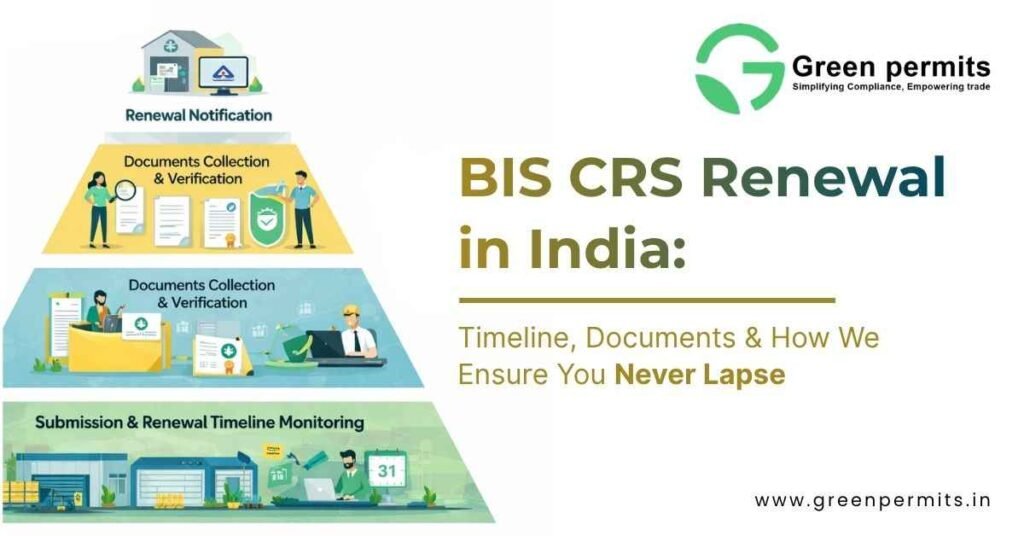
BIS CRS renewal requires a structured and proactive approach. Most companies fail due to lack of tracking, incomplete documentation, and poor coordination with testing labs.
Green Permits provides a systematic compliance framework that ensures no renewal deadline is missed.
The focus is on ensuring zero disruption to business operations while maintaining full regulatory compliance.
BIS CRS renewal in India is a critical compliance requirement that directly impacts your ability to operate in the market. A single lapse can result in shipment delays, production stoppage, and financial losses.
Businesses must treat renewal as an ongoing compliance activity rather than a one-time task. With increasing regulatory integration across BIS and environmental frameworks, the complexity of compliance is only rising.
Early planning, accurate documentation, and timely execution are essential to ensure uninterrupted business continuity.
📞 +91 78350 06182
📧 wecare@greenpermits.in