
A mid-sized automotive component manufacturer importing nearly ₹9 crore worth of inputs annually applied for MOOWR conversion expecting immediate duty savings. However, the application was rejected during inspection due to improper segregation of bonded and non-bonded areas inside the factory.
The result was not just a delay of 35 days but also increased scrutiny from customs authorities and disruption in import planning. This kind of situation is more common than expected, especially when businesses attempt conversion without understanding regulatory sequencing.
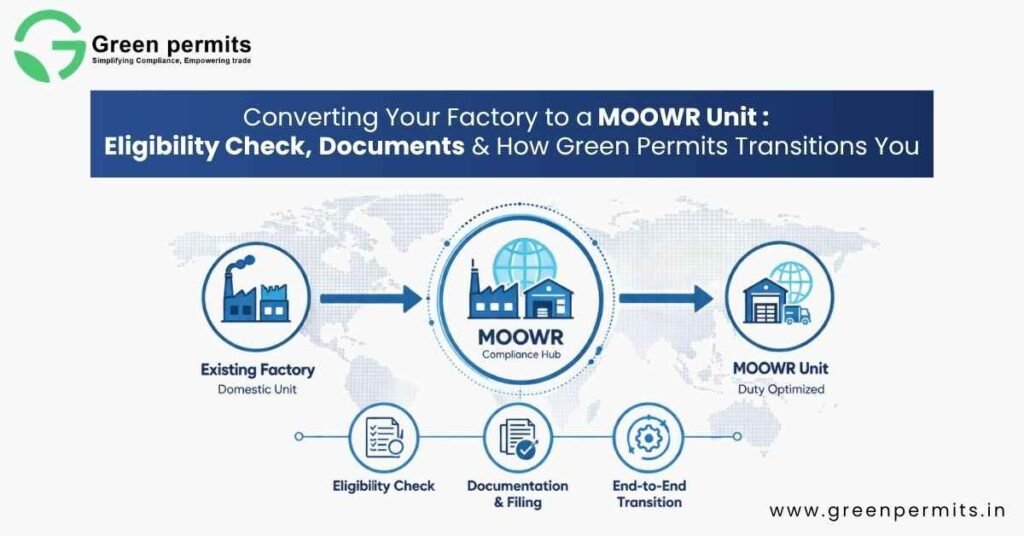
The MOOWR Scheme operates under the Customs Act, 1962 and enables manufacturers to defer customs duty on imported goods used in production. The framework is primarily governed by Section 58 and Section 65, supported by MOOWR Regulations, 2019.
For manufacturers dealing with import dependency between ₹5 crore to ₹50 crore annually, the scheme can unlock working capital improvements ranging from 18% to 28%. In a competitive manufacturing environment, this becomes a direct advantage in pricing and scalability.
However, converting an existing factory into a MOOWR unit is not just a legal formality. It is a structured transition involving factory layout redesign, documentation alignment, customs approvals, and ongoing compliance discipline.
MOOWR allows manufacturing operations to be carried out within a customs-bonded warehouse without immediate payment of import duty. This fundamentally changes how working capital is managed in manufacturing operations.
When raw materials are imported under MOOWR, the duty is not paid at the time of import. Instead, it is deferred until the finished goods are cleared into the domestic market. If the finished goods are exported, the duty liability becomes zero.
This model has gained traction across sectors such as electronics, auto components, chemicals, and engineering goods. Over the past 3–4 years, manufacturers have increasingly adopted MOOWR due to rising input costs and the need to optimize liquidity.
In practical terms, a manufacturer importing ₹12 crore annually can defer duty worth approximately ₹2.5 crore, improving cash flow cycles by nearly 20%–30%.
Eligibility for MOOWR is not restricted to new units. Existing factories can also transition, provided they meet structural and compliance requirements. This is where most businesses face challenges, as legacy factory setups are not always aligned with customs expectations.
An existing factory must be capable of functioning as a bonded warehouse under customs supervision. This includes clear demarcation of storage areas, secure access control, and the ability to maintain digital inventory records.
Manufacturers operating with at least ₹3–5 crore annual imports typically see measurable benefits, but larger units with ₹10 crore or more imports derive the highest financial impact.
The customs authorities evaluate not just documents but also operational readiness before granting approval.
Documentation plays a decisive role in MOOWR approval timelines. Incomplete or misaligned documentation is the primary reason for rejection or delay in more than 60% of cases.
The documentation requirement is multi-layered, covering business identity, factory infrastructure, environmental compliance, and customs-specific filings.
Business documents establish the legal identity of the applicant, while factory documents validate the physical readiness of the premises. Compliance documents ensure that the unit meets environmental and industrial regulations, which indirectly impact customs approvals.
Customs documentation is the most critical layer, as it forms the basis for licensing and operational permission.
The conversion process is structured but requires coordination between internal teams and customs authorities. While the official timeline may appear short, practical delays often extend the process to 25–35 days if documentation is not precise.
The process begins with application filing and is followed by site inspection, where customs officers verify the physical readiness of the factory. This includes checking storage segregation, access control, and infrastructure compliance.
Bond execution is a financial step that ensures duty security. Only after this is completed does the authority grant the warehouse license and manufacturing permission.
A well-prepared application can reduce approval time by up to 30%.
| Regulation | Requirement | Deadline | Applicable To | Risk |
|---|---|---|---|---|
| Section 58 | Warehouse License | Before operations | All units | No approval |
| Section 65 | Manufacturing permission | Post license | Manufacturers | Illegal operations |
| Section 59 | Bond execution | Before import | All units | Duty recovery |
| MOOWR Regulations 2019 | Operational compliance | Continuous | All units | Suspension |
The regulatory structure is layered. Section 58 enables the factory to function as a warehouse, while Section 65 permits manufacturing activities within that warehouse. Without both approvals, the MOOWR framework cannot be operationalized.
| Step | Authority | Timeline | Documents | Risk |
|---|---|---|---|---|
| Registration | Customs | 1–3 days | Basic KYC | Delay |
| License approval | Customs | 10–15 days | Layout, lease | Rejection |
| Manufacturing approval | Customs | 5–7 days | Process flow | Delay |
| Import operations | Customs | Post approval | Bond | Violation |
| Ongoing compliance | Customs | Monthly | Inventory records | Penalty |
The timeline indicates that approvals can be completed within 20–30 days, but this is achievable only when documentation is accurate and factory readiness is verified beforehand.
Once a factory is converted into a MOOWR unit, compliance becomes an ongoing operational responsibility rather than a one-time activity.
Manufacturers must maintain detailed records of imports, consumption, and finished goods. Inventory tracking must be accurate to the level of batch or lot, especially in high-volume operations.
Customs authorities may conduct periodic audits, and any mismatch between physical and recorded inventory can lead to immediate penalties.
Companies with automated ERP systems typically perform better in maintaining compliance, reducing audit risks by nearly 40% compared to manual systems.
MOOWR provides significant benefits, but the risks associated with non-compliance are equally serious. In many cases, penalties are not limited to fines but can disrupt entire operations.
Duty recovery under Section 72 is one of the most critical risks. If goods are not properly accounted for, customs authorities can demand full duty along with interest.
General penalties under Section 117 may appear smaller, but repeated violations can lead to license cancellation. In extreme cases, manufacturing operations may be halted until compliance is restored.
A manufacturer importing ₹15 crore annually shifted to MOOWR and deferred nearly ₹3 crore in duties. This allowed the company to reinvest in capacity expansion within the same financial year.
Another export-oriented unit reduced its duty liability to zero, improving its export margins by approximately 12%.
On the other hand, a poorly planned conversion resulted in rejection due to layout issues, delaying operations by over 45 days and increasing compliance costs significantly.
The conversion process is not just about filing an application. It requires synchronization between factory design, documentation, and regulatory approvals.
Most businesses underestimate the importance of layout planning and compliance sequencing. As a result, even minor errors can lead to rejection or delays.
A structured approach ensures that all requirements are addressed before submission, reducing the risk of rework and saving 20–30 days in approval timelines.
MOOWR is a powerful mechanism for manufacturers looking to optimize costs and improve working capital efficiency. For businesses operating with significant import volumes, the financial impact can be substantial.
However, the benefits come with strict compliance obligations. A poorly executed conversion can lead to delays, penalties, and operational disruptions.
The key to successful MOOWR conversion lies in structured planning, accurate documentation, and regulatory alignment from the beginning.
📞 +91 78350 06182
📧 wecare@greenpermits.in
Book a Consultation with Green Permits