
A mid-sized FMCG importer dealing in laminated food packaging faced a complete disruption in supply chain because their EPR registration for multi-layered plastic was rejected twice. The issue was not lack of intent, but incorrect classification of packaging, mismatch in declared quantities, and non-sequential filing of quarterly returns.
Within 30 to 45 days, the company started facing operational pressure. Distributors refused to accept shipments without valid compliance proof, and the company had to pause imports temporarily. The financial exposure increased due to potential environmental compensation and compliance penalties.
This situation is increasingly common. Multi-layered plastic falls under one of the most scrutinized categories under EPR, and even minor errors in reporting or documentation can lead to delays and financial risks.
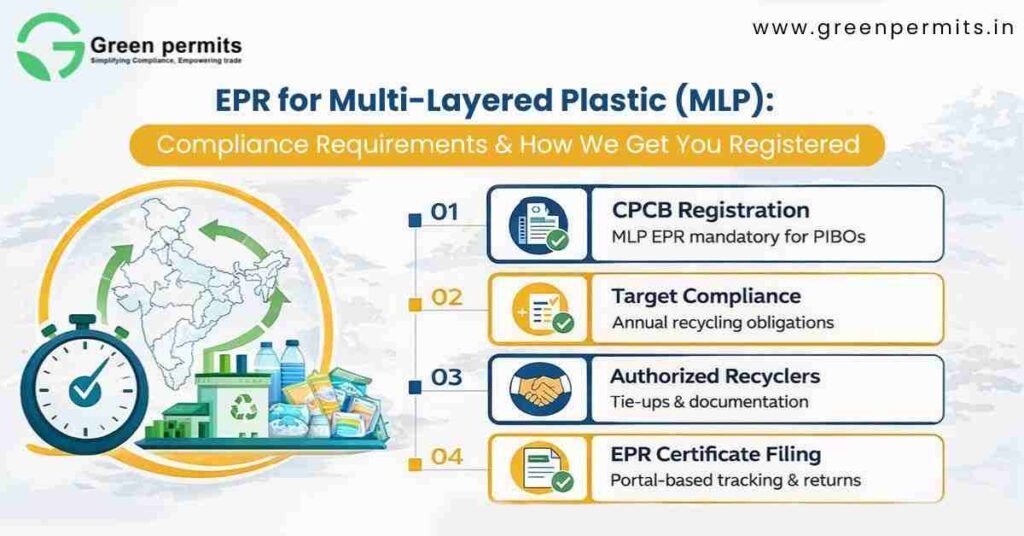
Extended Producer Responsibility for multi-layered plastic is governed under the Plastic Waste Management Rules, 2016 and its latest amendments in 2025. The framework places direct responsibility on producers, importers, and brand owners to ensure that the plastic they introduce into the market is collected and processed in an environmentally sound manner.
Multi-layered plastic typically consists of multiple materials combined into a single structure, such as plastic with aluminum foil or paper. These materials are widely used in packaging because of their durability and barrier properties, but they are difficult to recycle due to their composite nature.
From a compliance perspective, this creates additional obligations for businesses. Unlike rigid plastics, where recycling infrastructure is more established, MLP requires a mix of recycling, co-processing, and waste-to-energy solutions. This increases both compliance complexity and cost.
Businesses must understand that EPR is not just a registration requirement. It is a continuous compliance system that includes planning, execution, reporting, and verification.
MLP compliance is significantly more complex compared to other plastic categories because of its low recyclability and high regulatory scrutiny. Many businesses underestimate the operational effort required to meet compliance targets, especially when dealing with large volumes of packaging.
One of the major challenges is the limited availability of authorized processors who can handle multi-layered plastic. This leads to dependency on co-processing units such as cement kilns or waste-to-energy plants. Additionally, the cost of processing MLP waste is typically 20 to 40 percent higher than standard plastic recycling.
Another challenge is the need for accurate data tracking. Companies must maintain precise records of packaging introduced, waste processed, and certificates procured. Even a small mismatch in data can lead to rejection or compliance delays.
| Regulation | Requirement | Deadline | Applicable To | Risk |
|---|---|---|---|---|
| PWM Rules 2016 | EPR registration mandatory | Before market entry | PIBOs | Business restriction |
| PWM Amendment 2025 | Traceability through barcode/QR | From July 2025 | Producers/Importers | Penalty |
| CPCB Guidelines | Portal-based compliance | Continuous | All entities | Rejection |
| EPA 1986 | Legal enforcement | Ongoing | All entities | Fine and closure |
The regulatory framework for MLP compliance is designed to ensure full traceability and accountability. With the introduction of barcode and QR code requirements, every unit of packaging can now be linked back to the producer. This has significantly increased the transparency of the system and reduced the possibility of misreporting.
For businesses, this means that compliance is no longer limited to documentation. It now involves integration of packaging systems, IT tracking, and coordination with recyclers.
EPR targets are structured to increase gradually over time, ensuring that businesses progressively improve their waste management systems. These targets are calculated based on the quantity of plastic introduced into the market during a financial year.
For most compliance frameworks, the target progression follows a structured model. Businesses must align their waste processing capacity and recycler partnerships accordingly.
These targets may appear small initially, but for companies introducing 1,000 to 10,000 metric tonnes of packaging annually, even an 8 percent obligation translates into significant processing volumes.
Companies must also note that failure to meet targets leads to carry-forward liability and additional penalties.
| Step | Authority | Timeline | Documents | Risk |
|---|---|---|---|---|
| Registration | CPCB/SPCB | 15 to 30 days | PAN, GST, IEC | Rejection |
| Action Plan | CPCB | During application | Waste plan | Delay |
| Certificate Purchase | Recycler | Quarterly | Agreements | Shortfall |
| Quarterly Filing | CPCB | Every quarter | Data reports | Portal block |
| Annual Filing | CPCB | End of FY | Full disclosure | Penalty |
The CPCB portal is the backbone of EPR compliance. Every activity, from registration to reporting, is managed digitally. Businesses must ensure that all filings are accurate and submitted on time.
A critical aspect of the portal is the sequence-based filing system. Quarterly returns must be filed in order. If a company skips a quarter, the system does not allow further filings, which creates a compliance bottleneck.
Processing timelines also depend on the quality of application. Incomplete or incorrect submissions can delay approval by 30 to 60 days.
The registration process requires a structured approach, combining documentation, planning, and accurate data submission.
The first stage involves creating an account on the CPCB portal and generating login credentials. This is followed by submission of detailed company information, including business operations and packaging data.
The second stage focuses on preparing the EPR action plan. This is one of the most critical components, as it defines how the company will meet its waste management obligations. Authorities closely review this section before granting approval.
The final stage involves document submission and application review. Any discrepancies at this stage can lead to queries or rejection.
Documentation plays a crucial role in the approval process. Authorities verify both the legal existence of the company and its operational capability to comply with EPR requirements.
Most applications are delayed due to incomplete or incorrect documents. Companies must ensure that all documents are valid, updated, and consistent with application data.
The EPR system operates through a certificate-based model, which ensures that waste processing is measurable and verifiable. Each certificate represents a specific quantity of plastic waste that has been processed by an authorized recycler.
Producers must purchase these certificates to meet their compliance targets. The entire process is tracked through the CPCB portal, ensuring transparency and accountability.
For example, if a company has an obligation of 500 metric tonnes, it must procure certificates equivalent to that quantity within the compliance period.
Recyclers are a critical part of the EPR ecosystem. For MLP, the role of recyclers becomes even more important due to limited processing options.
Companies must carefully select recyclers who are registered with CPCB and have the capacity to handle multi-layered plastic. Any mismatch between declared and processed quantity can lead to invalid certificates.
Non-compliance with MLP EPR requirements can result in significant operational and financial risks. Authorities have increased enforcement, and penalties are now more structured and strict.
Companies that fail to comply may face multiple consequences simultaneously, including financial penalties, operational delays, and legal action.
In real-world cases, most compliance failures occur due to operational mistakes rather than intentional violations. Understanding these scenarios helps businesses avoid similar issues.
A company that incorrectly classified its packaging faced rejection and had to resubmit its application, resulting in a delay of over 30 days. Another company failed to file one quarterly return, which blocked its entire compliance cycle.
There are also cases where businesses partnered with non-registered recyclers, leading to invalid certificates and penalties.
Businesses that adopt early compliance strategies are able to reduce costs, avoid penalties, and maintain smooth operations. Waiting until the last moment increases the risk of errors and delays.
Early compliance also allows companies to build long-term partnerships with recyclers and optimize their waste management systems.
Green Permits provides structured and end-to-end support for MLP EPR compliance. Our approach focuses on accuracy, speed, and long-term compliance management.
We help businesses navigate complex regulations, prepare accurate documentation, and manage ongoing compliance requirements efficiently.
EPR for multi-layered plastic is one of the most complex compliance areas under environmental regulations in India. With increasing enforcement and new requirements such as traceability, businesses must adopt a structured approach to compliance.
The cost of non-compliance is significantly higher than the cost of proper planning and execution. Companies that invest in accurate and timely compliance are better positioned to operate smoothly and grow sustainably.
📞 +91 78350 06182
📧 wecare@greenpermits.in