
A mid-sized manufacturer produces 10,000 units of galvanized steel pipes and dispatches them across 3 states. Within 15 days, enforcement authorities stop distribution due to absence of ISI marking. Inventory worth ₹1.2 crore is blocked, dealers refuse acceptance, and compliance notices are issued.
This is the operational reality for many businesses in India. ISI certification is not optional for notified products. Even a short delay can disrupt supply chains, damage credibility, and trigger regulatory action.
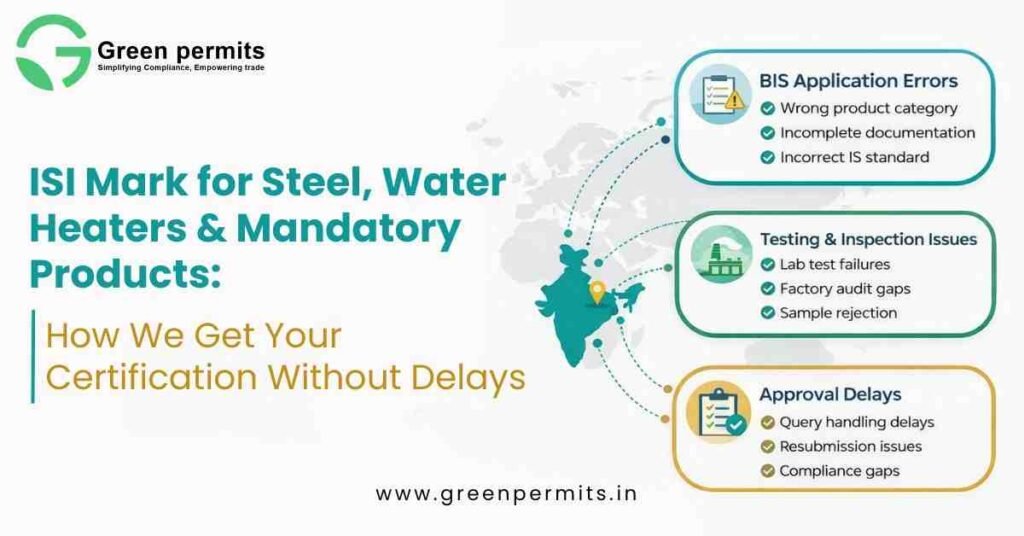
ISI Mark certification is issued by the Bureau of Indian Standards (BIS) and applies to more than 300 mandatory products across sectors such as steel, electrical appliances, construction materials, and consumer goods.
For manufacturers and importers, this certification acts as a legal clearance that confirms the product meets Indian safety and quality benchmarks defined under specific IS standards.
From a compliance perspective, ISI certification is directly linked with market access. Without it, manufacturing, sale, storage, and even advertisement of certain products become illegal.
In practical terms, businesses dealing in products like steel pipes, water heaters, cables, switches, and pressure vessels must obtain certification before production or import.
ISI certification does not operate in isolation. It is part of a broader regulatory ecosystem that includes environmental approvals, waste management compliance, and EPR obligations.
Manufacturers often face delays because they treat BIS approval separately from SPCB consent or CPCB registration. In reality, these systems are interconnected and require synchronized documentation.
Products that require ISI marking may also fall under E-Waste Rules, Plastic Waste Rules, or Battery Waste Rules depending on their composition and usage.
For example, an electrical appliance manufacturer must comply with BIS testing, EPR registration, and SPCB consent simultaneously. Any mismatch in data across these platforms leads to rejection.
The BIS certification process is structured but execution-intensive. Most delays happen due to incomplete preparation before application.
The process begins with identifying the correct IS standard applicable to the product. For example, steel pipes, water heaters, and electrical equipment all fall under different IS codes.
After identification, the application is filed through the BIS portal along with technical details and manufacturing information. This is followed by product testing and factory inspection.
At this stage, businesses submit company details, product specifications, and production capacity. Accuracy is critical because even minor mismatches can trigger queries.
Testing is conducted in BIS-recognized laboratories. Products must meet strict quality and safety parameters defined in the IS standard.
In many cases, first-time applicants fail testing due to minor deviations in material composition or performance standards.
BIS officials conduct inspection to verify manufacturing processes, quality control systems, and production capacity.
Inspection focuses not only on the product but also on the consistency of production and quality assurance mechanisms.
Once testing and inspection are successfully completed, BIS issues the ISI license.
Documentation is one of the most critical aspects of BIS certification. Inconsistent or incomplete documents are responsible for nearly 40 percent of application delays.
Manufacturers must ensure that all documents are aligned across BIS, SPCB, and CPCB platforms.
The basic documentation includes company identity, manufacturing details, and regulatory approvals.
These documents validate the production process and quality control mechanisms.
After 2023 and 2025 regulatory updates, BIS certification is increasingly linked with Extended Producer Responsibility (EPR).
Manufacturers of electrical, plastic, battery, and automotive products must ensure that their BIS-approved products are also registered under EPR frameworks.
EPR compliance requires producers to take responsibility for post-consumer waste and ensure recycling through authorized channels.
Producers must purchase EPR certificates from registered recyclers based on the quantity of waste generated.
These certificates are submitted through CPCB portals as proof of compliance.
Failure to align BIS certification with EPR obligations can lead to portal suspension and compliance penalties.
Non-compliance with ISI certification can result in severe legal and operational consequences. The risks are not limited to fines but can directly impact business continuity.
Under the Environment Protection Act, 1986, violations can lead to penalties, imprisonment, and closure orders.
The financial impact of non-compliance is often underestimated. A single rejected application can delay product launch cycles and block working capital.
A water heater manufacturer failed BIS testing due to insulation deviation of less than 5 percent. The approval was delayed by 45 days, leading to loss of peak winter sales.
An importer submitted different addresses in GST and factory license. The application was rejected, and the re-application process added 30 days delay.
An electronics brand obtained ISI certification but did not register under EPR. CPCB flagged the company, resulting in compliance notices and portal restrictions.
Businesses that plan certification early experience smoother approvals and lower compliance costs.
ISI certification should be treated as a strategic process rather than a last-minute requirement. Proper planning reduces rejection risk and improves operational efficiency.
ISI Mark certification is a critical requirement for manufacturers and importers dealing with regulated products in India. It ensures product quality, legal compliance, and market credibility.
With increasing integration between BIS standards and environmental regulations, businesses must adopt a structured and proactive compliance strategy.
Delays or errors in certification can lead to financial losses, operational disruptions, and regulatory penalties. On the other hand, timely compliance ensures uninterrupted business operations and long-term sustainability.
📞 +91 78350 06182
📧 wecare@greenpermits.in