
A solar module manufacturer in Gujarat invested nearly ₹22 crore in a new production facility with a planned capacity of 150 MW per year. Production started on schedule, but within the first month, dispatches were halted due to pending BIS CRS certification.
In less than 30 days:
This is not an isolated case. In India, over 60% of new solar manufacturers face delays due to incomplete understanding of BIS certification requirements.
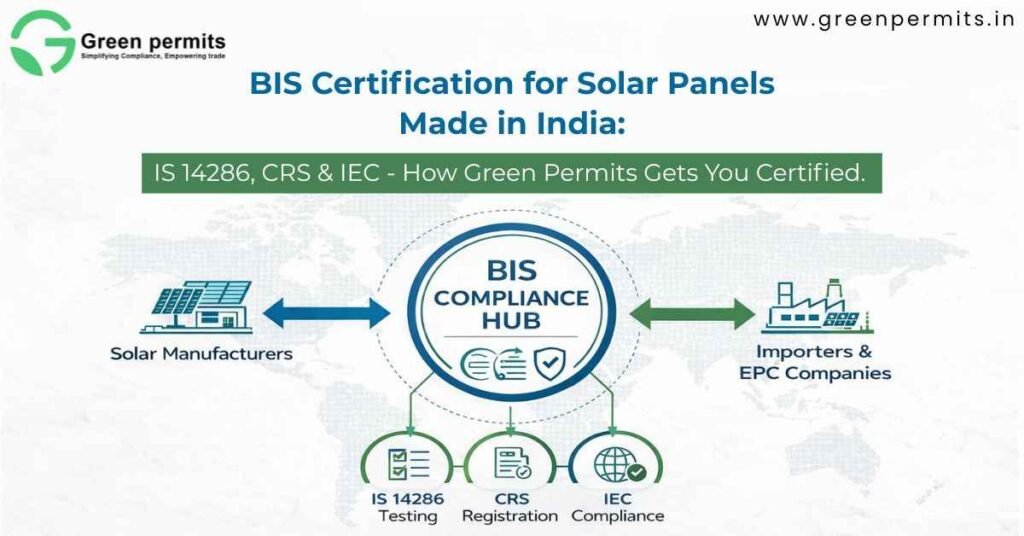
BIS Certification for Solar Panels Made in India is a mandatory regulatory requirement under the BIS Act, 2016. It ensures that solar PV modules meet defined standards of safety, durability, and performance before entering the market.
The compliance framework is built around three key pillars:
India’s solar manufacturing sector is expanding rapidly, with installed capacity crossing 70 GW. However, regulatory compliance remains a bottleneck, especially for new manufacturers and importers.
The regulatory structure for solar panel certification in India is layered and interconnected. BIS certification is only one part of a broader compliance ecosystem involving multiple authorities.
At the core is the BIS Act, 2016, which mandates product certification before sale or import. This is supported by the CRS framework, which applies specifically to electronics and electrical products, including solar modules.
Additionally, MNRE enforces Quality Control Orders that make BIS certification compulsory for solar modules used in India. For government and large-scale EPC projects, inclusion in the Approved List of Models and Manufacturers (ALMM) is also required.
This creates a multi-level compliance requirement where failure at any stage impacts business operations.
IS 14286 is the Indian standard specifically designed for crystalline silicon terrestrial photovoltaic modules. It is aligned with global IEC standards but adapted to Indian climatic and operational conditions.
The standard evaluates modules across multiple stress conditions, including high temperature, humidity, and mechanical pressure. Given India’s diverse climate, these tests are critical to ensure long-term module performance.
IEC standards form the technical backbone:
For example, thermal cycling tests simulate temperature variations from -40°C to +85°C across multiple cycles. Modules must maintain performance within acceptable degradation limits, typically less than 5%.
Failure to meet these standards results in rejection during the testing phase, which is the most common cause of delays.
The BIS certification process follows a structured workflow, but practical timelines often extend due to testing failures and documentation issues.
The process begins with application filing on the BIS portal. Once submitted, product samples are sent to BIS-recognized laboratories for testing. Testing alone can take 20 to 30 days depending on lab availability and product complexity.
After testing, reports are submitted for verification. BIS authorities evaluate both technical and documentation aspects before granting certification.
Typical timelines observed in industry:
This brings the total certification timeline to approximately 30 to 60 days under normal conditions.
However, delays can extend timelines beyond 90 days in cases of:
Documentation is a critical part of the BIS certification process. Incomplete or incorrect submissions are one of the top reasons for application rejection.
Manufacturers and importers must provide detailed company and product information. This includes legal documents, technical specifications, and compliance declarations.
For importers, additional requirements such as IEC and Authorized Indian Representative (AIR) details must be submitted.
In India, regulatory filings are increasingly digitized, requiring structured documentation aligned with portal-based systems. This means that data accuracy and consistency play a major role in approval timelines.
Typical document set includes:
Additional supporting documents:
Testing is the most time-intensive and technically demanding part of the BIS certification process. It directly determines whether a product will be approved or rejected.
Solar modules undergo rigorous testing under controlled conditions. These tests simulate real-world environmental stress and operational loads.
For example, damp heat testing exposes modules to high humidity conditions for extended durations, often exceeding 1,000 hours. Mechanical load testing applies pressure equivalent to wind speeds of over 240 km/h.
Failure rates in testing are not uncommon. Industry estimates suggest that nearly 25% of first-time applications face some form of testing failure.
Common testing areas include:
While CRS certification is product-based, manufacturing readiness significantly influences the success of the application.
Authorities assess whether the manufacturer has the capability to consistently produce modules that meet the certified standard. This includes reviewing production processes, quality control systems, and traceability mechanisms.
For example, manufacturers must maintain batch-level tracking of raw materials and finished products. This ensures that any quality issue can be traced back to its source.
In addition, compliance with environmental regulations is mandatory for plant operations. Without approvals such as Consent to Establish and Consent to Operate, manufacturing activities cannot legally continue.
BIS certification does not operate in isolation. Solar manufacturing units must comply with multiple environmental regulations.
Approvals required include:
India’s environmental framework mandates that no industrial unit can operate without proper authorization. This creates a direct dependency between BIS certification and environmental approvals.
For instance, delays in SPCB approvals can indirectly impact BIS certification timelines, especially when factory details are part of the evaluation process.
Failure to obtain BIS certification can have serious consequences for businesses. The risks are not limited to regulatory penalties but extend to operational and financial impacts.
Products without BIS certification can be seized or banned from sale. For importers, shipments may be held at customs, leading to demurrage charges and inventory losses.
Under environmental laws, non-compliance can result in plant closure and financial penalties. Legal liabilities can also arise under the Environment Protection Act, 1986.
Key risks include:
Green Permits approaches BIS certification as a structured compliance process rather than a documentation exercise. The focus is on aligning technical, regulatory, and operational aspects from the beginning.
The process includes identifying applicable standards, coordinating with testing laboratories, and ensuring documentation accuracy. Integration with environmental approvals is also managed to avoid delays.
This approach reduces approval timelines and minimizes the risk of rejection.
BIS Certification for Solar Panels Made in India is a critical requirement that directly impacts market entry, production continuity, and business credibility.
With solar manufacturing capacity in India expected to cross 100 GW in the coming years, compliance will play an even more important role in determining business success.
Companies that approach certification proactively can reduce delays by up to 40% and avoid unnecessary costs. Structured planning, accurate documentation, and integration with regulatory approvals are essential for smooth certification.
📞 +91 78350 06182
📧 wecare@greenpermits.in