
A manufacturing company is preparing for onboarding with a large listed buyer. The buyer asks for ESG disclosures, CSR records, waste authorization details, GHG data, EPR compliance status, and proof of valid SPCB consent. The finance team has CSR numbers. The plant team has CTO copies. The EHS team has CPCB portal filings. The management team has sustainability goals. But no one has a single verified sustainability reporting file.
This is where sustainability reporting in India becomes a business compliance issue, not just a communication exercise.
Indian companies are now expected to show measurable sustainability performance. Listed companies must align with BRSR requirements. Eligible companies must report CSR obligations. Manufacturers, importers, brand owners, recyclers, and plant operators must maintain environmental approvals, CPCB registrations, EPR certificates, and waste compliance records.
For many businesses, the biggest problem is not the absence of sustainability work. The real problem is weak documentation. A company may have reduced waste by 18%, improved energy efficiency by 12%, recycled 500 MT of material, or spent 2% of average net profit on CSR, but if the data is not structured, verified, and linked to compliance evidence, the report loses credibility.
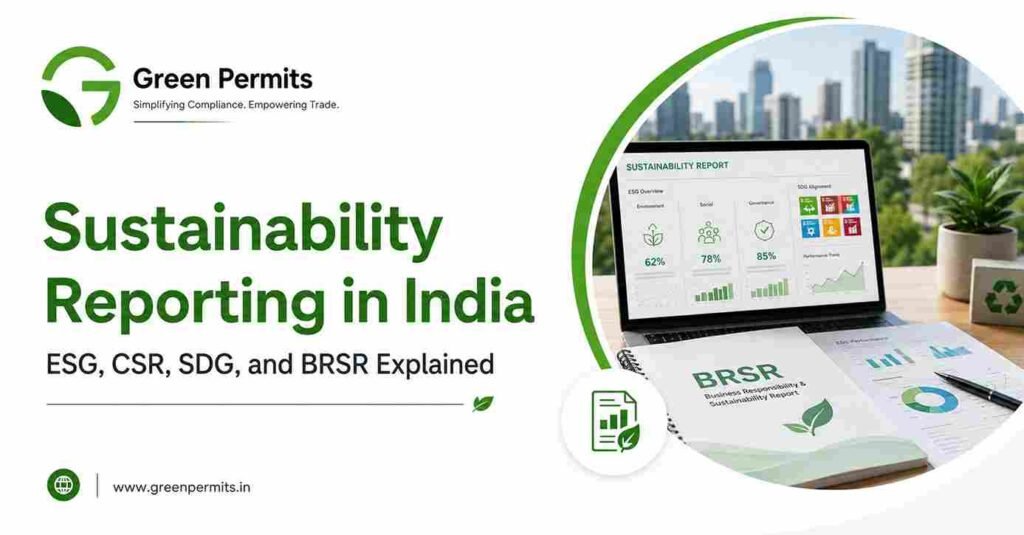
Sustainability reporting in India is the structured disclosure of a company’s environmental, social, governance, CSR, and responsible business performance. It explains how a business uses resources, manages waste, treats workers, governs decisions, reduces risk, and contributes to long-term sustainable growth.
For listed entities, BRSR is the most important reporting framework in India. For unlisted manufacturers, MSMEs, importers, exporters, and suppliers, sustainability reporting is increasingly required by buyers, banks, investors, multinational customers, and procurement teams.
A good sustainability report should answer five practical questions. What impact does the company create? Why does that impact matter? How is the company managing it? What timeline applies? What is the business risk if compliance is weak?
For example, a battery importer cannot simply say it supports circular economy. It must show CPCB registration, EPR obligation, sales or import quantity, EPR certificate adjustment, and return filing status. Similarly, a plastic brand owner must support recycling claims with PIBO registration, plastic category data, PWP certificates, and annual return records.
Key data points normally required include:
ESG, CSR, SDG, and BRSR are connected, but they are not the same. Many Indian businesses mix these terms in reports, which creates confusion during audits and buyer reviews.
ESG stands for Environmental, Social, and Governance. It is mainly used by investors, lenders, large buyers, and rating agencies to understand business risk and sustainability performance. ESG looks at issues such as pollution control, worker safety, board governance, climate risk, waste management, and supply chain responsibility.
CSR stands for Corporate Social Responsibility. In India, CSR is linked to Section 135 of the Companies Act, 2013. Eligible companies are required to spend at least 2% of their average net profits from the previous 3 financial years on CSR activities. CSR is mostly about social impact, community development, education, healthcare, environment projects, and similar activities.
SDGs are the United Nations Sustainable Development Goals. There are 17 SDGs. Companies use them to map their business impact. For example, water conservation can align with SDG 6, climate action with SDG 13, responsible production with SDG 12, and decent work with SDG 8.
BRSR means Business Responsibility and Sustainability Reporting. It is India’s structured ESG disclosure format for listed entities. BRSR connects governance, environment, employees, consumers, human rights, value chain responsibility, and sustainable business practices.
| Term | Full Form | Main Purpose | Common Users |
|---|---|---|---|
| ESG | Environmental, Social, Governance | Risk and sustainability performance | Investors, buyers, lenders |
| CSR | Corporate Social Responsibility | Statutory social impact spending | Eligible Indian companies |
| SDG | Sustainable Development Goals | Impact mapping | Corporates, NGOs, global buyers |
| BRSR | Business Responsibility and Sustainability Reporting | Structured business sustainability disclosure | Listed companies |
A company may spend crores on CSR but still have weak ESG performance if it has expired pollution control consent, poor waste tracking, or incomplete EPR compliance. That is why sustainability reporting must combine CSR data with environmental authorization India records, CPCB filings, and operational performance numbers.
Sustainability reporting is no longer limited to large listed companies. It now affects manufacturers, importers, MSMEs, exporters, recyclers, plant owners, and suppliers. Large corporates increasingly ask vendors for ESG data before procurement approval. Banks ask for environmental and governance information before funding. Export buyers ask for sustainability evidence before long-term contracts.
A small manufacturer supplying to a listed company may not be directly required to file BRSR. However, the listed company may still ask the supplier for energy use, labour practices, waste disposal method, pollution control license India status, and EPR compliance data. This is because value chain disclosure is becoming more important.
For plant-based businesses, sustainability reporting also reduces operational risk. If consent to operate has expired, hazardous waste authorization is missing, or CPCB portal filing is incomplete, the ESG report may expose the business to questions from buyers, auditors, regulators, and investors.
Strong reporting helps businesses in 5 practical ways:
| Regulation | Main Requirement | Timeline / Deadline | Applicable To | Business Risk |
|---|---|---|---|---|
| BRSR | Structured sustainability disclosure | Annual reporting cycle | Covered listed entities | Investor scrutiny, weak ESG rating |
| BRSR Core | Assured ESG indicators | Phased applicability | Large listed entities and value chain partners | Assurance failure |
| CSR under Companies Act | 2% CSR spending and board disclosure | Annual financial year | Eligible companies | Governance and reporting risk |
| Plastic Waste Rules | EPR registration, category-wise obligations, returns | Annual and portal-based | PIBOs | CPCB action, environmental compensation |
| Battery Waste Rules | Registration, EPR targets, certificates | Annual and portal-based | Producers, importers, recyclers | Import and sales disruption |
| E-Waste Rules | EPR registration, recycling targets, returns | Annual and portal-based | Producers, manufacturers, recyclers, refurbishers | CPCB rejection, portal suspension |
| ELV Rules 2025 | EPR for end-of-life vehicles | Effective from 1 April 2025 | Vehicle producers, RVSFs, bulk consumers | EPR liability, certificate shortfall |
| SPCB Consent | CTE, CTO, authorization | Validity-based | Industrial units and plants | Production halt, refusal, penalty |
This table shows one important point. Sustainability reporting is not only about ESG policies. It must include statutory records. If a company says it is managing waste responsibly, it should have valid waste authorization. If it says it is recycling plastic, battery, e-waste, or vehicle waste, it should have EPR certificates or recycler records.
Environmental compliance is the backbone of credible ESG reporting in India. Many sustainability reports fail because they present broad statements without supporting records.
For example, a company may write that it is committed to responsible waste management. But during review, the buyer may ask for CPCB registration, SPCB approval process documents, recycler agreements, annual returns, and EPR certificate proof. If these are missing, the ESG claim becomes weak.
CPCB and SPCB records create evidence. They show whether the business has obtained required approvals, filed returns, met targets, and used authorized recyclers or processors. This is especially important for businesses dealing with plastic packaging, batteries, electronics, hazardous waste, biomedical waste, tyres, and end-of-life vehicles.
Important compliance records for ESG reporting include:
If these records are not aligned with the sustainability report, the company may face questions during audits, tenders, exports, funding, and regulatory inspections.
| Step | Authority / Owner | Practical Timeline | Key Documents | Risk if Delayed |
|---|---|---|---|---|
| 1 | Management / ESG team | Week 1 | Entity list, sites, products, reporting boundary | Wrong reporting scope |
| 2 | EHS / plant team | Week 1 to 2 | CTE, CTO, waste authorization, water data | Missing compliance evidence |
| 3 | CPCB portal team | Week 2 to 4 | EPR registration, targets, certificates | Portal mismatch |
| 4 | Finance team | Week 2 to 4 | CSR spend, turnover, capex, opex | Wrong financial disclosure |
| 5 | HR team | Week 3 to 5 | Employee count, safety, training, diversity | Weak social data |
| 6 | Operations team | Week 3 to 6 | Energy, fuel, production, waste, water | Inconsistent ESG numbers |
| 7 | Legal / compliance team | Week 5 to 7 | Licenses, notices, penalties, litigation | Hidden regulatory risk |
| 8 | ESG drafting team | Week 6 to 8 | Final data sheets and evidence files | Poor report quality |
| 9 | Management review | Week 8 to 9 | Draft report, risk notes, action plan | Disclosure error |
| 10 | Final reporting | Week 9 to 10 | Approved sustainability report | Delayed submission |
A practical sustainability reporting cycle should start at least 8 to 10 weeks before the report is needed. For larger companies with multiple plants, 12 to 16 weeks may be required.
Year-end reporting becomes difficult when plant-wise data is not collected monthly. A company with 5 plants, 3 product categories, 2 EPR registrations, and 12 months of waste records may need to reconcile hundreds of data points before final reporting.
BRSR and ESG reporting require more than general policy language. Companies need numbers, explanations, and proof. The strongest reports include both quantitative data and compliance interpretation.
Environmental data usually includes energy use, fuel consumption, emissions, water withdrawal, wastewater generation, waste generation, recycling quantity, hazardous waste disposal, renewable energy use, and pollution control measures.
Social data includes employee numbers, gender diversity, wages, health and safety, training hours, welfare measures, grievance redressal, and community impact. Governance data includes board oversight, risk management, ethics, anti-corruption systems, stakeholder engagement, and compliance status.
A practical ESG data file should include:
For example, instead of writing “the company reduced waste,” a stronger disclosure would state: “The company reduced landfill-bound waste from 420 MT in FY 2023-24 to 335 MT in FY 2024-25, representing a 20.2% reduction, supported by segregation, recycler tie-ups, and monthly waste tracking.”
EPR compliance is one of the most important parts of sustainability reporting for manufacturers, importers, and brand owners. EPR stands for Extended Producer Responsibility. It means the producer is responsible for environmentally sound management of products or packaging after use.
EPR applies across several waste streams in India, including plastic packaging, e-waste, battery waste, waste tyres, and end-of-life vehicles. Each stream has its own rules, portal requirements, registration process, targets, returns, and certificate mechanism.
For ESG reporting, EPR data helps prove circular economy performance. It shows how much product was placed in the market, what obligation was generated, how much waste was recycled or processed, and whether certificates were purchased or generated.
A strong EPR disclosure should include:
For ELV EPR, the 2025 framework uses steel-based targets. Producers must meet minimum targets of 8%, 13%, and 18% across phased financial years. For FY 2025-26 to FY 2029-30, the minimum target begins at 8% of steel used in applicable vehicles. From FY 2030-31 to FY 2034-35, it increases to 13%. From FY 2035-36 onward, it reaches 18%.
These numbers are important because they convert sustainability claims into measurable compliance obligations.
CPCB portal filing is often handled by compliance teams, while ESG reporting is handled by sustainability or management teams. This separation creates reporting gaps. ESG teams should understand the basic CPCB portal filing sequence so that they can ask for the right evidence.
The filing process generally begins with entity classification. A business must identify whether it is a producer, importer, brand owner, manufacturer, recycler, refurbisher, PWP, RVSF, or bulk consumer. Wrong classification can lead to incorrect registration or rejected filings.
After classification, the company must create portal login credentials, upload KYC documents, enter product or facility details, provide sales or capacity data, pay fees, respond to deficiencies, and maintain return filing records.
Typical CPCB portal filing sequence:
For annual ESG reporting, these portal documents should be stored in a structured folder. File names should include financial year, portal name, registration number, return period, and submission date.
A sustainability report becomes stronger when every claim has a supporting document. For Indian companies, this means combining ESG data with statutory compliance records.
A manufacturer may require plant-level consent copies, water bills, electricity bills, production records, waste disposal records, and occupational safety data. An importer may require IEC, CPCB registration, customs-linked product data, EPR obligation, and certificate records. A recycler may require CTO, hazardous waste authorization, capacity approval, process flow, and certificate generation records.
Common documents include:
For large companies, the document set may include 100 to 300 files across plants, departments, and compliance areas. Without proper indexing, ESG reporting becomes slow and error-prone.
Weak sustainability reporting can create both business and regulatory risk. A company may lose a buyer approval, fail an ESG audit, face investor questions, or trigger regulatory scrutiny if disclosures are not backed by proper evidence.
The most common risk is inconsistency. For example, the ESG report may say the company recycled 1,000 MT of plastic waste, but the CPCB portal return may show 820 MT. Such a mismatch can raise questions during audit or due diligence.
Another common risk is expired consent. If the report states that the plant is compliant but the CTO expired 3 months earlier, the company may face serious questions from the buyer, lender, or regulator.
Major risks include:
For plant owners, the risk is operational. For importers, the risk can affect customs and sales. For listed companies, the risk can affect disclosure credibility. For MSMEs, the risk can affect vendor approval and funding.
An audit-ready sustainability report should be built from evidence, not from assumptions. The first step is to define the reporting boundary. This includes company entities, factories, warehouses, imported products, brands, waste streams, and value chain responsibilities.
The second step is to map applicable laws. A company dealing with plastic packaging may need PWM compliance. A battery importer may need BWM compliance. An electronics producer may need e-waste compliance. A vehicle producer may need ELV compliance. A plant operator may need Air Act, Water Act, hazardous waste authorization, and factory-related approvals.
The third step is to collect monthly data. Annual reporting becomes easier when energy, water, waste, safety, CSR, and compliance data are tracked every month.
A practical sustainability reporting system should include:
This approach helps businesses respond quickly during buyer audits, bank reviews, BRSR preparation, export due diligence, and regulatory inspections.
Green Permits supports businesses by connecting sustainability reporting with real compliance evidence. This is important because many reports look polished but fail when an auditor asks for proof.
For manufacturers, importers, recyclers, plant owners, and brand owners, Green Permits helps identify applicable rules, collect compliance records, structure ESG data, review CPCB and SPCB status, and prepare a reporting file that is practical for business use.
The objective is not to make the report look promotional. The objective is to make it credible, traceable, and useful during compliance review.
Green Permits can assist with:
Sustainability reporting in India is no longer a generic annual document. It is a compliance-backed business record that connects ESG, CSR, SDG, BRSR, CPCB filings, EPR obligations, SPCB approvals, and operational performance.
The companies that prepare early are better positioned. They can respond faster to buyer audits, investor questions, lender reviews, export requirements, and regulatory checks. They also reduce the risk of last-minute data gaps, expired approvals, incorrect filings, and unsupported sustainability claims.
A strong sustainability report should show numbers, timelines, responsibilities, risks, and evidence. It should explain what the company has done, what is pending, and how gaps will be closed.
For Indian manufacturers, importers, brand owners, recyclers, MSMEs, and corporates, early compliance is cheaper than delayed correction. A structured sustainability reporting system can reduce business risk, improve credibility, and support responsible growth.
📞 +91 78350 06182
📧 wecare@greenpermits.in