
A manufacturer may receive a sustainability questionnaire from a customer, tendering authority or international buyer asking for the environmental footprint of its product. Providing annual electricity consumption or a company-wide carbon footprint may not be sufficient. The buyer may require a product-specific assessment covering raw materials, manufacturing, transport, product use and end-of-life treatment.
A Life Cycle Assessment Consultant in India helps a business define the correct study boundary, collect reliable operational and supply-chain data, model environmental impacts and prepare an assessment aligned with recognised LCA standards. The real challenge is not running software. It is ensuring that the functional unit, allocation method, data quality, system boundary and interpretation are appropriate for the decision the company intends to make.
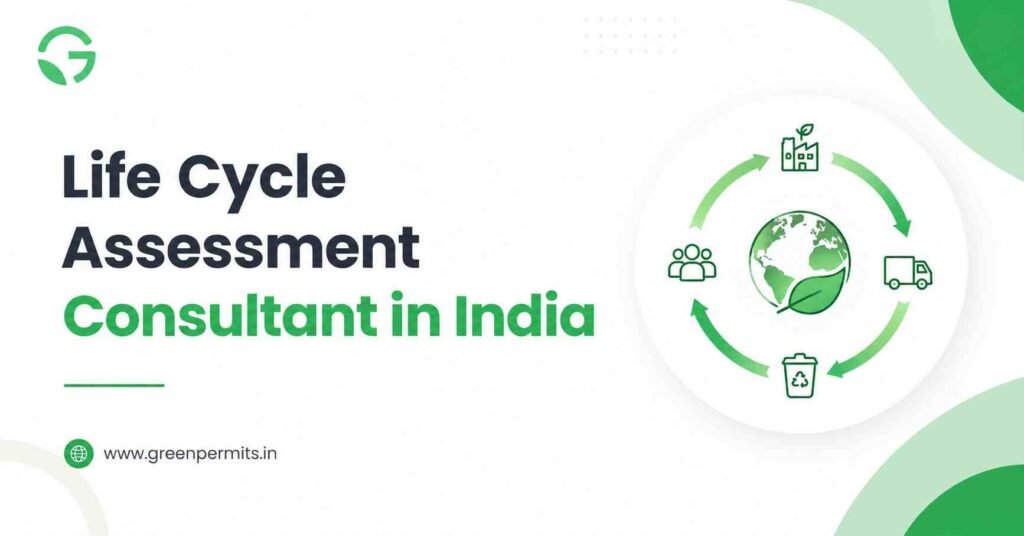
Life Cycle Assessment, or LCA, is a structured method for evaluating the potential environmental impacts of a product, process or service across its life cycle. A typical study covers goal and scope definition, inventory analysis, impact assessment and interpretation in accordance with ISO 14040 and ISO 14044.
LCA is becoming commercially important for Indian manufacturers because environmental performance is increasingly evaluated at the product level rather than only at the company level.
A corporate greenhouse gas inventory may show the organisation’s total Scope 1, Scope 2 and selected Scope 3 emissions. An LCA answers a different question: what environmental impacts are associated with producing and using a defined quantity of a particular product or service?
Businesses commonly initiate an LCA when they need to:
For most Indian businesses, LCA is a standards-based environmental assessment rather than a separate government licence or registration. Its commercial importance may arise from customer contracts, reporting frameworks, procurement requirements, product declarations, export markets or internal sustainability targets.
ISO 14040 describes the principles and framework for LCA. It covers goal and scope definition, life cycle inventory analysis, life cycle impact assessment, interpretation, reporting, limitations and critical review. ISO 14044 provides the detailed requirements and guidelines for conducting the assessment.
An LCA may examine environmental impacts associated with stages such as:
A study does not always have to cover every stage. The boundary should be selected according to the intended use of the assessment.
Cradle-to-gate
The assessment starts with raw material extraction and ends when the finished product leaves the manufacturing facility. This is frequently used for industrial materials, components and business-to-business products.
Cradle-to-grave
The study covers raw material extraction, production, distribution, use and final disposal or recycling.
Gate-to-gate
Only a defined manufacturing process or facility is assessed. This can support process improvement but does not represent the complete product life cycle.
Cradle-to-cradle
The study considers how materials may be recovered and returned to another production cycle instead of being treated only as waste.
The selected boundary must be disclosed clearly. A cradle-to-gate result should not be promoted as a complete cradle-to-grave assessment.
There is no single applicability test based only on company turnover or manufacturing capacity. The need depends on the product, customer requirement, intended claim and reporting objective.
| Entity or business situation | LCA relevance | Typical objective | Main output |
|---|---|---|---|
| Product manufacturer | High | Identify product environmental hotspots | Product LCA report |
| Exporter supplying international buyers | High | Provide product-level environmental data | Buyer data pack or verified study |
| Construction material manufacturer | High | Develop an EPD or support green-building requirements | LCA and EPD data |
| Consumer product brand | Medium to high | Compare packaging, materials or product designs | Comparative environmental analysis |
| Listed company preparing BRSR | Relevant where product-level assessment is reported | Respond to the Life Cycle Perspective or Assessment indicator | BRSR-ready disclosure |
| Recycler or circular-economy business | High | Compare recovered materials with alternative production routes | Circularity and impact analysis |
| Service company | Case-specific | Assess the life-cycle perspective of a defined service | Service LCA |
| Company seeking only a corporate carbon inventory | LCA may not be the first requirement | Measure organisational Scope 1, 2 and 3 emissions | Corporate GHG inventory |
The updated SEBI BRSR format contains a Leadership Indicator asking whether an entity has conducted a Life Cycle Perspective or Assessment for products or services. The requested disclosure includes the product or service, turnover contribution, boundary of the assessment and assurance information. This does not automatically make an LCA compulsory for every reporting entity, but it makes product-level life-cycle analysis relevant to stronger sustainability disclosure.
| Standard or framework | Main purpose | Applicable to | Status or use | Main risk if applied incorrectly |
|---|---|---|---|---|
| IS/ISO 14040:2006 | LCA principles and framework | Products, processes and services | Core LCA framework recognised in India | Incorrect study design or boundary |
| ISO 14044:2006 | LCA requirements and guidelines | Detailed LCA and LCI studies | Core methodology, with applicable amendments | Non-transparent assumptions or allocation |
| ISO 14067:2018 | Product carbon footprint quantification | Products and services | Used when climate change is the primary impact | Calling a carbon footprint a complete LCA |
| ISO 14025:2026 | Environmental Product Declaration programmes | EPD programme operators and product declarations | Current ISO framework for EPD programmes | Preparing an EPD without applicable programme rules |
| ISO 14071:2024 | Critical review processes and reviewer competence | Reviewed LCA studies | Strengthens credibility and review consistency | Inadequate independence or review scope |
| GHG Protocol Product Standard | Product life-cycle GHG accounting | Product-level climate inventories | Supporting product carbon accounting framework | Mixing corporate and product boundaries |
| SEBI BRSR format | Sustainability disclosure | Applicable listed entities | Includes a leadership disclosure on life-cycle assessment | Unsupported or incomplete disclosure |
BIS identifies life cycle assessment, GHG management and environmental labelling within the work of its Environmental Management Sectional Committee. Its environmental management compendium also describes IS/ISO 14040:2006 and the four principal LCA phases.
ISO 14067:2018 provides requirements and guidance for quantifying a product carbon footprint consistently with ISO 14040 and ISO 14044. ISO lists the 2018 edition as the currently published version while a revision is under development.
ISO 14025:2026 provides the current framework for Environmental Product Declaration programmes and specifically requires the use of ISO 14040 and ISO 14044 in developing EPDs.
Businesses frequently use these terms interchangeably, creating confusion in project scope and customer communication.
A full LCA may evaluate several environmental impact categories, such as climate change, resource use, water-related impacts, acidification, eutrophication and other categories selected through the applicable assessment method.
A Product Carbon Footprint focuses on greenhouse gas emissions associated with a product life cycle. ISO 14067 provides the relevant international requirements and guidance. It is narrower than a multi-impact LCA because climate change is the principal impact assessed.
An EPD is a structured product declaration prepared under an EPD programme. It normally requires an LCA based on the applicable Product Category Rules and independent verification. An internal LCA report does not automatically become an EPD.
A corporate inventory calculates emissions within the organisational and operational boundaries of the company. A product LCA allocates impacts to a defined functional unit of a product or service.
A company may need more than one of these studies. The requirement should be confirmed before data collection begins.
The company and consultant should first determine why the study is being conducted.
Possible objectives include:
A study prepared for internal hotspot analysis may not be suitable for a public comparative claim.
The functional unit is the quantified reference against which inputs, outputs and environmental impacts are calculated.
Examples may include:
Using only “one product” without defining its function, life or performance can make comparisons misleading.
The consultant determines which activities will be included and excluded.
The boundary may cover:
Cut-off criteria and exclusions should be documented rather than silently omitted.
Primary data generally comes from the manufacturer’s own operations, suppliers, utility records and production systems.
Secondary data may be needed where primary data is unavailable, particularly for upstream material production, electricity, fuels, transport and waste treatment.
Data quality should be assessed for:
The Life Cycle Inventory, or LCI, brings together the quantified inputs and outputs associated with the functional unit.
The inventory may include:
Where a process produces multiple products, an appropriate allocation or system-expansion approach must be selected and justified.
Inventory data is converted into environmental impact indicators using the selected impact assessment method.
A product carbon footprint may examine only climate change. A broader LCA may include several environmental categories.
Interpretation should identify:
The result should not be reduced to a single headline number without explaining the boundary, functional unit and assumptions.
The final report should provide enough transparency for the intended reader to understand how the conclusions were reached.
ISO 14071:2024 provides additional guidance on LCA critical-review processes and reviewer competence. Critical review is particularly important where the study supports public comparative assertions, environmental declarations or high-risk external claims.
The exact checklist depends on the product and boundary, but businesses should normally prepare the following information.
Data should preferably be collected for a representative operating period rather than an unusual shutdown, trial-production or low-utilisation month.
There is no government processing timeline because an LCA is not a government registration. The following periods are advisor estimates and depend on product complexity, data readiness and review requirements.
| Stage | Main activity | Indicative duration | Common delay risk |
|---|---|---|---|
| Scope confirmation | Objective, functional unit and boundary | 3-7 working days | Unclear intended use |
| Data collection | Operational and supplier information | 2-6 weeks | Missing supplier or production data |
| Inventory modelling | Data validation and LCI preparation | 2-4 weeks | Unit mismatch or incomplete allocation data |
| Impact assessment | Environmental modelling | 1-3 weeks | Method or database selection |
| Interpretation and draft report | Hotspot and sensitivity analysis | 1-2 weeks | Unsupported conclusions |
| Client review | Technical clarification and corrections | 1-3 weeks | Late changes in product scope |
| Independent critical review or EPD verification | External review where required | Variable | Reviewer queries or PCR non-conformity |
A focused cradle-to-gate study for one product with complete data may be completed faster. A multi-product, multi-site or independently verified study may require considerably more time.
There is no statutory government fee for conducting a general LCA study.
Professional cost depends on:
A basic screening study and a verified EPD-ready LCA should not be priced or treated as the same assignment.
Before issuing a commercial proposal, the consultant should confirm the product, functional unit, boundary, intended use, output format and verification requirement.
A technically polished report can still be unsuitable if the underlying scope or data is weak.
Common issues include:
The most important work often takes place before the LCA model is built. A structured data template and boundary workshop can prevent weeks of corrections.
The BRSR format recognises Life Cycle Perspective or Assessment as a leadership disclosure for products and services. A company undertaking an LCA should maintain an audit trail showing the product assessed, turnover coverage, assessment boundary, methodology and assurance status.
LCA can also support:
For exporters, life-cycle data is becoming commercially important as overseas regulations and buyers seek stronger information on product sustainability. The EU Ecodesign for Sustainable Products Regulation creates a framework for improving product sustainability across the life cycle and introduces the Digital Product Passport for relevant product groups. Product-specific delegated requirements and implementation schedules must still be checked separately.
The European Commission’s Product Environmental Footprint method evaluates environmental performance across the product life cycle and covers multiple environmental impacts. An ISO-based LCA may provide a strong data foundation, but a study intended for a particular export programme must follow the exact methodology and category rules required by that programme.
An LCA is intended to improve decision-making, but poor methodology can create additional risk.
Possible consequences include:
Environmental claims should be supported by a robust, science-based and verifiable method. This is particularly important where a company publicly claims that one product is greener, lower carbon, recyclable or environmentally preferable to another.
An Indian packaging manufacturer is asked by an international buyer to demonstrate whether a new package containing recycled polymer has a lower environmental impact than its existing package.
The company initially plans to compare only electricity consumption at the conversion plant. This would produce an incomplete result because polymer production, recycled-material processing, packaging weight, transport, manufacturing loss and end-of-life treatment may materially affect the conclusion.
A more appropriate sequence would be:
The practical lesson is that reducing product weight or increasing recycled content may improve one impact category while affecting another. The business decision should be based on the complete study rather than a single assumption.
Before appointing a Life Cycle Assessment Consultant in India, confirm the following:
Green Permits can support manufacturers, exporters, recyclers, brand owners and corporates through a structured LCA engagement covering:
The scope should be customised to the product, intended use and required level of verification. A study prepared only for internal improvement should not be presented as a verified declaration unless the applicable review and programme requirements have been completed.
Life Cycle Assessment helps a business move from broad sustainability commitments to measurable product-level environmental information. Its usefulness depends on correct classification of the product system, an appropriate functional unit, a transparent boundary and reliable operational and supply-chain data.
Engaging a qualified Life Cycle Assessment Consultant in India is particularly valuable when the study will support customer reporting, product design, BRSR disclosure, product carbon footprinting, an EPD or an external environmental claim.
Early preparation reduces data gaps, review queries and inconsistent conclusions. More importantly, it helps management identify where environmental improvement is technically and commercially achievable rather than investing in measures that have limited product-level impact.
📞 +91 78350 06182
📧 wecare@greenpermits.in
👉 Book a Consultation with Green Permits