
The promoters had already purchased the land, finalised the LPG storage capacity and placed an order for the pressure vessels. Civil work had started, the filling shed was marked on the site and the project team expected commercial operations to begin within a few months.
The problem surfaced only when the technical layout was reviewed for PESO approval.
The distance between the proposed LPG storage vessels and the plot boundary was not sufficient. The cylinder-filling shed was also positioned too close to another project facility. Correcting the layout meant shifting the vessel foundations, redesigning the transfer pipeline, changing the internal road and revising the firefighting network.
A mistake that could have been identified during the first 10 days of project planning resulted in several months of delay and substantial additional expenditure.
This is why obtaining a PESO License for LPG Bottling Plant should not be treated as a final-stage registration. PESO compliance begins with site selection, storage-capacity planning and layout design, long before pressure vessels are installed or LPG is received at the premises.
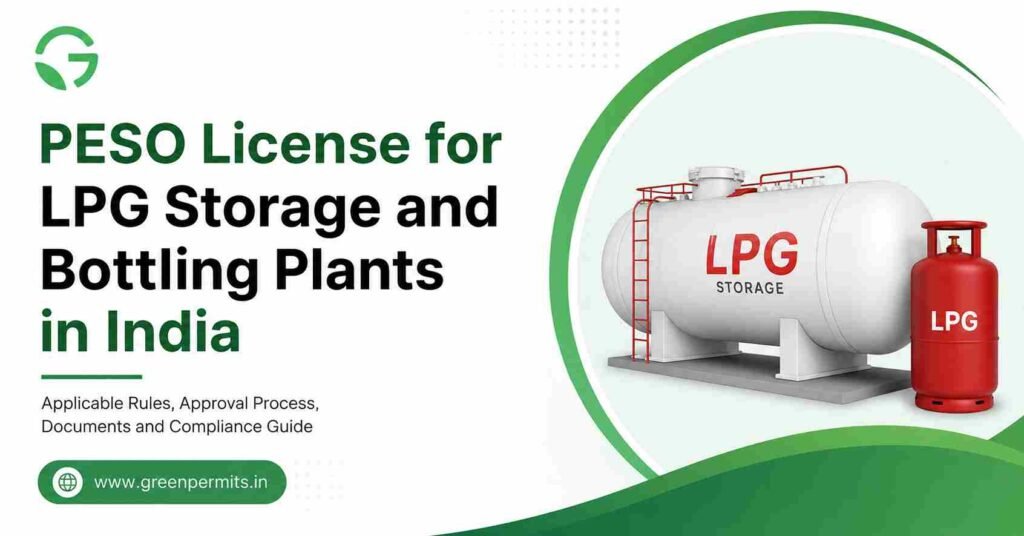
An LPG storage and bottling plant normally combines bulk LPG storage, tanker unloading, pressure piping, cylinder filling and storage of filled cylinders. Each activity carries a different safety risk and may require approval under more than one regulatory framework.
For project owners, plant managers and compliance teams, the objective should be clear – design the plant around the applicable safety requirements instead of attempting to adjust compliance after construction.
The Petroleum and Explosives Safety Organisation, commonly known as PESO, administers approvals for petroleum products, compressed gases, pressure vessels, explosives and other hazardous materials in India.
An LPG bottling plant receives liquefied petroleum gas in bulk, stores it in approved pressure vessels and fills the gas into cylinders for distribution. Depending on the project design, the plant may contain LPG storage bullets, tanker unloading bays, pumps, compressors, filling carousels, cylinder-storage sheds, pipelines and firefighting installations.
Since LPG is stored under pressure and is highly flammable, the installation cannot be operated like an ordinary manufacturing facility.
The regulatory system evaluates several technical and operational issues, including:
A PESO licence confirms that the regulated installation has been approved for the activities and capacity stated in the licence. It does not replace environmental consent, Fire NOC, Factory Licence or local building approval.
The principal regulatory framework depends on the activities carried out within the facility.
The Static and Mobile Pressure Vessels (Unfired) Rules, 2016 apply to the bulk LPG storage system and related pressure equipment.
These rules govern matters such as:
In practical terms, the LPG bullets or other static storage vessels form the bulk storage section of the bottling plant. Their capacity, location, fittings and distance from surrounding structures must conform to the approved installation plan.
The Gas Cylinders Rules, 2016 apply to operations involving LPG cylinders.
These may include:
A project may comply with the bulk storage requirements but still be unable to legally begin cylinder filling if the relevant cylinder-filling and storage permissions have not been obtained.
This dual-regulation structure is one of the most important points for an LPG bottling project.
Businesses often use the term PESO licence as though it refers to one permission covering the entire plant. In reality, different sections of the project may fall under separate permissions.
| Plant component | Primary compliance area | Purpose |
|---|---|---|
| LPG storage vessel | SMPV Rules | Safe bulk storage of LPG |
| Tanker unloading bay | SMPV Rules | Safe transfer of LPG from tanker |
| Pressure piping | SMPV Rules | Controlled movement of LPG |
| Cylinder-filling line | Gas Cylinders Rules | Authorised filling of cylinders |
| Filled-cylinder shed | Gas Cylinders Rules | Safe storage before dispatch |
| Empty-cylinder area | Gas Cylinders Rules | Inspection and segregation |
| Firewater system | SMPV and Fire requirements | Emergency protection |
| Vessel testing | SMPV Rules | Mechanical integrity |
A plant storing LPG only for captive consumption may have a different licence configuration from a commercial LPG bottling facility filling thousands of cylinders per shift.
The correct licensing route must therefore be determined from:
The land may appear adequate from a commercial or civil-construction perspective but may still be unsuitable for an LPG installation.
Safety distances are measured from specific equipment and structures, not merely from the centre of the plot. A large plot with an irregular shape may be less suitable than a smaller rectangular plot with clear boundaries and better access.
The site review should consider:
For LPG bottling plants, an important capacity threshold is 100 metric tonnes. Plants with storage exceeding 100 MT and plants below 100 MT may be assessed under different safety-distance tables.
This means that a planned increase from 90 MT to 120 MT is not merely a commercial capacity revision. It may change the applicable layout requirements and affect the entire installation.
Before purchasing land or freezing the layout, the project owner should complete at least 4 preliminary studies:
These checks can prevent costly redesign after the project has already committed capital.
| Regulation or approval | Main requirement | Stage | Main risk |
|---|---|---|---|
| SMPV Rules, 2016 | Bulk LPG storage approval | Before construction and operation | Layout rejection |
| Gas Cylinders Rules, 2016 | Cylinder filling and storage approval | Before filling begins | Operation cannot start |
| Rule 22 safety distances | Separation between regulated facilities | Planning stage | Vessel relocation |
| Rule 26 fire protection | Firefighting arrangements | Construction and operation | Inspection objection |
| Rule 19 testing | Periodic pressure-vessel testing | Operational stage | Vessel declared unsafe |
| Consent to Establish | Environmental approval before construction | Pre-construction | Project delay |
| Consent to Operate | Approval before production | Pre-operation | Production halt |
| Fire NOC | Fire safety approval | Construction and operation | Commissioning delay |
| Factory Licence | Factory compliance | Before operation | Labour and operational restriction |
No single approval in this table replaces another.
A Fire NOC does not grant permission for bulk LPG storage. A PESO licence does not automatically authorise environmental discharge. A Consent to Operate does not permit cylinder filling without the applicable PESO approval.
The first stage is to prepare a clear description of what the plant will actually do.
This should cover:
Many applications face delay because the applicant describes only the bulk storage section while the layout clearly shows cylinder filling and dispatch.
The project should define:
For example, a facility designed to fill 10,000 domestic cylinders per day will have different space, storage and handling requirements from a smaller industrial cylinder-filling unit.
Capacity should be realistic and supported by the equipment selected for the project.
A technical assessment should be carried out before finalising the property.
The study should verify:
The outcome should be a preliminary layout showing whether the desired capacity can be safely accommodated.
The PESO application depends heavily on the quality and consistency of the technical drawings.
The project may require:
The drawings should use consistent equipment numbers, dimensions and capacity values.
If one drawing shows 2 LPG vessels of 50 MT each while the application mentions a total capacity of 120 MT, the file is likely to attract a clarification.
The application is filed with the applicable company, land and technical documents.
At this stage, the authority may examine:
Technical observations must be answered clearly. A revised drawing should not change one dimension while leaving conflicting data in other documents.
Several approvals may proceed in parallel.
These commonly include:
The project schedule should account for each department separately.
After approval, the facility should be developed in accordance with the sanctioned layout.
This includes:
Material changes should not be made informally at the construction stage.
A 5-metre shift in a vessel location may appear minor to the civil contractor but may affect approved safety distances and require regulatory review.
Before commissioning, the applicant should compile all required testing and compliance records.
These may include:
The installed equipment should match the identification and capacity shown in the approved documents.
The inspection stage verifies whether the plant has been constructed and equipped according to the approved plan.
The inspection may focus on:
Any deviation may lead to a compliance observation or requirement for correction.
Bulk LPG storage and cylinder filling should begin only after the applicable final permission is available.
Project owners should avoid trial filling, commercial receipt or cylinder dispatch merely because the equipment is mechanically ready.
The exact list varies by project, but a complete application generally includes corporate, land and technical records.
| Stage | Typical planning period | Major dependency |
|---|---|---|
| Applicability assessment | 3 to 7 working days | Complete project scope |
| Land and layout assessment | 1 to 2 weeks | Survey and capacity |
| Engineering documentation | 2 to 4 weeks | Final equipment selection |
| PESO scrutiny | Case-specific | Quality of application |
| CTE and Fire approval | State-specific | Project report and drawings |
| Construction | Project-specific | Approved design |
| Testing and certification | 1 to 3 weeks | Mechanical completion |
| Inspection and final licensing | Case-specific | Closure of observations |
These are practical project-planning periods, not guaranteed statutory timelines.
A small installation with complete documents may move faster than a high-capacity bottling plant requiring several rounds of technical revision.
LPG safety cannot be reduced to placing a few portable extinguishers near the vessel.
A bottling plant requires an integrated firefighting and emergency-response system appropriate to the risk and storage capacity.
The system may include:
The plant should also maintain written emergency procedures for:
Personnel should receive periodic training and mock drills should be documented.
The pressure vessel is the central risk equipment in the installation.
Its compliance should be verified from the design stage through operation.
Important checks include:
Periodic testing is an operational requirement. A licence does not mean that the vessel remains approved indefinitely without examination.
Maintenance teams should track:
Most delays arise from planning and document inconsistencies rather than from the online filing itself.
Common problems include:
A technically complete application can reduce repeated queries, although it cannot guarantee approval.
A company planned a medium-scale LPG bottling plant with 2 storage vessels, a tanker unloading platform and a cylinder-filling shed.
The company purchased the land based on price, road connectivity and proximity to the target market. The pressure vessels were ordered before the regulatory layout was finalised.
During technical review, 3 major issues were identified:
The proposed correction required shifting both vessel foundations, changing approximately 60 metres of pipeline route and redesigning the fire hydrant network.
The project suffered additional civil, engineering and equipment costs. The expected commissioning date was also pushed back by several months.
The case demonstrates that regulatory design must come before procurement. The company could have avoided most of the loss by completing a preliminary layout and safety-distance assessment before ordering the vessels.
A PESO licence is tied to a specified site, activity, equipment and licensed capacity.
The licence holder should review whether prior approval or amendment is needed before making changes such as:
Renewal should be initiated before expiry with the required records and fee.
Operating with an expired licence can expose the business to enforcement and insurance risk.
Failure to obtain or maintain the required approvals can affect the entire project.
Possible consequences include:
The commercial impact may be much higher than the application cost. A bottling plant with installed equipment but no operational licence continues to incur interest, manpower, lease and security expenses without generating revenue.
Early compliance planning improves both safety and financial control.
Before committing major capital, the project should confirm:
A structured compliance plan also helps the procurement team include appropriate technical and certification conditions in equipment purchase orders.
A PESO License for LPG Bottling Plant is not simply an online application submitted before commissioning. It is a technical approval process covering land suitability, storage capacity, safety distances, pressure vessels, cylinder filling, firefighting systems and operational controls.
The most expensive compliance problems usually begin before the application is filed. They arise when land is purchased without a safety-distance study, vessels are ordered before capacity approval or civil construction begins without an accepted layout.
For an LPG storage and bottling project, early regulatory planning can protect the investment, reduce redesign and support faster commissioning.
The recommended sequence is straightforward:
Careful documentation and consistent engineering data are essential at every stage.
📞 +91 78350 06182
📧 wecare@greenpermits.in
👉 Book a Consultation with Green Permits