
A manufacturing company was preparing to commission a new facility. The DG sets were installed, electrical work was almost complete, and the project team had planned a 20 KL High Speed Diesel storage tank near the utility block.
From an engineering point of view, the arrangement looked straightforward. The diesel would only be used for backup power inside the factory. There was no retail sale and no public fuel station.
The team therefore assumed that installing the tank and obtaining a basic fire approval would be enough.
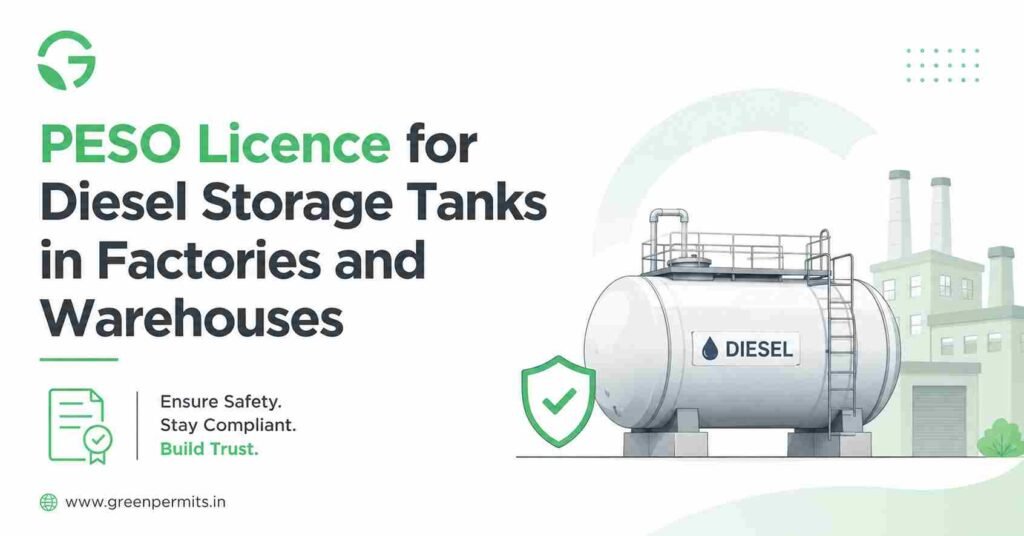
During the compliance review, however, one important question came up: Can the company legally store 20 KL of diesel in this tank without obtaining the required petroleum storage approval?
The answer was no.
Diesel storage in factories, warehouses, data centres, hospitals, industrial plants and logistics facilities can fall under the Petroleum Act, 1934 and Petroleum Rules, 2002. Depending on the storage quantity, individual tank capacity, installation design and intended use, a PESO licence for diesel storage tank may be required before petroleum is stored.
For many businesses, the problem is not that they intentionally ignore the rules. The problem is that diesel tanks are often treated as ordinary utility equipment instead of regulated petroleum-storage installations.
That difference can become important when the factory is close to commissioning.
PESO stands for Petroleum and Explosives Safety Organisation. It regulates activities involving petroleum, compressed gases, explosives and certain other hazardous substances under the applicable laws and rules.
High Speed Diesel, commonly called HSD, falls within the petroleum regulatory framework.
When diesel is stored in a factory or warehouse, businesses need to determine whether the proposed quantity and storage arrangement require licensing.
A typical industrial diesel installation may include:
The licence requirement should therefore be examined for the entire installation rather than looking only at the tank capacity.
No.
But one of the biggest mistakes businesses make is assuming that all diesel storage below 2,500 litres is automatically exempt.
The Petroleum Act provides an exemption for possession of Petroleum Class B where the total quantity stored at one place does not exceed 2,500 litres, provided that no individual receptacle exceeds 1,000 litres capacity.
Both conditions matter.
For example, consider these 2 situations.
A facility stores:
The total is below 2,500 litres and each receptacle is below 1,000 litres.
Subject to the actual storage arrangement and other applicable requirements, the statutory exemption may be relevant.
Another facility stores:
Although the total quantity is below 2,500 litres, the individual receptacle exceeds 1,000 litres.
Therefore, the company should not simply rely on the 2,500-litre exemption.
This distinction is extremely important for factories because industrial diesel tanks are commonly larger than 1,000 litres.
For petroleum-storage purposes, the distinction between bulk and non-bulk storage becomes important.
A tank or receptacle exceeding 1,000 litres generally falls into bulk-storage considerations under the Petroleum Rules framework.
This means a company planning a 5 KL, 10 KL, 20 KL or 50 KL diesel tank should not ask only:
“Is our total diesel below the exemption limit?”
The more useful questions are:
These questions should ideally be answered before the purchase order for the tank is issued.
Another common area of confusion is the licence form.
Some websites simplify the difference by saying Form XV is for captive use while Form XIV is for commercial use. That is not an accurate way to classify every installation.
The actual use of the tank and dispensing arrangement matters.
Form XV relates to importing and storing petroleum in an installation.
For a typical manufacturing plant or warehouse storing HSD for stationary equipment such as:
Form XV is commonly the relevant licence route, subject to the exact installation.
Form XIV specifically relates to storage of petroleum in tanks connected with pump outfits used for fuelling motor conveyances.
This becomes relevant where diesel is dispensed to:
A factory should therefore not select the licence form only on the basis that the diesel is being used internally.
The entire fuel-storage and dispensing system needs to be examined.
A major practical mistake is purchasing the diesel tank first and thinking about licensing later.
The Petroleum Rules provide for prior approval of specifications and plans for installations covered under relevant licence forms.
For industrial projects, this means the tank position is not simply an internal engineering decision.
The layout may need to identify several elements, including:
Protected works within approximately 100 metres can become relevant in the layout examination.
If civil foundations are completed before regulatory review, the business may later discover that the proposed location needs modification.
Relocating a 20 KL or 50 KL tank after foundations, piping and electrical work have been completed can be significantly more expensive than reviewing the layout before construction.
Although the exact workflow depends on the installation, a typical factory or warehouse project can be planned in the following sequence.
The company should first document the proposed maximum inventory.
For example:
Tank capacity – 20 KL
Number of tanks – 1
Product – HSD
Purpose – DG set operation
Tank type – Aboveground
Vehicle dispensing – No
This simple data set can help determine the likely regulatory route.
Before finalizing the tank foundation, the site should be checked for practical and regulatory feasibility.
Review should include:
This stage can prevent major redesign later.
The installation drawing should clearly represent what will actually be constructed.
The submission may include details of:
Accuracy matters because the final installation should remain consistent with the approved arrangement.
For relevant installations, prior approval of the specifications and plans is required before moving ahead with the licensed premises.
The scrutiny fee prescribed for approval of specifications and plans under the applicable framework is Rs 2,000.
This amount is different from the licence fee.
Businesses should therefore separate:
Combining everything into one “PESO fee” can create confusion during budgeting.
Depending on the licence and authority involved, a No Objection Certificate from the District Authority may form part of the approval process.
The NOC examination can involve several local considerations.
These may include:
The prescribed framework directs the authority to process the NOC inquiry as expeditiously as possible and within a period that may extend up to 3 months.
However, businesses should not treat this as a guaranteed project completion timeline.
Actual processing can depend on:
A business planning commissioning should therefore begin the petroleum-storage approval process well before the expected first diesel filling.
Once the required approvals are available, the project should be executed according to the sanctioned specifications.
Typical installation work may include:
Changing the tank location casually during construction can create problems later.
If there is a material change, the approval implications should be reviewed before execution.
A petroleum tank is not considered ready simply because fabrication and installation are complete.
After installation in its final position, the tank may need testing under the applicable requirements before petroleum is stored.
Testing becomes especially important:
The required certificate should be issued by the appropriately recognised competent person or authorised inspection agency as applicable.
Before petroleum is stored for the first time, the installation must be reviewed for safety compliance under the applicable provisions.
This is a particularly important stage because many businesses assume:
“Tank installed means tank ready for diesel.”
That is not necessarily correct.
The installation may still require verification of:
Only after the applicable licensing requirements are completed should the business proceed with petroleum storage.
The exact document list depends on the licence category and installation, but businesses should generally prepare their documentation in 4 groups.
The information appearing across the documents should remain consistent.
For example, the same:
should appear consistently throughout the submission.
The government fee should not be confused with the total cost of setting up a compliant diesel-storage installation.
For Form XV, the prescribed licence fee structure includes:
Rs 5,000 for the first 50 KL for each class of petroleum for each calendar year.
For capacity above 50 KL:
Rs 50 is added for each additional KL or part thereof.
The fee is subject to the prescribed maximum of Rs 50,000 per calendar year or part thereof.
Suppose a company proposes a 60 KL Class B installation.
The calculation would broadly be:
First 50 KL – Rs 5,000
Additional 10 KL – 10 x Rs 50 = Rs 500
Indicative licence fee – Rs 5,500 per calendar year
This does not represent the complete project cost.
Other expenditure can arise from:
Government fees should always be rechecked before filing because fee schedules can be amended.
Under the Petroleum Rules framework, relevant licences can generally be granted or renewed up to a maximum period of 3 years, subject to the applicable licence conditions and fee payment.
Businesses should maintain a compliance calendar rather than waiting until the last month.
A practical internal system should track:
A missed renewal can create unnecessary operating risk.
Diesel may have a higher flash point than more volatile petroleum products, but storage installations still require disciplined safety controls.
For relevant bulk-storage installations, electrical earthing connections may need periodic inspection and testing.
The applicable framework includes testing at least once every 12 months for covered installations.
The facility should preserve the testing record at the licensed premises.
This is a good example of why PESO compliance does not end when the licence certificate is issued.
Operational compliance continues throughout the life of the installation.
Several problems can be prevented if the compliance team is involved early.
Common mistakes include:
Most of these are planning problems rather than complex legal problems.
They become expensive only when discovered late.
Consider a manufacturing company planning a new 20 KL aboveground HSD tank for 2 emergency DG sets.
The company initially assumes that because diesel is only for captive consumption, the tank can be installed without a petroleum-storage licence.
During the compliance review, 3 important facts become clear.
First, the tank capacity is 20,000 litres, far above the 1,000-litre individual receptacle condition associated with the small Class B exemption.
Second, the tank will permanently form part of the factory utility installation.
Third, diesel cannot simply be filled immediately after mechanical installation.
The project therefore needs to be approached in a sequence:
The case demonstrates why compliance should begin before tank procurement rather than during factory commissioning.
This is an illustrative case study and not a representation of a specific Green Permits client.
Before applying for a PESO licence for diesel storage tank, the factory or warehouse team should confirm the following:
If 2 or 3 of these answers are still unclear, the project is probably not ready for filing.
A company should not rely only on the total 2,500-litre figure. The Class B exemption also contains a condition concerning the capacity of individual receptacles. A single 2,000-litre tank exceeds 1,000 litres, so the installation needs a proper licensing assessment.
Not necessarily. Total petroleum quantity stored at the premises and the entire storage arrangement must also be considered.
For a fixed petroleum-storage installation serving stationary factory equipment, Form XV is commonly relevant. However, the actual configuration must be reviewed before selecting the licence.
Form XIV relates to storage connected with a pump outfit used for fuelling motor conveyances. A facility dispensing diesel to vehicles should therefore undergo a different applicability review.
This approach can create unnecessary risk. Layout and prior-approval requirements should ideally be reviewed before tank foundation, positioning and major civil work.
No. Fire-related approval and petroleum-storage licensing serve different regulatory purposes. One should not automatically be treated as a substitute for the other.
No. Applicable separation and layout requirements depend on the type of installation, tank arrangement and licence conditions. Avoid using one generic distance for every project.
A diesel storage tank may appear to be a small part of a large industrial project, but regulatory planning around it should begin early.
The most important decision is not simply whether the company needs “PESO registration.”
The project team must understand:
For a factory planning a 10 KL, 20 KL, 50 KL or larger HSD installation, reviewing these points before procurement can prevent redesign, delayed commissioning and repeated documentation.
Green Permits can assist factories, warehouses, industrial plants, data centres and commercial facilities with PESO diesel-storage applicability review, document-gap assessment, layout coordination and licence-application support.
📞 +91 78350 06182
📧 wecare@greenpermits.in
👉 Book a Consultation with Green Permits