
A manufacturing unit has a valid Consent to Operate for 10,000 tonnes per year. Demand improves, management approves another production line and the plant team plans to increase capacity to 15,000 tonnes.
At this stage, a common question appears: Can the company simply apply for a CTO amendment showing 15,000 tonnes, or does it need Consent to Establish again?
For a genuine capacity expansion, the answer is usually not simply CTE or CTO. The approvals address different stages.
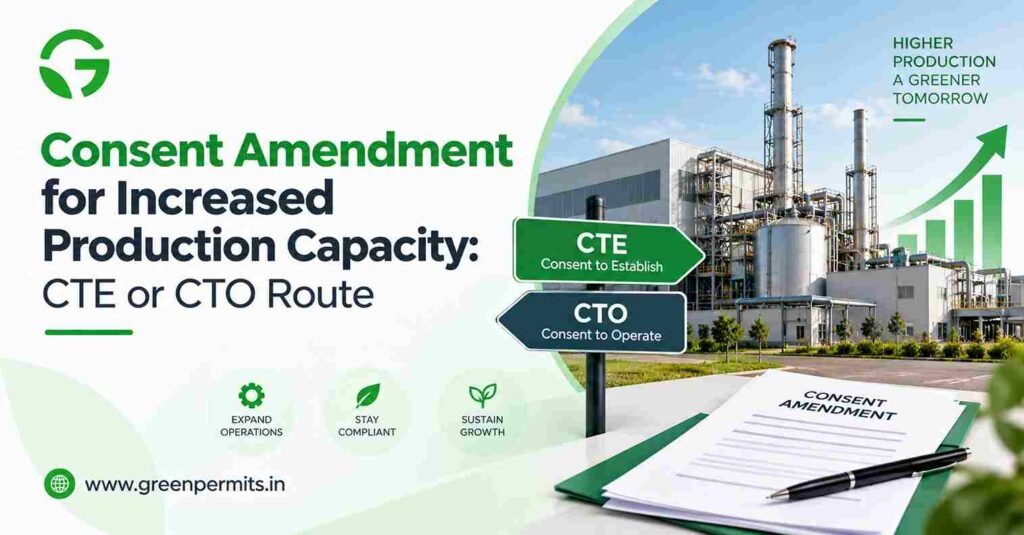
CTE for expansion deals with the proposed change before the expanded plant is commissioned. CTO for expansion or amendment deals with permission to operate the plant after that expansion has been implemented. The exact portal terminology and procedure can vary by State Pollution Control Board, so the existing consent orders and applicable state procedure must be checked before work begins.
For most industrial expansion cases, think of the process this way:
| Situation | Likely consent action |
|---|---|
| Capacity increase is only being proposed | Review and obtain CTE for expansion where applicable |
| New machinery or production line will be installed | CTE for expansion should normally be addressed before commissioning |
| Expansion has been installed under approved CTE | Apply for CTO for expansion/amendment before operating expanded capacity |
| Existing CTE already approves the proposed higher capacity but CTO is for a lower capacity | CTO expansion/amendment may be the next consent step, subject to the State Board’s requirements |
| Product, process, fuel, wastewater or emission load is also changing | Reassess CTE, EC and other approval requirements |
| Capacity was already increased without approval | Do not treat it as a routine amendment – assess the compliance gap with the concerned Board |
The terminology may differ between states. Maharashtra commonly refers to Consent to Establish for expansion, Gujarat may use CTE and CCA terminology, while other Boards may provide separate amendment or expansion options on their portals.
The legal purpose matters more than the portal label.
The Consent to Establish stage is not restricted to a completely new factory.
The Control of Air Pollution Consent Guidelines, 2025 provide that an application for CTE also applies in the case of expansion, modernisation, change of products or process before commissioning of the industrial plant. The corresponding Water Consent Guidelines contain the same basic expansion principle.
The Water Act is particularly relevant because Section 25 expressly refers to an industry, operation, process, treatment system or an extension or addition thereto where the statutory discharge conditions apply.
This makes capacity expansion more than an administrative change when it affects the physical or pollution profile of the facility.
For example, increasing output may require:
These changes need to be assessed before they are implemented rather than after expanded production begins.
CTO addresses the operational stage.
Under the 2025 Air Consent Guidelines, once the industrial plant has been established with the requisite pollution-control systems and is ready to operate, the occupier must obtain Consent to Operate.
The 2026 amendments make the expansion route even clearer by specifically identifying “consent to operate for expansion or amendment.” The central guidelines prescribe decision periods of 90 days for Red-category applications, 60 days for Orange and 30 days for Green, calculated under the applicable framework for complete applications.
This does not mean an industry can bypass CTE and first install the expansion.
Instead, the two approvals normally perform different functions:
CTE expansion: approval for what the company proposes to establish.
CTO expansion: approval to operate what has subsequently been established.
A useful internal control is therefore to prevent expanded commercial production until the CTO scope has been updated to the approved capacity.
Potentially, yes – but only after reviewing the approvals already held by the unit.
Consider a factory whose CTE was originally granted for 20,000 tonnes per year, but it initially installed only part of the plant and obtained CTO for 12,000 tonnes per year.
If the proposed next phase is already fully covered by the valid CTE, EC and approved technical configuration, the immediate regulatory requirement may be CTO for the additional approved capacity rather than another CTE.
But that conclusion should not be made from the capacity number alone.
The company should compare the proposed configuration against the existing CTE for:
If the expanded project falls outside what the CTE approved, the CTE stage needs to be addressed.
A Pollution Control Board consent amendment does not automatically cover Environmental Clearance requirements.
If the project is included in the Schedule to the EIA Notification, 2006, the company should separately assess whether the proposed capacity expansion, modernisation or product change requires prior EC or amendment to the existing EC.
Para 7(ii) of the EIA Notification addresses expansion and modernisation of existing scheduled projects. Certain changes may require prior EC, while specific exemptions can apply in some sectors where the prescribed conditions – including pollution-load conditions – are satisfied.
The practical sequence for an EC-applicable industry may therefore be:
EC applicability/amendment -> CTE for expansion -> installation -> CTO for expansion.
This check should happen before the machinery order or project execution if possible.
Do not start with the portal.
First record exactly what the existing approvals permit:
| Parameter | Existing approval | Proposed expansion |
|---|---|---|
| Production capacity | Current consent | Revised capacity |
| Products | Current list | Proposed list |
| Machinery | Existing | Additional |
| Water | Approved KLD | Revised KLD |
| Effluent | Approved KLD | Revised KLD |
| Fuel | Existing | Proposed |
| Air sources | Existing | Additional |
| Hazardous waste | Existing | Revised |
| Capital investment | Current | Post-expansion |
This comparison usually reveals whether the proposed project is inside or outside the approved consent envelope.
If the proposed production increase requires establishment, extension, additional machinery or changes to the approved process, assess the CTE expansion route before commissioning the change.
The actual application category and documentation should then be checked against the relevant SPCB or PCC procedure.
Expansion may also affect Environmental Clearance, hazardous waste authorization, groundwater permission, Factory Licence, Fire NOC, waste-specific registrations or other approvals.
The pollution consent application should not be prepared in isolation.
The Board needs to understand the environmental effect of the expanded facility, not only the existing plant.
The technical package should therefore compare existing and proposed water balance, material balance, fuel requirement, emissions, wastewater, solid waste, hazardous waste and pollution-control capacity.
Once the applicable establishment approval has been obtained, machinery and pollution-control systems should be installed according to the approved configuration.
A capacity increase without corresponding treatment or emission-control capacity can create a major problem at the CTO stage.
After the approved expansion is physically ready, the company should file the applicable operational consent application.
The Board may examine whether:
Expanded production should remain within the capacity eventually covered by the operating consent.
The exact state checklist can differ, but the technical file will commonly require the existing approvals together with updated project information.
Important documents can include the existing CTE and CTO, proposed-vs-existing capacity statement, revised project report, process-flow diagram, machinery list, plant layout, material balance, water balance, fuel details, emission-source assessment, wastewater details, pollution-control proposal, capital-investment evidence and applicable EC or authorization documents.
The most important principle is consistency.
If the project report says 15,000 tonnes, the machinery list says 18,000 tonnes and the EC says 12,000 tonnes, an online consent application cannot solve the underlying approval mismatch.
For some regulated waste facilities, the CTO capacity becomes important for other regulatory registrations.
CPCB’s October 2024 SOP for E-Waste Recyclers requires the recycler to provide both CTE and CTO details and records the recycling capacity in tonnes per year “as per CTO.”
This means an e-waste recycler should not view the SPCB capacity amendment as an isolated approval.
If the plant expands from 3,000 TPA to 6,000 TPA, the company should also examine whether CPCB portal data, waste authorization and other capacity-linked approvals need corresponding amendment.
The same principle should be checked under the specific regulatory framework applicable to other waste streams rather than assuming that one waste-management rule follows another.
One frequent mistake is installing new machinery first and asking the consultant to “add it in CTO” later. That reverses the regulatory sequence where prior establishment approval was required.
Another is assuming that no CTE is necessary because the increase does not generate additional wastewater. Capacity, machinery, air emissions, fuel, process, waste generation and existing approval conditions still need review.
Companies also sometimes renew an old CTO without disclosing a physical expansion. A routine continuation filing should not be used to conceal or regularise an unapproved change.
Finally, businesses often forget to compare the Pollution Control Board capacity with Environmental Clearance, Factory Licence and waste-registration capacity. The plant should ideally have one reconciled regulatory capacity matrix.
Consider an existing manufacturing plant with a CTO for 10 tonnes per day.
Management proposes to increase production to 18 tonnes per day by installing another processing line. The expansion increases electricity use, water consumption from 8 KLD to 12 KLD and wastewater from 3 KLD to 5 KLD.
The correct assessment would not begin with “file a CTO amendment.”
First, the existing CTE and any EC would be checked to determine whether 18 TPD and the additional line are already approved.
If they are not, the proposed expansion would ordinarily be addressed at the establishment stage first. The updated water balance, machinery, effluent treatment and pollution-control arrangements would form part of the expansion assessment.
After the plant is installed in accordance with the applicable approval, the company would proceed with CTO for the expanded configuration before operating at 18 TPD.
This example is illustrative. Actual approval requirements depend on the industrial activity, state procedure, pollution category and existing consent conditions.
Before increasing production, management should be able to answer these questions:
If several answers are unclear, the expansion should be reviewed before installation starts.
Not automatically in every factual situation, but a proposed capacity expansion needs CTE assessment. The central consent guidelines expressly place expansion, modernisation and product/process changes within the CTE framework before commissioning. Whether a fresh CTE, expansion CTE or another state-specific route applies depends on the existing approvals and proposed change.
Only where the underlying establishment approval already covers the proposed project or where the competent Board’s applicable procedure permits that route. A CTO amendment should not normally be used to bypass an establishment approval that was required before the physical expansion.
Where the machinery forms part of an expansion requiring prior CTE, installation before approval creates compliance risk. The applicable state procedure and existing consent conditions should be checked before implementation.
The company should not assume that a routine renewal or amendment automatically regularises the situation. The existing approvals, actual expanded configuration and state-specific regulatory route should be reviewed immediately.
Not necessarily. “No increase in pollution load” can be relevant to Environmental Clearance provisions in particular circumstances, but consent applicability under the Water Act, Air Act, applicable guidelines and existing consent conditions still needs separate examination.
For increased production capacity, the key question is not simply whether to choose CTE or CTO.
A proposed expansion is generally examined first from the CTE or establishment stage, while permission to operate the completed expansion is dealt with through the applicable CTO expansion or amendment route.
The exception is where the proposed higher capacity and plant configuration are already covered by the existing establishment approvals. That is why the first document to review should be the current CTE, CTO and EC – not the online application form.
Green Permits can review the existing consent scope against the proposed expansion and identify whether CTE expansion, CTO amendment, EC amendment or related authorization changes need to be addressed.
📞 +91 78350 06182
📧 wecare@greenpermits.in
👉 Book a Consultation with Green Permits