
A promoter may find a pyrolysis reactor supplier, identify plastic waste at an attractive price and calculate a promising oil yield within a few weeks.
The project can still stop at the Pollution Control Board.
The difficult questions usually begin after that: What exact plastic will enter the reactor? Is the output going to be burned as oil or converted into feedstock for new plastic? What happens to the non-condensable gas? Where does the carbon-rich residue go? What emission-control system has been designed? Is the proposed oil tank covered by the fire and storage approvals? Does the machinery capacity match the capacity applied for in the Consent to Establish?
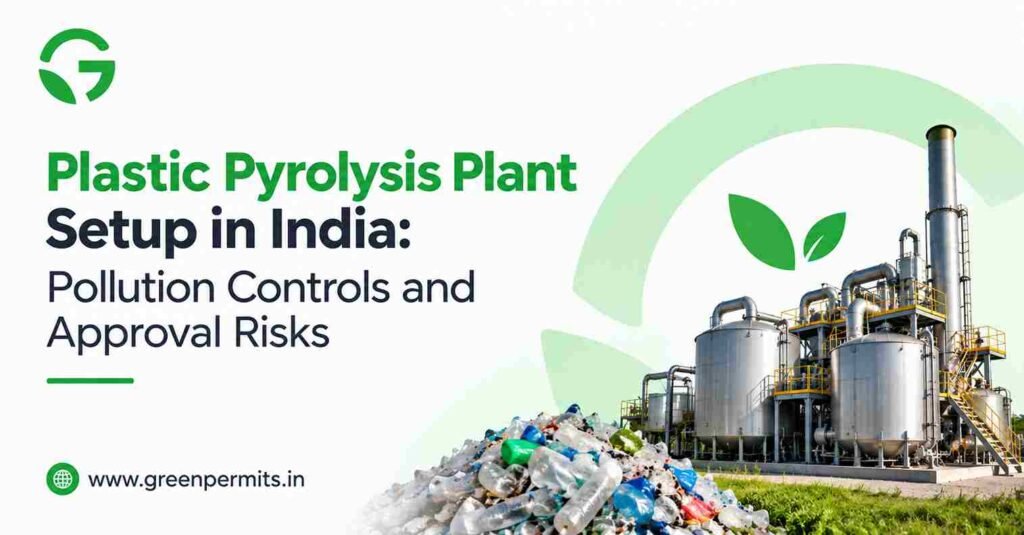
These issues make plastic pyrolysis plant setup in India as much a regulatory-engineering project as a machinery project.
For investors entering this sector in 2026, there is another important issue. The Plastic Waste Management Rules now make a regulatory distinction between conventional waste-to-oil and processes in which plastic is converted into feedstock chemicals for producing new plastic. That distinction should be resolved before the DPR, consent application and machinery configuration are finalised.
Plastic pyrolysis uses heat in an oxygen-restricted environment to break plastic polymers into smaller hydrocarbon fractions.
Depending on the technology and feedstock, the process can generate:
A typical system may therefore contain more than a reactor. It can involve feed preparation, shredding, reactor feeding, thermal conversion, condensers, gas handling, pollution-control equipment, oil storage, residue handling, cooling systems and fire-safety infrastructure.
CSIR-CMERI, for example, describes a polymer-waste pyrolysis system comprising equipment such as a reactor, condenser, oil and gas storage, cooling tower and shredder.
But a technically functional reactor does not automatically make the plant approvable.
This is one of the most important questions to resolve before preparing the project file.
The Plastic Waste Management (Amendment) Rules, 2026, notified through G.S.R. 237(E) on 31 March 2026, revised the regulatory framework for end-of-life disposal. Waste-to-oil used for energy-recovery purposes falls within end-of-life disposal. The amendment simultaneously provides an important exception where plastic waste is converted into feedstock chemicals or material for production of new plastic. That route is treated as recycling.
| Project route | Regulatory treatment to examine |
|---|---|
| Plastic waste converted to pyrolysis oil for energy/fuel use | Generally an end-of-life disposal route |
| Plastic waste converted into feedstock chemicals used to produce new plastic | Can fall under recycling under the 2026 definition |
This distinction should not be decided merely by changing terminology in the DPR.
The promoter should be able to demonstrate:
Practical recommendation: settle this classification before filing the CTE. A project described as chemical recycling in one document and fuel-oil production in another can create avoidable questions during consent and PWP scrutiny.
There is no single “plastic pyrolysis licence” that replaces all other approvals.
The exact approval package depends on the state, plant capacity, land, feedstock, output, storage configuration, workforce, utility systems and waste streams.
A typical project should screen the following.
| Approval / compliance | Typical relevance |
|---|---|
| Industrial land-use or zoning | Before site finalisation |
| Consent to Establish – CTE | Before establishment/installation where applicable |
| Consent to Operate – CTO | Before operation |
| Plastic Waste Processor registration | Core PWM/EPR requirement for covered PWP activity |
| Hazardous and Other Waste authorization | Where applicable to the plant and generated waste |
| Factory approval/licence | Depending on applicable factory law thresholds |
| Fire NOC / fire approval | Depending on state/local requirements and storage |
| PESO or petroleum-storage approval | If product classification, flash point, storage type and quantity trigger it |
| Building-plan approval | As applicable |
| Electricity / electrical-safety approval | Depending on connection and installation |
| Groundwater permission | If groundwater extraction is proposed and requires authorization |
| Environmental Clearance | Only after project-specific EIA Notification applicability screening |
The Water Act restricts establishment of applicable industrial operations or disposal systems likely to make specified discharges without previous State Board consent.
The current Air consent framework also provides for applications to establish or operate applicable industrial plants under Section 21.
This distinction is commonly blurred online.
CTE and CTO are Pollution Control Board consents.
Environmental Clearance, where applicable, operates under the EIA framework and should be separately screened.
A promoter should therefore not write “EC from SPCB” in a compliance plan and assume the requirement has been addressed.
A safer sequence is:
1. Feedstock and product definition
↓
2. Legal classification of process
↓
3. Land and siting due diligence
↓
4. DPR + process flow + mass balance
↓
5. Pollution-control and fire-safety design
↓
6. CTE application
↓
7. Civil work and machinery installation in accordance with consent
↓
8. Trial/commissioning readiness and required testing
↓
9. CTO
↓
10. PWP/Common EPR registration and applicable audit/verification
↓
11. Commercial processing within approved capacity and conditions
Buying the reactor before Steps 1 to 6 can reverse the proper project-development sequence.
CPCB’s Plastic Waste Processor SOP historically recognised a separate process classification:
E4 – End-of-life plastic waste processing in Waste-to-Oil Units.
The SOP required applicants to align their selected process code with the process-flow diagram, machinery, processing capacity, production capacity and other supporting details. It also sought pollution-control information and geotagged plant evidence.
The document checklist included items such as:
However, applicants should note that the SOP predates the 2026 amendments and the portal migration.
CPCB discontinued operational use of the old Plastic EPR Portal from 28 June 2026 and migrated registered-unit data to the Common EPR Portal.
The current filing route should therefore be checked on the Common EPR Portal rather than relying on old screenshots, blogs or 2022 portal instructions. CPCB Common EPR Portal
A pollution-control plan should follow the entire material flow instead of focusing only on a chimney.
Incoming plastic can create litter, dust, odour, contaminated runoff and fire load.
The facility should establish:
A project planning to accept “all plastic waste” without understanding polymer composition creates both process and regulatory risk.
Chlorine-rich or otherwise unsuitable fractions can introduce additional corrosion, emission and residue-management problems. Feedstock restrictions should therefore form part of the technology design rather than being decided after commissioning.
Shredding can generate dust, lightweight plastic fragments and noise.
Depending on the feedstock and equipment, controls can include:
The SPCB application should show where shredding takes place rather than representing the plant only as a reactor and oil tank.
The reactor is the highest-risk section from a process-safety perspective.
A robust engineering package should address:
These are practical engineering recommendations. The exact instruments, interlocks and design standards should be selected by the process designer and should match the conditions imposed by the concerned authority.
A weak condensation system can turn an oil-recovery problem into an air-pollution problem.
The project should document:
The condenser should be sized against actual design throughput, not merely the nameplate reactor capacity.
Non-condensable gas should not simply be shown as “gas released” in the process diagram.
The design should demonstrate how it is:
The CTE application should also explain what happens during start-up, shutdown and emergency conditions when normal gas reuse may not be available.
Exact air-pollution-control equipment, stack requirements and monitoring conditions should come from the applicable consent and regulatory requirements rather than from a generic machinery supplier.
An actual TNPCB consent for a plastic-pyrolysis unit, for example, required a scrubber system, odour-control measures, defined plastic feedstock and additional safety compliance.
That example demonstrates the type of scrutiny a plant may receive. It should not be copied as a universal CPCB specification for every state or capacity.
Once condensable product is recovered, the project acquires a storage and fire-risk dimension.
Before the tank farm is designed, determine:
Whether PESO approval is required should be established from the actual product characteristics, tankage and applicable rules. It should not be assumed automatically either way.
One of the most common weak points in a DPR is a line such as:
“Carbon black will be sold.”
The authority may reasonably ask what the material actually is.
The project should establish:
Do not automatically classify every pyrolysis residue as either valuable carbon black or hazardous waste.
Characterisation and the applicable consent/waste rules should determine the disposal or utilization route.
A plant promoted as a “dry process” can still generate wastewater from:
The water balance should therefore account for each stream.
The DPR should show:
Fresh water -> process/use point -> wastewater generation -> treatment -> reuse/disposal
Saying “zero liquid discharge” without a technically supported water balance and treatment scheme can weaken rather than strengthen an application.
| Risk | Why it creates a problem | What should be fixed |
|---|---|---|
| 1. Wrong land or industrial zoning | Activity may not be acceptable at site | Conduct land-use due diligence before purchase |
| 2. Project called “recycling” while oil is burned | Conflicts with 2026 classification | Define actual output and end use |
| 3. Feedstock simply stated as “plastic waste” | Pollution profile cannot be evaluated | Prepare polymer/feedstock specification |
| 4. Reactor capacity differs from CTE/DPR | Creates capacity and mass-balance discrepancy | Freeze capacity before consent filing |
| 5. Weak non-condensable gas plan | Creates emission and fire concern | Show closed gas handling and treatment/reuse |
| 6. Pollution controls added after reactor purchase | Equipment may not match approved load | Engineer APCD with process design |
| 7. No credible residue route | Char/sludge can accumulate illegally | Characterise and document authorized outlets |
| 8. Oil tank farm ignored in approval planning | Fire/storage licences may be missed | Complete product and storage screening |
| 9. PWP data differs from CTO | Registration evidence becomes inconsistent | Keep one controlled master dataset |
| 10. EC applicability never checked | Can create a major project-level regulatory gap | Complete an EIA applicability screening |
A pyrolysis project should be capable of explaining what happens to 100% of incoming material.
An illustrative structure is:
Plastic feedstock input = liquid product + gas + solid residue + moisture/other losses or recoverable fractions
The actual percentages should come from validated technology data, pilot trials, vendor guarantees or technically defensible studies.
Do not insert an attractive internet yield percentage into a DPR simply to improve the projected financial return.
The material balance connects directly with:
CPCB’s PWP SOP also expects plant machinery, power load, process code and processing capacity to be compatible with one another.
The cheapest industrial plot is not necessarily the cheapest project site.
Before committing money, review:
CPCB’s revised industrial categorisation framework applies a pollution-potential methodology, while state boards implement consent requirements and may impose activity-specific conditions.
For this reason, the article should not claim a universal national “minimum land area” or a single consent category for every plastic-pyrolysis plant.
Do not assume “yes,” and do not assume “no.”
Environmental Clearance under the EIA framework is different from CTE/CTO.
The project should be screened against:
If EC is triggered, the approval sequence should be planned accordingly.
For projects where EC is not independently triggered, CTE/CTO and the waste-management approvals still remain separate compliance issues.
Production of waste-to-oil under the Plastic Waste Management framework does not by itself answer every legal question concerning sale, storage or end use of the resulting oil.
Before building project revenue around oil sales, establish:
A long-term offtake arrangement based on an undefined product is a weak basis for a bankable DPR.
Where the commercial model instead uses pyrolysis output as petrochemical feedstock for producing new plastic, the 2026 PWM classification becomes especially important and the material route must be documented.
A realistic plastic pyrolysis project cost should not be represented by the reactor quotation alone.
A project budget may need separate provisions for:
There is no responsible single “plastic pyrolysis plant cost in India” without defining capacity, technology, feedstock and environmental-control scope.
Before ordering machinery, a promoter should be able to answer yes to most of the following:
If several of these questions remain unanswered, the project is generally not ready for machinery procurement.
State Pollution Control Board records demonstrate that pyrolysis projects are examined beyond the simple question of whether a reactor is available.
An APPCB case concerning a plastic-pyrolysis proposal raised questions about the proposed technology and land-use documentation before the CFE could proceed.
A TNPCB consent separately imposed process-specific conditions concerning plastic feedstock, pollution-control measures, odour and safety.
The practical lesson is straightforward:
The strongest application is one where land, feedstock, technology, mass balance, pollution controls, product route, waste disposal and statutory documentation tell the same story.
Green Permits can support a project from pre-investment review to environmental approval and registration.
The scope can include:
A consultant should not simply file forms after the machinery has been installed. The higher-value role is to identify approval risks before irreversible capital expenditure begins.
If you are planning a plastic pyrolysis or plastic waste-to-oil project, Green Permits can review the proposed capacity, site, feedstock, process, pollution controls and approval sequence before you commit to the plant.
📞 +91 78350 06182
📧 wecare@greenpermits.in
👉 Book a Consultation with Green Permits