
Two Bio-CNG plants of the same advertised capacity may require very different machinery.
A plant processing cattle dung does not need exactly the same feedstock preparation system as a project processing press mud, food waste, municipal wet waste or fibrous agricultural biomass. Similarly, a project supplying CBG through cascades may have a different downstream configuration from a project designed for pipeline injection.
This is why Bio-CNG plant machinery should not be selected simply by asking vendors for a “5 TPD CBG plant quotation.”
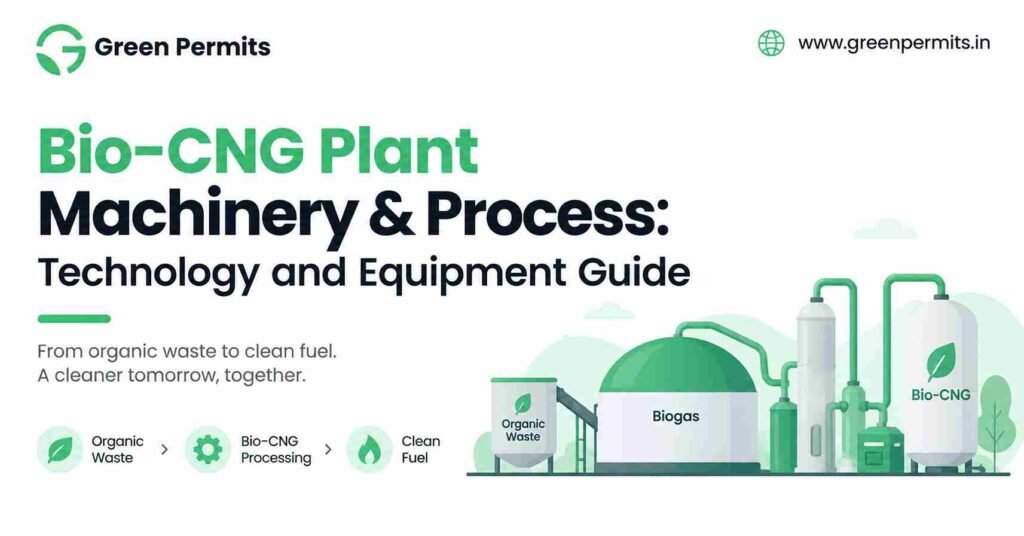
The correct sequence is to establish the feedstock characteristics, daily input, expected gas production, digestion technology, CBG delivery route, water balance and digestate management plan before freezing equipment capacities.
Indian technical guidance also treats a CBG facility as a complete system rather than only a digester and compressor. SSS-NIBE’s CBG training framework covers feedstock preprocessing, digestion, gas upgrading, compression, storage, instrumentation, digestate processing and safety as interconnected plant sections.
A commercial Bio-CNG or Compressed Biogas plant normally contains several interconnected machinery packages.
The exact equipment depends on the feedstock and project design, but the plant can broadly be divided into:
SSS-NIBE specifically identifies shredders, mixers, slurry tanks, solid and liquid feeding equipment, digesters, pumps, agitators, heat exchangers, solid-liquid separators, gas upgrading units, compressors, cascades, gas analysers, PLC/SCADA and related instrumentation as important CBG plant systems.
A simplified commercial process can be understood as:
Feedstock Receiving → Segregation/QC → Size Reduction → Mixing/Slurry Preparation → Feeding → Anaerobic Digestion → Raw Biogas → Gas Cleaning → Gas Upgrading → Quality Testing → Compression → CBG Storage/Dispatch
A second material stream moves simultaneously:
Digester Slurry → Solid-Liquid Separation → Manure/Digestate Processing + Liquid Management/Reuse
The process looks simple when shown in a flow diagram, but the engineering decisions at each stage influence the next stage.
For example, inadequate removal of foreign material at feed preparation can increase pump blockage and digester sedimentation. Poor biological stability can reduce gas generation. Weak H2S control can create problems for downstream gas-treatment equipment. An incorrectly sized upgrading unit can then become a production bottleneck even when the digester is operating properly.
The first section of the Bio-CNG plant handles the incoming biomass or organic waste.
Equipment can include:
The configuration must follow the material being processed.
Cattle dung can generally move into slurry preparation with comparatively simple handling. Municipal or commercial food waste may require greater segregation and contaminant removal. Agricultural biomass can require dedicated collection, storage and size-reduction infrastructure.
Feedstock quality parameters such as moisture, contaminants, total solids and volatile solids are important inputs when designing the preprocessing and digestion system. SSS-NIBE’s technical training framework therefore places feedstock assessment before digestion itself.
Preprocessing prepares the organic material for controlled digestion.
Depending on the project, machinery may include:
The purpose is not simply to make the waste smaller. The objective is to provide the digestion system with reasonably consistent feed.
Cattle dung: generally requires mixing, slurry preparation and pumping.
Press mud: requires controlled storage, feeding and appropriate moisture management.
Food waste: can require segregation, crushing, pulping and removal of plastics, metals or grit.
Agricultural biomass/Napier-type feed: can require chopping, shredding and more careful feed preparation.
Organic fraction of municipal waste: usually demands greater attention to sorting and contamination.
There is therefore no universally correct “standard preprocessing package.”
The digester is the biological centre of the plant.
During anaerobic digestion, microorganisms convert biodegradable organic material into biogas in the absence of oxygen.
The biological sequence is commonly described through four stages:
Hydrolysis → Acidogenesis → Acetogenesis → Methanogenesis
SSS-NIBE identifies these stages as part of CBG plant operation and also identifies CSTR, plug-flow and fixed-dome systems among digester configurations.
A commercial digestion section can include:
The technology should be selected from the characteristics of the biomass rather than from the name of the digester alone.
A Continuous Stirred Tank Reactor (CSTR) uses mixing to maintain relatively uniform conditions inside the digestion volume. It can suit slurry-type feed configurations where continuous process control and mixing are required.
A plug-flow configuration moves the material progressively through the digester and may be considered for different solids characteristics or process configurations.
Neither technology should automatically be called “better.” Technology selection should consider feedstock solids, biodegradability, pumping characteristics, required mixing, process stability, operating skills and the overall mass balance.
Gas leaving the digester is not automatically ready to be sold as Bio-CNG.
Before upgrading and compression, the plant has to manage contaminants and moisture that may affect downstream equipment or gas quality.
A gas-preparation section can contain:
SSS-NIBE specifically identifies CO2, H2S and moisture removal systems as part of commercial gas upgradation.
Gas cleaning should therefore be treated as an engineered process section, not an accessory added after the main plant is purchased.
Upgrading increases the biomethane concentration by separating carbon dioxide and managing other unwanted constituents.
Major technologies referenced in SSS-NIBE’s current CBG technical framework include:
Water scrubbing uses the different solubility behaviour of gas components to separate carbon dioxide and other contaminants from methane-rich gas.
Important engineering considerations can include:
Pressure Swing Adsorption uses adsorbent media and changes in pressure to separate gas components.
A package may include:
SSS-NIBE specifically includes hands-on PSA operation in its CBG technician curriculum.
Membrane systems use differences in gas permeation through specialized membrane material.
Typical evaluation parameters include:
Chemical absorption systems use a suitable solvent or chemical process to remove carbon dioxide.
The project’s chemical consumption, regeneration requirement, heat demand, corrosion management and effluent or spent-media handling need to be considered before selecting this route.
There is no technology that should be selected only because its initial machinery quotation is cheapest.
A proper comparison should examine:
| Parameter | What the Developer Should Check |
|---|---|
| Feed gas flow | Minimum, normal and maximum gas rate |
| Feed gas quality | CO2, H2S, moisture and other relevant constituents |
| Product requirement | Required final biomethane specification |
| Methane recovery | How much methane remains in the product stream |
| Electricity | Connected and operating load |
| Water | Requirement and treatment/recycle |
| Chemicals | Consumption and replacement |
| Maintenance | Spares and skilled manpower |
| Automation | PLC/SCADA and remote monitoring |
| Turndown | Performance at partial plant loading |
| Vendor guarantee | Clearly defined measurable parameters |
The project owner should ask the vendor to state each design assumption in the quotation.
Once the upgraded gas meets the required quality specification for its intended use, it can move to the compression section.
Typical equipment includes:
SSS-NIBE identifies CNG compressors, cascade systems, cylinder handling, storage-pressure considerations and gas dispensing/bottling operations as important CBG plant functions.
Compression capacity should be matched to actual upgraded-gas production. Oversizing can increase capital and operating burden, while undersizing can create a downstream bottleneck.
The final configuration depends heavily on how the CBG will be sold.
Possible project routes include:
Cascade dispatch: compressed gas is stored and transported through an appropriate cascade system.
Direct industrial use: gas may be supplied under a project-specific arrangement.
CGD or pipeline injection: requires a different interface, metering, gas-quality and network-integration configuration.
This delivery route should be fixed during feasibility and DPR preparation because it affects machinery, layout, compression requirements, safety planning and capital cost.
A Bio-CNG plant produces both gas and digestate.
Ignoring the digestate line during machinery selection is a significant project-design mistake.
Equipment can include:
SSS-NIBE includes solid-liquid separation, drying/centrifuge systems and bio-fertilizer handling within the CBG operating process.
The final route should be based on the actual quantity and characteristics of digestate and the applicable environmental and fertilizer requirements.
Modern CBG plants require much more instrumentation than a basic biogas installation.
Important systems can include:
NIBE identifies PLC/SCADA, pressure gauges, flow meters, temperature and level sensors, gas analysers and instrument calibration among the core O&M requirements for CBG plants.
Automation is especially valuable because biological digestion, gas upgrading and compression need to operate as one coordinated system rather than three independent packages.
CBG is a combustible gas, while parts of the plant can involve confined spaces, rotating machinery, electrical systems and pressurized equipment.
A project therefore requires engineering for:
SSS-NIBE’s current CBG training framework specifically covers gas-leak response, hydrants, extinguishers, fire systems, PPE and emergency drills. BIS also maintains IS 9478:2023 for the design, construction, installation and operation of biogas/biomethane plants.
Gas quality should not be defined only by a machinery supplier’s internal specification.
BIS currently identifies IS 16087:2025 – Biogas (Biomethane) Specification, Second Revision as the applicable Indian Standard in its petroleum-products standards programme.
Accordingly, the vendor guarantee should identify the intended end-use gas specification and the parameters the upgrading package is designed to meet.
A useful first-level technology matrix is:
| Feedstock | Important Machinery Consideration |
|---|---|
| Cattle dung | Slurry preparation, mixing and pumping |
| Press mud | Storage, controlled feeding and mixing |
| Food waste | Sorting, shredding/pulping and contaminant removal |
| Municipal wet waste | Strong segregation and pretreatment |
| Napier/energy crop | Chopping, shredding and controlled feeding |
| Crop residue | Aggregation, storage, size reduction and pretreatment |
| Mixed feedstock | Flexible preprocessing and careful biological control |
These are planning considerations rather than fixed regulatory prescriptions. Actual plant design should be based on feedstock testing and engineering calculations.
Before issuing a purchase order, ask the machinery supplier for at least:
A low machinery quotation may exclude several of these items, so comparing only the final quotation value can be misleading.
A technically sound Bio-CNG DPR should establish at least:
Feedstock → Input capacity → Mass balance → Gas generation → Digestate generation → Water balance → Process technology → Machinery sizing → Utilities → Layout → Pollution controls → Project cost
Only after these assumptions are aligned should the main equipment package be frozen.
This also reduces the risk of preparing one machinery layout for the vendor, another process description for the Pollution Control Board and a third set of assumptions for the lender.
Green Permits’ wider Bio-CNG setup guidance similarly recommends freezing feedstock, process design, material balance, water balance and environmental-management assumptions before establishment work.
CBG continues to receive strong policy attention in India. For FY 2026-27, the notified CBG Obligation trajectory is 3%, increasing to 4% in FY 2027-28 and 5% from FY 2028-29 onward. Recent Government communication around GOBARdhan also emphasizes assured offtake, pricing and project-development support.
However, project developers should not assume that an older subsidy window remains open. MNRE’s BioURJA portal currently states that new Waste-to-Energy applications closed on 31 December 2025, with further applications stopped until further notice, and that certain proposals depend on approval/funding under the next phase of the National Bioenergy Programme.
This is another reason to verify current scheme status before including subsidy assumptions in a project financial model.
The major sections are feedstock preparation, anaerobic digesters, pumps and mixers, gas cleaning, gas upgrading, CBG compressors, storage/cascades, digestate processing, instrumentation, SCADA and safety systems.
Commercial options include water scrubbing, chemical scrubbing, PSA/VPSA and membrane separation. The correct option depends on feed-gas characteristics, required product quality, utility availability, operating cost and plant configuration.
CSTR and plug-flow systems are among the technologies used for commercial digestion. Selection should depend on feedstock characteristics, solids content, mixing requirement, biological design and project capacity rather than selecting a digester solely from a vendor catalogue.
Freeze the feedstock, capacity, feedstock analysis, process flow, mass balance, water balance, expected gas production, upgrading route, digestate strategy and CBG delivery method before finalizing equipment.
No. A conventional biogas system primarily produces biogas, while a commercial CBG project also needs gas cleaning, upgrading, quality monitoring, compression and an appropriate storage or delivery system.
Green Permits can support project developers in evaluating the complete plant concept rather than looking at machinery independently.
The project-development scope can include feasibility assessment, feedstock and capacity planning, DPR preparation, process and machinery review, utility planning, environmental approval mapping and coordination of the technical information required for the project.
📞 +91 78350 06182
📧 wecare@greenpermits.in
👉 Book a Consultation with Green Permits