
A plastic recycling entrepreneur in India can spend months comparing machinery quotations, calculating production capacity and negotiating plastic waste prices. Yet one decision made much earlier can determine whether the entire project becomes efficient or expensive: choosing the right site.
Consider a promoter planning a medium-sized plastic recycling unit. He finds an industrial shed at an attractive rent, the highway is nearby and the owner promises that electricity and water are “available.” The lease is signed and machinery is ordered.
Only during detailed planning does the project team discover that the available electrical load is lower than what the processing line needs. The washing section requires more water-management infrastructure than originally planned. There is limited space for storing incoming plastic waste, and adding an effluent treatment area reduces the usable production floor even further.
Nothing is technically impossible, but almost every correction now costs money.
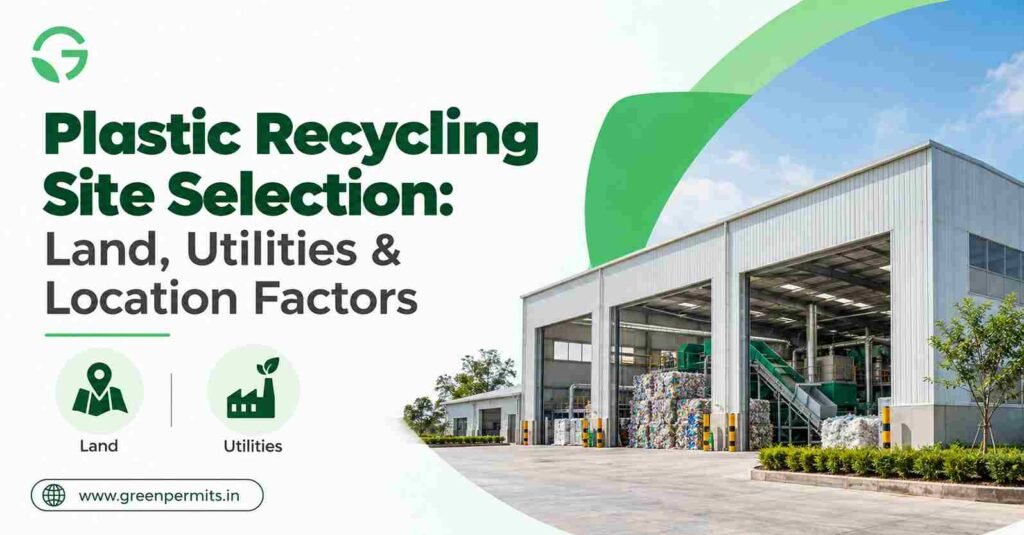
This is why plastic recycling plant site selection should happen before a long-term lease, land purchase or major machinery order. Land price is only one part of the decision. A workable site needs the right combination of land, industrial zoning, power, water, wastewater management, feedstock availability, transport connectivity, storage space and access to buyers.
For an Indian recycling business, the objective is not simply to find a plot where machinery can fit. The objective is to find a location where the complete recycling operation can function efficiently and move through the applicable regulatory approvals.
A plastic recycling plant is a connected system.
Raw material enters the facility, passes through storage and sorting, moves through processing equipment, generates finished material and rejects, consumes utilities and finally leaves the factory as recycled flakes, granules, pellets or another product.
If any one part of this chain is ignored during site selection, operating costs can increase later.
For example, a plant may have excellent road connectivity but poor access to plastic waste. Another location may have cheap land but insufficient sanctioned electrical load. A third site may have adequate power and water but insufficient space for storage and wastewater-treatment infrastructure.
The best location is therefore rarely the cheapest plot.
A good location should support at least 8 major requirements:
These factors should be studied together rather than independently.
One of the most common mistakes is searching for land before deciding exactly what the proposed plant will do.
“Plastic recycling plant” is a broad term. A facility processing clean industrial PP scrap can have very different requirements from a plant recycling post-consumer PET bottles or contaminated plastic film.
The first planning document should therefore define:
Once this information is available, the promoter can calculate what kind of site is actually required.
For example, a dry grinding operation may primarily need storage, power and dust-control planning. A washing and pelletising operation introduces additional requirements for water tanks, washing lines, drying systems, pumps, wastewater treatment and sludge handling.
The correct sequence is:
Feedstock – Capacity – Process – Machinery – Utilities – Layout – Site
Not:
Cheap Land – Machinery – Problems Later
There is no single land requirement that applies to every plastic recycling plant in India.
A 5 tonne per day unit processing clean industrial scrap and a 50 tonne per day post-consumer plastic recycling facility cannot logically use the same site-planning assumptions.
Land should therefore be calculated from the actual project configuration.
A proper land assessment normally includes space for:
The headline plot area can also be misleading.
A 20,000 square feet rectangular industrial plot with good access may be easier to operate than a larger irregular plot where substantial land cannot be used efficiently.
The focus should therefore be on usable industrial area, not only total area.
Plastic is relatively lightweight but can occupy significant volume before processing.
A plant handling loose bottles, film, packaging or mixed rigid plastics may therefore require substantial storage even when the material weight appears manageable.
Consider an illustrative 20 TPD recycling plant.
If the operator wants only 1 day of raw-material stock, the plant needs storage for approximately 20 tonnes of incoming material.
At 5 days of inventory, that becomes approximately 100 tonnes.
At 10 days, the facility may need to accommodate approximately 200 tonnes of feedstock.
These are simple inventory examples, not regulatory requirements. The actual physical area will depend heavily on whether the plastic arrives loose, baled, shredded or pre-sorted.
This is why a promoter should decide the expected inventory policy before finalising the property.
A recycling operation that depends on daily material arrival has lower storage requirements but greater supply-chain risk. A plant carrying several days of feedstock needs more land but may be more resilient to short-term supply interruptions.
A low rental price should never replace land-use verification.
Before purchasing or leasing a site, the business should confirm whether the proposed recycling activity is permissible at that location.
Important questions include:
These checks should preferably be completed before a substantial security deposit, land purchase or long-term lease commitment.
A promoter should also avoid relying only on statements such as “many factories are already operating here.” The fact that industrial activity exists in an area does not automatically mean that every type of recycling process will be acceptable there.
Plastic recycling equipment can place a substantial electrical load on the facility.
Depending on the process, major electricity consumers may include:
The total load should therefore be calculated from the proposed machinery rather than guessed from the size of the factory.
Suppose an illustrative project has machinery with a combined connected load of 350 kW. Selecting a factory where only a small electrical connection is readily available may require a substantial upgrade.
That upgrade can involve additional electrical infrastructure, transformer planning, deposits, cabling and approval time.
The CPCB Plastic Waste Processor registration framework also links sanctioned electrical load with machinery power ratings. This makes electricity more than just an operational issue. The machinery and available electrical infrastructure should tell a consistent story.
Before selecting the site, obtain preliminary confirmation about:
Water consumption varies enormously between recycling processes.
A dry recycling facility handling relatively clean industrial scrap may use limited process water.
A post-consumer washing line can require a completely different utility setup.
Water may be used for:
Instead of asking only “Is water available?”, prepare a preliminary water balance.
For an illustrative example, assume a washing plant requires 80 cubic metres of gross process water per day. If a well-designed recirculation system allows a significant percentage of treated water to be reused, the fresh-water demand can be reduced.
The exact numbers will depend on plant technology, contamination level and process design, so they must be calculated project by project.
The site study should identify:
This is especially important where the proposed water source is groundwater or where local supply is limited.
For washing-based plastic recycling plants, wastewater is one of the most important site-selection considerations.
Many entrepreneurs plan the recycling machinery first and try to find space for an Effluent Treatment Plant later.
That approach can create layout problems.
The wastewater system may need space for:
The recycling process, water balance and ETP should therefore be designed together.
If 10 percent of the site is suddenly needed for utilities and wastewater infrastructure after the machinery layout has already been frozen, the entire plant design may need to be rearranged.
The correct question is not simply:
“Can we fit an ETP somewhere?”
It is:
“Can this site support the production line, wastewater system, storage, vehicle movement and future expansion at the same time?”
A recycling plant makes money only when sufficient usable plastic waste reaches the facility at a commercially workable cost.
This makes raw-material geography extremely important.
A proposed plant should map major feedstock sources within practical transport distances.
Depending on the business model, suppliers may include:
Transport cost becomes particularly important for low-density plastics.
A truck may reach its volume limit before reaching its maximum legal weight when carrying loose plastic film or bottles. This increases the freight cost per tonne.
Baled material generally improves transportation efficiency, but the actual economics depend on the specific feedstock.
A useful calculation is:
Delivered Feedstock Cost = Material Purchase Price + Loading + Freight + Sorting Loss + Handling Cost
A site offering land at 20 percent lower rent may not be economical if inbound logistics are consistently much more expensive.
Site planning should not stop at the raw-material side.
A recycling plant also needs economically accessible buyers.
Potential customers may include:
A plant located near feedstock but hundreds of kilometres away from major buyers may save on inbound logistics but lose those savings on outbound freight.
The better decision comes from calculating both.
Total Logistics Cost = Inbound Feedstock Logistics + Outbound Product Logistics
This is one reason some of India’s stronger recycling clusters develop around regions where waste generation, manufacturing and transport infrastructure overlap.
A factory 2 km from a highway is not necessarily better than one 8 km away.
The real question is whether trucks can reach the factory easily.
Check:
Within the factory, internal material movement also matters.
Raw-material trucks should ideally reach the receiving area without disrupting finished-goods dispatch or normal plant movement.
Poor internal logistics creates repeated handling, additional manpower requirement and safety risks.
Consider an illustrative entrepreneur planning a 20 TPD plastic washing and pelletising plant.
The promoter identifies 3 possible locations.
Monthly rent: ₹2.2 lakh
Distance from major feedstock cluster: 25 km
Electricity: adequate load appears feasible
Water: reliable industrial supply
Plot: good rectangular layout
Buyer distance: approximately 90 km
Monthly rent: ₹1.5 lakh
Distance from feedstock: 110 km
Electricity: load enhancement required
Water: uncertain
Plot: slightly larger than Site A
Buyer distance: approximately 140 km
Monthly rent: ₹2.7 lakh
Distance from feedstock: 40 km
Electricity: strong infrastructure
Water: available
Plot: excellent storage and expansion area
Buyer distance: approximately 35 km
At first glance, Site B appears cheapest.
Its rent is ₹70,000 per month lower than Site A and ₹1.2 lakh lower than Site C.
But assume Site B adds only ₹600 per tonne in combined additional inbound and outbound logistics.
At 20 TPD and 300 operating days:
20 tonnes x 300 days = 6,000 tonnes per year
6,000 tonnes x ₹600 = ₹36 lakh additional annual logistics cost
The saving in rent may therefore become insignificant compared with the logistics disadvantage.
This case study is illustrative, but it shows why site-selection decisions should be based on total annual operating economics rather than land price alone.
A useful approach is to compare shortlisted sites using a 100-point internal score.
For example:
| Factor | Suggested Weight |
|---|---|
| Regulatory and land-use suitability | 20 |
| Feedstock availability | 15 |
| Electricity | 15 |
| Water and wastewater management | 15 |
| Land and layout | 10 |
| Buyer access | 10 |
| Road connectivity | 5 |
| Labour availability | 5 |
| Expansion potential | 5 |
| Total | 100 |
These weightages are a project-planning tool, not a statutory formula.
A washing-intensive project might assign greater weight to water and wastewater. A dry grinding facility may give more importance to power, storage and logistics.
The benefit is that management can compare locations on the same basis instead of allowing one attractive factor, such as cheap rent, to dominate the decision.
A well-planned facility normally tries to create a logical movement:
Receiving – Storage – Sorting – Processing – Quality Control – Finished Goods – Dispatch
Repeated backward movement increases handling and congestion.
The plant layout should also separate, where practical:
CPCB’s Plastic Waste Processor documentation also requires facility-level information such as plot area, plant location, processing capacity, machinery and facility photographs. This means the physical plant layout and the declared processing operation should be consistent.
A project designed for 10 TPD today may target 20 TPD or 30 TPD later.
Expansion is much easier when considered during site selection.
The promoter should ask:
Moving an operating recycling plant because the original site became too small can be significantly more disruptive than selecting a scalable location at the beginning.
Several errors repeatedly create avoidable problems.
Low rent does not compensate for weak logistics, insufficient utilities or regulatory complications.
The site and machine load should be evaluated together.
Plastic waste can occupy far more physical space than its tonnage suggests.
For washing operations, ETP and water-reuse infrastructure should form part of the original layout.
A recycling project becomes vulnerable if the location works only because of a single supplier.
The best location should balance incoming waste and outgoing recycled material.
Setbacks, access, utilities, storage, drainage and movement can reduce the space actually available for production.
Before committing to a plastic recycling site, management should have written answers to these 12 questions:
If 3 or 4 important questions remain unanswered, the property probably needs further due diligence before the company signs a long-term commitment.
Green Permits works with recycling entrepreneurs from the early project-planning stage through DPR, regulatory approvals and plant implementation support.
For a proposed plastic recycling project, the site evaluation can connect the commercial and regulatory parts of the investment rather than treating them separately.
The assessment can include:
This approach is particularly useful when a promoter has shortlisted 2 or 3 industrial locations and wants to compare them before making a final investment decision.
Plastic recycling plant site selection is one of the earliest and most important decisions in the project.
A suitable site should support the complete business model: enough usable land, reliable electricity, practical water and wastewater arrangements, efficient feedstock logistics, access to buyers, adequate storage, workable transport movement and a clear regulatory path.
The correct site cannot be identified using one universal land-area or utility figure. A 5 TPD dry recycling plant and a 50 TPD washing and pelletising facility have completely different requirements.
The better approach is to first define the waste stream, capacity, process and machinery. From there, calculate utilities and layout requirements and compare shortlisted locations using a structured site-selection framework.
Spending more time on site due diligence before signing the lease can prevent much larger costs after construction begins.
Green Permits can support site feasibility, DPR preparation, recycling plant setup, CTE and CTO, Plastic Waste Processor registration and complete compliance planning.
📞 +91 78350 06182
📧 wecare@greenpermits.in
🌐 www.greenpermits.in
👉 Book a Consultation with Green Permits