
A PET bottle is used for a few minutes. The material inside that bottle, however, can remain commercially useful for years.
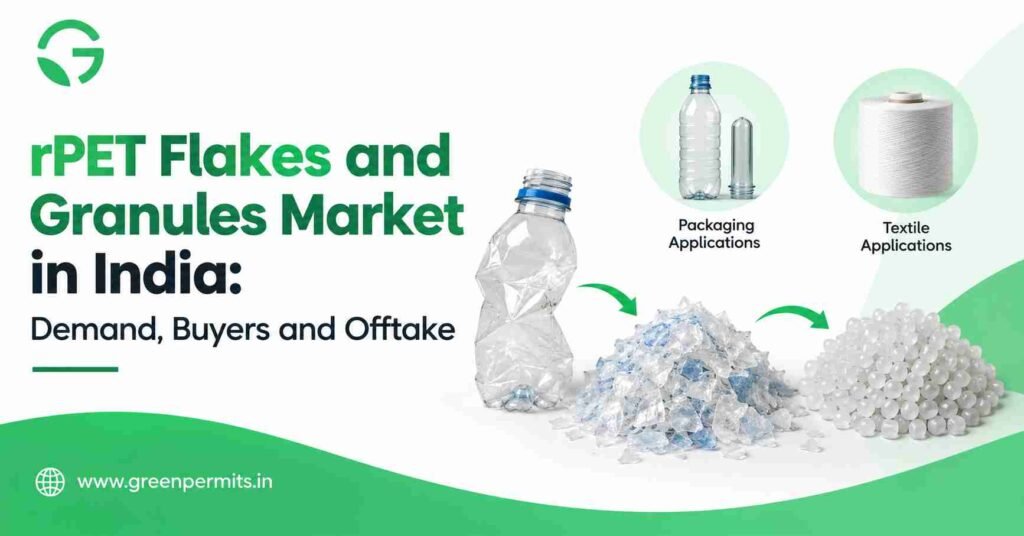
Consider what happens after a used water or soft-drink bottle enters India’s recycling chain. It may pass through a waste picker, scrap dealer and aggregator before reaching a recycling plant. There, the bottle is sorted, labels and caps are removed, the material is crushed, washed and converted into clean PET flakes. Depending on the plant, those flakes may then move through extrusion, filtration, pelletisation and further treatment to become recycled PET, commonly known as rPET.
A few years ago, many entrepreneurs entering PET recycling mainly asked one question: “How much does the recycling plant cost?”
Today, that is not enough.
The more important questions are: Who will buy the output? Should the plant manufacture hot-washed flakes, granules or bottle-grade rPET? What quality will buyers accept? How much PET bottle waste can the plant procure every month? Can the proposed customers absorb the planned production capacity?
These questions matter because India’s rPET flakes and granules market is becoming larger, more organised and more specification-driven. Recycled-content requirements, sustainability commitments, growing bottle-to-bottle recycling capacity and the development of food-contact rPET are creating new opportunities.
But a large market does not automatically create a profitable recycling plant. Feedstock, product quality and offtake have to work together.
rPET stands for recycled polyethylene terephthalate. PET is widely used in beverage bottles, packaged-water bottles, containers and several other packaging applications.
The recycling process normally starts with post-consumer PET bottles. Depending on the technology and required final product, the broad process may include collection, segregation, bale opening, sorting, label removal, crushing, washing, drying and further processing.
A conventional PET washing plant generally produces recycled PET flakes.
Further processing can convert flakes into pellets, granules, chips or recycled PET resin. The terminology used in the market can vary, but commercially the important distinction is the final specification and application.
For example, clear washed flakes supplied to a polyester-fibre manufacturer are different from resin supplied for bottle preforms.
Similarly, material intended for food-contact applications requires a much higher level of process control, traceability, testing and regulatory compliance than ordinary recycled flakes used in non-food applications.
This is why an rPET project should not simply be described as a “PET bottle recycling plant”. The plant has to be designed around a clearly defined finished product.
The Indian rPET market is being influenced by regulation, corporate sustainability commitments and increasing investment in organised plastic recycling.
One of the most important drivers is India’s recycled-content framework for plastic packaging.
For Category I rigid plastic packaging, the recycled-plastic-content requirement has been structured to increase progressively:
PET water bottles fall within the rigid plastic packaging ecosystem, making recycled PET particularly relevant to packaging manufacturers and brands trying to increase recycled material in their packaging portfolio.
These percentages should not be interpreted as meaning that every individual PET product automatically has to contain exactly the same percentage of recycled PET. Applicability depends on the relevant category, product and regulatory framework.
But from a market perspective, the direction is important.
Packaging companies increasingly need reliable supplies of traceable recycled polymer. That creates demand not only for basic PET flakes but also for higher-grade rPET resin capable of meeting demanding packaging specifications.
The second major change is the growth of food-contact rPET.
Food-grade recycled PET opens an entirely different value chain compared with ordinary bottle-to-fibre recycling. Recycled material can potentially move back into beverage and food-packaging applications when the recycling technology, material quality and regulatory requirements are satisfied.
This moves part of the Indian PET recycling industry from a relatively simple waste-processing model towards a circular packaging model.
There is no single government database that provides one definitive number for the entire Indian rPET market covering flakes, fibre, sheets, strapping, non-food pellets and food-grade resin.
Commercial market studies therefore produce different estimates depending on what they include.
One recent commercial estimate placed India’s recycled PET flakes market at approximately US$1.58 billion in 2025, with projected growth of around 8.4% CAGR between 2026 and 2033.
Such numbers are useful for understanding direction, but they should not become the primary basis for deciding whether a particular recycling plant will work.
A plant with a capacity of 10,000 tonnes per year does not need to capture the whole Indian rPET market.
It needs reliable customers for approximately 800 to 900 tonnes per month when operating near full utilisation.
That is a much more practical question.
Instead of asking whether India’s rPET market is worth several billion rupees, a project promoter should ask whether five or six realistic buyers can absorb the proposed production at the required specification and price.
This is the difference between market research and project feasibility.
rPET flakes have multiple applications, but different buyers want different grades.
A recycler producing clear hot-washed flakes may target recycled polyester fibre manufacturers, yarn producers, sheet manufacturers, strapping manufacturers or companies that further process flakes into higher-grade rPET.
Fibre and textile remain important markets because PET bottles can be converted into polyester staple fibre and other textile materials.
In this segment, buyers generally focus heavily on consistency.
They may check contamination, colour, moisture, PVC content, labels, metals, other polymers and particle-size consistency before approving a supplier.
A supplier offering a slightly lower price but inconsistent material may be less attractive than a supplier capable of delivering the same quality every month.
Typical buyers of rPET flakes include:
The exact buyer mix should be identified during the feasibility stage.
Granules and pellets generally move further downstream in the value chain.
Depending on product quality, they may be supplied to sheet manufacturers, packaging converters, non-food container manufacturers, industrial product manufacturers or preform and packaging producers.
The technical requirements are usually more demanding than for basic washed flakes.
Buyers may evaluate characteristics such as intrinsic viscosity, colour, moisture, melt behaviour, filtration quality, contamination and consistency between production batches.
For bottle and food-contact applications, the qualification process becomes significantly more demanding.
This means that an entrepreneur should not assume that adding an extruder and pelletiser automatically makes the product more valuable.
The product becomes more valuable only when the resulting material satisfies the requirements of a buyer willing to pay for that quality.
Food-contact recycled PET is one of the most important developments in India’s rPET sector.
It creates the possibility of converting used beverage bottles back into resin suitable for new food or beverage packaging, subject to the required process, safety and regulatory conditions.
But this is not the same business as producing ordinary washed PET flakes.
A food-contact rPET facility may require advanced sorting, high-quality washing, extrusion, filtration, decontamination and technologies designed to achieve the required material safety and performance.
The plant also needs stronger systems for:
This significantly raises the technical and operational expectations from the recycler.
At the same time, it can provide access to a more organised buyer base involving packaging manufacturers, preform producers, beverage companies and their approved supply chains.
Therefore, investors considering food-grade rPET should prepare a separate technical and financial feasibility model rather than simply extending the economics of a normal PET washing plant.
Choosing the final product is one of the most important decisions in the entire project.
A flakes plant may require lower investment and a simpler production line, but the selling price and customer base will differ from an integrated resin project.
An integrated granule or pellet facility adds more processing and potentially more value, but also introduces greater electricity consumption, quality-control requirements, maintenance, working capital and technical risk.
Food-grade rPET sits at an even higher level of complexity.
A simple decision framework can help.
If the project has strong access to bottle waste but limited capital and identified textile or sheet buyers, washed flakes may be a reasonable starting point.
If the project already has buyers requiring controlled recycled resin, additional pelletisation may be commercially justified.
If the promoter is targeting bottle-to-bottle recycling and food-contact packaging, the complete technology, authorization and customer qualification requirements should be evaluated before ordering machinery.
The correct product should come before the machinery decision.
Consider an entrepreneur evaluating a PET recycling project with a proposed installed capacity of 10,000 tonnes per year.
At first glance, the opportunity looks attractive. PET bottles are widely available, recycled-content demand is increasing and multiple industries consume recycled PET.
The promoter receives machinery quotations and begins planning the site.
But before finalising the plant, a detailed market exercise is undertaken.
At 10,000 TPA installed capacity, the plant would theoretically need to process around 833 tonnes per month if production were evenly distributed across 12 months.
Actual operating capacity will normally be lower during the initial ramp-up.
If the plant operates at 70% utilisation in its early stage, finished production could be around 7,000 tonnes annually, subject to yield and product losses.
The promoter then speaks with potential buyers.
Buyer A may require 200 MT per month of clear hot-washed flakes.
Buyer B may require 150 MT.
Buyer C may indicate 250 MT but requires tighter PVC and moisture specifications.
The promoter now has visibility of around 600 MT per month of potential demand, but this is not yet guaranteed business.
Samples still need approval. Pricing needs negotiation. Credit periods need to be understood. Transportation costs need to be calculated.
At the same time, the feedstock study shows that producing 7,000 tonnes of saleable material requires more than 7,000 tonnes of incoming bottle waste because labels, caps, contamination, moisture, rejects and process losses reduce final recovery.
This changes the project discussion completely.
Instead of simply asking whether a 10,000 TPA machine can be purchased, the promoter starts examining whether enough bottle waste can be contracted, whether the planned product will achieve buyer specifications and whether enough working capital is available to purchase several hundred tonnes of raw material every month.
That is how an rPET feasibility study should work.
The objective is not to prove that the project is attractive. The objective is to identify whether the entire commercial chain works before major capital is committed.
Many recycling projects begin with machinery quotations.
A better approach is to begin with the customer.
A recycler should ideally know the target buyer, required specification and approximate monthly demand before freezing the final process line.
An offtake agreement can reduce commercial uncertainty, but even where a formal long-term agreement is not available, the project should try to obtain some form of market validation.
This could include sample approval, buyer correspondence, an indicative purchase requirement, a trial order, memorandum of understanding or letter of intent.
The more advanced the project becomes, the stronger the evidence should become.
For a serious DPR, merely writing that “rPET has high market demand” is not enough.
The DPR should demonstrate who could buy the product, what quality they require, how much they consume and where they are located.
A structured buyer assessment should examine both technical and commercial requirements.
For every serious buyer, the project should record:
The objective is not to collect hundreds of company names.
Ten properly verified buyers are often more useful than a spreadsheet containing 500 companies with no information about actual purchasing requirements.
One of the most common mistakes in plastic recycling feasibility studies is spending considerable time studying selling prices while assuming PET bottles will always be available.
Feedstock deserves the same level of research as the finished product.
A recycling plant may procure PET bottles from waste aggregators, scrap dealers, municipal systems, institutional collection programmes, hotels, commercial establishments, beverage-distribution networks and other collection channels.
But availability does not automatically mean availability at the required price.
If three major recycling facilities are located in the same collection region, all three may compete for similar PET bottle waste.
That can increase procurement prices.
Transportation is equally important because PET bottles are lightweight and bulky before baling and processing.
A plant may discover material 800 km away, but that does not mean transporting it makes commercial sense.
For feasibility modelling, many projects therefore evaluate procurement within several distance bands, for example:
The cost and availability within each band can then be compared.
The ideal radius will depend on bottle density, baling, transport rates, quantity and location.
The words “PET flakes” can describe very different products.
Clear hot-washed flakes with controlled contamination may have access to buyers that low-grade mixed-colour flakes cannot serve.
Likewise, high-quality recycled resin can enter applications that ordinary flakes cannot.
Important quality parameters may include:
The required numbers can differ significantly between buyers.
Therefore, a recycler should obtain actual buyer specifications rather than relying entirely on generic machinery-supplier claims.
A machine vendor may say that the line produces “bottle-grade flakes”, but the buyer ultimately decides whether the material meets its purchasing standard.
The selling price of rPET depends on grade, colour, quality, end use, location and market conditions.
But the selling price alone says very little about profitability.
The project should examine the spread between feedstock cost and finished-product realisation.
Imagine two plants.
Plant A sells flakes at a higher price but buys PET bottles from distant suppliers and spends heavily on logistics.
Plant B sells at a slightly lower price but has secured strong local feedstock and lower transport costs.
Plant B may ultimately produce the better margin.
The financial model should therefore connect:
Raw-material cost -> recovery yield -> processing cost -> logistics -> finished-product realisation -> working capital -> margin.
Even a ₹2 to ₹5 per kg variation in either feedstock cost or selling price can have a major annual impact when a plant processes several thousand tonnes.
At 10,000 tonnes per year, a difference of ₹3 per kg represents around ₹3 crore in annual value.
This is why sensitivity analysis is important in a DPR.
The exact approvals depend on state, location, plant configuration, capacity and final product.
A PET recycling project may need to examine requirements including Consent to Establish, Consent to Operate, Plastic Waste Processor registration and other environmental and industrial approvals applicable to the facility.
Depending on the project, additional requirements may relate to factory operations, fire safety, electricity, building approvals, labour, groundwater or local industrial authorities.
Food-contact rPET requires another layer of technical and regulatory evaluation because the recycled material is intended to re-enter food packaging.
The approval sequence should therefore be mapped before construction begins.
A common mistake is purchasing machinery first and investigating pollution-control and authorization requirements later.
That can result in layout changes, additional equipment and commissioning delays.
A strong recycling project normally has four elements working together.
First is feedstock security.
The project should know where its PET bottles will come from and how procurement will scale as utilisation increases.
Second is product clarity.
The promoter should decide whether the business will sell flakes, pellets, non-food resin or higher-grade bottle-to-bottle material.
Third is buyer validation.
The project should understand who buys the product, how much they need and what specifications they require.
Fourth is regulatory readiness.
The plant layout, technology and investment plan should account for the approvals and pollution-control requirements applicable to the proposed operation.
When these four pieces are analysed together, the DPR becomes useful for actual investment decisions rather than simply becoming a bank-format document.
The Indian rPET market is moving into a more organised phase.
Regulatory recycled-content requirements are creating structural demand. Food-contact applications are expanding the potential market for higher-quality recycled resin. Consumer brands are increasing recycled-material usage, while new recycling capacity is entering the sector.
These developments create opportunities, but they also increase competition.
More recycling plants mean greater competition for high-quality PET bottle waste.
More organised buyers mean tighter quality requirements.
More sophisticated applications mean higher investment in process control, testing and traceability.
For entrepreneurs, this is positive because the industry is becoming more structured. But the project-development approach must also become more professional.
The old model was:
Collect bottles -> wash bottles -> produce flakes -> find someone to buy them.
The stronger model is:
Identify buyer -> obtain specification -> map feedstock -> select technology -> validate economics -> secure approvals -> construct plant -> qualify product -> scale production.
That sequence can significantly reduce commercial uncertainty.
The rPET flakes and granules market in India offers a significant opportunity for recyclers, manufacturers and entrepreneurs, particularly as recycled-content requirements become stronger and organised demand for recycled PET increases.
But rPET should not be viewed simply as a high-growth recycling business.
A successful project depends on matching the right raw material with the right technology, product specification and customer.
A plant capable of producing 10,000 or 20,000 tonnes per year has little commercial advantage if reliable feedstock is available for only half that quantity or if buyers reject the final product on quality.
Before investing, project promoters should therefore complete feedstock mapping, buyer identification, product benchmarking, offtake assessment, regulatory planning and detailed financial sensitivity analysis.
Green Permits supports recycling-project promoters with feasibility studies, Detailed Project Reports, market and buyer assessment, plant setup planning, environmental approvals and regulatory compliance for plastic recycling projects in India.
📞 +91 78350 06182
📧 wecare@greenpermits.in
👉 Book a Consultation with Green Permits