
Imagine investing ₹5 crore in a tyre recycling plant, purchasing machinery, arranging industrial land and preparing to start operations. Everything looks promising until the pollution control authorities identify problems with the plant layout, emission-control system or processing technology.
Now the business faces additional expenditure, approval delays and machinery modifications before production can begin.
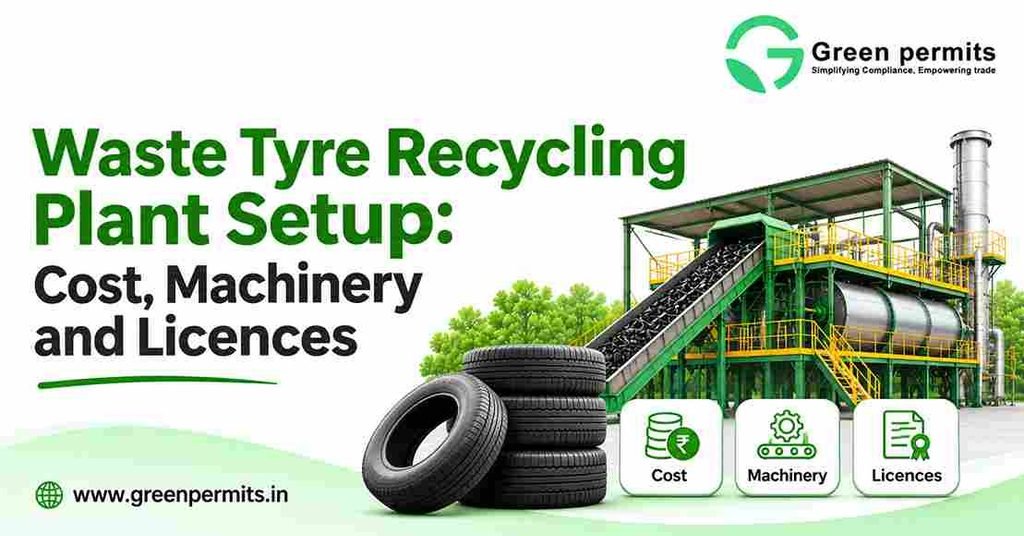
This is exactly why setting up a tyre recycling plant requires more than purchasing a machine.
India’s waste tyre recycling industry offers opportunities for entrepreneurs, manufacturers and industrial investors. Discarded tyres can be processed into crumb rubber, reclaimed rubber, recovered carbon black, steel and pyrolysis products. These materials have applications across several industrial sectors.
However, a successful waste tyre recycling plant setup in India depends on choosing suitable technology, estimating investment correctly, arranging reliable raw materials and obtaining the necessary government approvals.
This guide explains tyre recycling plant costs, machinery, production capacity, CPCB registration, environmental licences and the practical steps involved in establishing a commercially viable recycling facility.
India has a large automotive and transport industry, supported by millions of passenger vehicles, commercial vehicles, two-wheelers and industrial vehicles.
Every year, tyres become unsuitable for their intended use because of wear, damage or replacement. Unlike ordinary biodegradable waste, discarded tyres require organised collection, processing and recycling.
Waste tyre recycling helps recover reusable materials while reducing the environmental risks associated with improper disposal and uncontrolled burning.
The government’s Extended Producer Responsibility (EPR) framework has also introduced formal responsibilities for tyre producers and created a regulated system for recycling and certificate transactions.
Under the Hazardous and Other Wastes (Management and Transboundary Movement) Amendment Rules, 2022, tyre producers, recyclers and retreaders are covered by specific registration and compliance requirements.
For producers, the EPR framework generally provides for a recycling obligation equivalent to 100% of the quantity of tyres manufactured or imported in the relevant base year, under the applicable schedule and transition provisions.
For recycling businesses, this framework creates an additional commercial opportunity, although EPR certificate revenue should never be treated as guaranteed income.
Before estimating project investment, the first decision is selecting the recycling process.
There are three major approaches commonly considered by investors.
Mechanical recycling involves cutting, shredding and processing waste tyres into smaller rubber particles.
During processing, steel wires and textile fibres are separated from the rubber.
The recovered material can be sold as rubber chips, granules or fine crumb rubber.
Crumb rubber is used in applications such as rubber flooring, moulded products, playground surfaces, rubber mats and certain road-construction applications.
A mechanical recycling plant generally requires shredders, granulators, magnetic separators, fibre separators and dust-control equipment.
Reclaimed rubber manufacturing involves further processing of vulcanised rubber so it can be reused in manufacturing applications.
The process generally requires additional equipment and thermal or mechanical treatment, depending on the selected technology.
Recovered rubber may be supplied to manufacturers of rubber sheets, footwear components, mats and other industrial rubber products.
This model requires careful product-quality planning because customers may specify hardness, tensile strength, composition and other technical characteristics.
Tyre pyrolysis involves heating waste tyre material in an oxygen-deficient environment.
The thermal decomposition process generally operates at temperatures around 400-500°C, depending on the technology and operating conditions.
The process generates several output streams, including pyrolysis oil, gas, char and recoverable steel.
Pyrolysis requires more extensive safety and environmental controls than basic mechanical shredding because it involves high temperatures, combustible gases, oil storage and air-emission management.
CPCB’s revised tyre pyrolysis guidelines dated 16 January 2024 prescribe requirements for advanced batch automated and continuous processing systems.
Technology selection should therefore be completed before finalising machinery, land development and pollution-control applications.
One of the first questions investors ask is how much capital is required to establish a waste tyre recycling plant.
The answer depends on processing capacity, technology, machinery quality, land costs, automation and environmental infrastructure.
A small mechanical recycling facility may require considerably less investment than a large integrated reclaim-rubber or continuous pyrolysis project.
The following figures are broad preliminary budgeting assumptions, not verified vendor quotations.
| Plant type | Illustrative capacity | Indicative project budget |
|---|---|---|
| Basic tyre shredding and crumb rubber | 5-10 TPD | ₹1-4 crore |
| Integrated crumb and reclaim rubber | 15-30 TPD | ₹5-15 crore |
| Continuous tyre pyrolysis | 10-20 TPD | ₹4-12 crore |
| Large integrated tyre recycling facility | 30-50 TPD | ₹12-30 crore or more |
Important: These indicative ranges are intended only for early-stage financial screening. Actual costs may fall outside them. Land purchase, taxes, finance charges, imported equipment and working capital may significantly increase total investment.
A detailed project report should use updated machinery quotations, site-specific engineering estimates and documented commercial assumptions.
Investors sometimes compare machinery prices without calculating the complete cost of establishing the facility.
For example, a machinery supplier may quote ₹1.5 crore for a processing line. However, that quotation may exclude civil construction, transformers, electrical connections, pollution-control equipment, fire safety and installation.
A complete project budget should include:
These expenses should be estimated separately in the DPR to avoid unexpected financial pressure during implementation.
Machinery selection directly influences plant capacity, product quality, electricity consumption and maintenance expenses.
For a mechanical recycling plant, the main equipment generally includes a tyre debeader, cutter, primary shredder, secondary shredder, granulator, magnetic separator, fibre separator, screening machine and product packing system.
Dust extraction is also important because rubber cutting and grinding can generate airborne particles.
A pyrolysis facility requires a different machinery configuration.
Its principal equipment includes the reactor, feeding system, condensers, oil-storage tanks, gas-handling arrangements, char-discharge system, pollution-control equipment and automated safety instruments.
CPCB’s revised operating requirements emphasise several important systems, including:
For applicable advanced batch automated pyrolysis systems, CPCB also specifies an alkaline scrubber with a mist eliminator and a chimney of at least 30 metres.
The actual equipment configuration must be checked against the applicable CPCB SOP, state consent conditions and plant technology.
A low-cost machinery quotation should not be accepted without verifying whether the necessary environmental and safety systems are included.
Plant capacity is usually measured in tonnes per day (TPD) or tonnes per annum (TPA).
A 10 TPD recycling facility operating for 300 days annually has a theoretical input capacity of:
10 tonnes × 300 days = 3,000 tonnes per year
However, machinery rarely operates at full rated utilisation throughout the year.
Planned maintenance, material supply, equipment downtime, electricity interruptions and market demand can reduce actual throughput.
If the same plant operates at an average utilisation of 70%, annual input processing would be:
3,000 tonnes × 70% = 2,100 tonnes annually
This difference matters because labour, rent, maintenance and financing expenses continue even when the plant is operating below capacity.
A project report should therefore evaluate financial performance at different operating levels instead of assuming 100% utilisation from the first year.
Consider an illustrative entrepreneur planning a 10 TPD mechanical tyre recycling facility in North India.
The proposed business intends to purchase waste tyres from local aggregators and transport operators, process them into rubber granules and recover steel as a secondary product.
The project initially appears attractive because the promoter has identified machinery capable of processing 10 tonnes daily.
However, the financial feasibility changes when annual production and fixed expenses are examined.
Assume the plant operates for 300 days a year and achieves 70% utilisation during its stabilised operating period.
Annual waste tyre processing would be approximately 2,100 tonnes.
If the plant’s assumed feedstock purchase and inward transportation cost is ₹12 per kg, annual feedstock expenditure would be:
2,100,000 kg × ₹12 = ₹2.52 crore
This ₹12 rate is an illustrative calculation assumption, not a verified current market quotation.
The business must then account for rubber and steel recovery, product quality, selling prices, labour, electricity, maintenance, packaging and financing.
Suppose electricity, labour and other operational expenses increase beyond the original budget. Even if the plant performs technically, the expected profit may fall sharply.
The promoter must also consider whether buyers can consistently purchase the entire output.
A large inventory of finished rubber does not generate revenue until products are sold and payments are collected.
The key learning from this illustrative case study is that machinery capacity alone cannot establish project profitability. Feedstock security, recovery efficiency, product offtake and working capital are equally important.
A properly prepared DPR should calculate cash flow, break-even utilisation and financial sensitivity before the investment decision.
There is no single land-area requirement suitable for every tyre recycling project in India.
The required area depends on plant capacity, processing technology, equipment dimensions, tyre-storage arrangements, internal vehicle movement and fire-safety provisions.
Waste tyres occupy considerable storage space. Their storage arrangement must account for vehicle access, safe stacking, material handling and fire protection.
The plant layout should provide separate areas for incoming tyres, processing machinery, recovered materials, utilities, finished products and waste storage.
For pyrolysis plants, additional space may be necessary for the reactor system, gas handling, oil storage, pollution-control equipment and emergency access.
Land selection should also consider industrial zoning, road connectivity, electricity availability, water supply and the requirements of the concerned State Pollution Control Board.
Choosing an unsuitable site can create approval difficulties even when the machinery itself meets technical specifications.
A waste tyre recycling business must obtain the approvals applicable to its selected technology and location.
The regulatory requirements for mechanical recycling and pyrolysis may differ, particularly in relation to emissions, hazardous waste and fire safety.
Consent to Establish is issued by the concerned State Pollution Control Board or Pollution Control Committee under the applicable pollution-control framework.
The application generally includes the proposed process, capacity, raw materials, machinery, emissions, wastewater arrangements and pollution-control measures.
The promoter should obtain the necessary CTE before undertaking installation activities requiring that consent.
Consent to Operate is required before commercial operation where applicable.
It confirms the plant’s authorisation to operate subject to the conditions imposed by the concerned pollution-control authority.
The installed machinery and pollution-control arrangements must correspond to the approved project.
Authorization under the Hazardous and Other Wastes (Management and Transboundary Movement) Rules, 2016 is an important requirement for applicable tyre recycling operations.
CPCB specifically identifies hazardous-waste authorization among the requirements for tyre-pyrolysis facilities.
Waste tyre recyclers covered under Schedule IX must register on the centralised EPR portal.
Registration supports the formal recording of recycling activity and, where eligible, the generation and transfer of EPR certificates.
Fire safety is particularly important because waste tyres, rubber products, pyrolysis oil and combustible gases present significant risks.
CPCB’s pyrolysis SOP requires a Fire Safety Certificate from the concerned department.
Depending on the proposed project and state requirements, further approvals may include a Factory Licence, building plan approval, electricity load sanction, groundwater permission and applicable labour-related registrations.
The complete approval list should be checked before construction begins.
Extended Producer Responsibility is an important part of India’s formal waste tyre management framework.
Under the applicable rules, tyre producers have recycling obligations linked to the quantity of tyres manufactured or imported.
Registered recyclers can participate in the EPR certificate mechanism based on eligible recycling activity and documentation.
The official EPR portal maintains information relating to stakeholders, recycling activity and certificate transactions.
For recycler registration and related compliance, businesses should prepare accurate details of their plant, authorised processing capacity, pollution-control approvals and recycling operations.
Records must support the quantities of waste tyres received, materials processed and products generated or sold.
For EPR certificate generation, relevant supporting records may include procurement invoices, product quantities and GST-linked sales invoices.
An important practical distinction is that EPR registration does not replace CTE, CTO or other statutory permissions.
These are separate compliance requirements.
Documentation should be prepared early because inconsistent information can delay applications.
Common records include:
The exact checklist should follow the relevant authority’s current application procedure.
Company names, addresses, plant capacities and process descriptions should remain consistent across applications.
A successful project generally follows a structured development process.
Step 1: Conduct a feasibility study. Evaluate waste tyre availability, transportation, product markets and potential investment.
Step 2: Select recycling technology. Choose mechanical recycling, reclaim rubber or pyrolysis based on commercial and technical suitability.
Step 3: Finalise plant capacity. Estimate realistic processing volume and future expansion requirements.
Step 4: Prepare the DPR. Develop machinery specifications, project cost, material balance, financial projections and implementation planning.
Step 5: Select the site. Confirm industrial land-use suitability, access to utilities and environmental considerations.
Step 6: Obtain applicable preliminary approvals. Prepare and submit CTE and other required applications.
Step 7: Procure and install machinery. Install equipment according to the approved process and engineering layout.
Step 8: Complete commissioning and operating compliance. Test the plant, obtain required operating permissions and complete applicable recycler registration before undertaking regulated commercial operations.
The precise sequence may vary depending on the state, technology and approval conditions.
One of the most common mistakes is purchasing machinery before completing regulatory and commercial feasibility.
A supplier may provide an attractive quotation, but the final project cost can rise substantially when pollution-control systems, fire safety, electrical infrastructure and civil construction are included.
Another mistake is overestimating operating capacity.
A 20 TPD plant does not automatically process 6,000 tonnes annually simply because the machinery is rated for that capacity. Actual throughput depends on operating days, utilisation and technical availability.
Entrepreneurs also sometimes overlook raw-material transportation and finished-product sales.
A recycling plant located far from waste tyre collection centres may face higher delivered feedstock costs.
Similarly, recovered rubber or pyrolysis products must meet buyer specifications. Product quality and regular offtake are more important than theoretical sales projections.
For tyre pyrolysis, a further compliance concern is feedstock sourcing. The applicable waste tyre rules prohibit importing waste tyres for producing pyrolysis oil or char.
A project dependent on that prohibited feedstock model would therefore need to be redesigned.
A waste tyre recycling project involves technical, financial and regulatory decisions that should be coordinated from the beginning.
Green Permits supports entrepreneurs and industrial businesses with recycling plant planning, DPR preparation, machinery assessment and environmental compliance.
The objective is to develop a project in which production capacity, equipment selection, site planning and statutory applications are consistent.
Support can include project feasibility analysis, preparation of financial projections, identification of applicable licences, CTE and CTO assistance, waste tyre EPR registration guidance and coordination of plant setup requirements.
This allows investors to evaluate important regulatory and financial risks before making major capital commitments.
A waste tyre recycling plant setup in India can create opportunities to recover valuable industrial materials while supporting organised waste management.
However, the profitability and long-term performance of the business depend on much more than installing a recycling machine.
Investors must evaluate waste tyre availability, processing technology, realistic plant utilisation, product markets, machinery cost, environmental compliance and working capital.
Whether the proposed project is a 5 TPD mechanical recycling facility or a 30 TPD integrated recycling operation, the investment should begin with a detailed feasibility assessment.
A properly developed DPR can help identify cost gaps, evaluate commercial risks and establish a realistic project implementation plan.
Planning to establish a waste tyre recycling facility?
Green Permits can assist with feasibility studies, detailed project reports, regulatory approvals, CPCB EPR registration and plant setup planning.
Website: https://www.greenpermits.in/
📞 +91 78350 06182
📧 wecare@greenpermits.in
👉 Book a Consultation with Green Permits