
Many Indian importers assume that battery compliance is only for manufacturers. But under India’s Battery Waste Management Rules, every importer who brings batteries or equipment that contains batteries into the country is treated as a Producer. That means you are legally required to register with CPCB and obtain your Battery EPR Certificate before you place anything on the market.
To understand why this matters, let’s begin with a real scenario.
Arun runs a mid-sized electronics import business in Mumbai. For years, he imported power banks and lithium-ion battery packs without issues. Everything ran smoothly until one day his shipment was held back by customs. The officer asked for his Battery EPR Registration and EPR Certificate—documents Arun had never even heard of.
The delay led to demurrage, storage costs, and weeks of back-and-forth with authorities. Only then did he learn that every importer of batteries or electronics with batteries needs EPR compliance. If he had registered earlier, he could have avoided all this stress.
This guide is built to help you avoid Arun’s situation.
A Battery EPR Certificate is an official proof that the importer has met their annual recycling obligations. Importers cannot recycle batteries themselves; instead, they buy EPR certificates from CPCB-approved recyclers.
The quantity of certificates you need is based on:
For importers, this certificate is much more than paperwork. It’s mandatory for releasing shipments, clearing audits, renewing registration, and continuing business legally in India.
Importers must upload correct documents while applying for Battery EPR Registration. These documents help CPCB validate your identity, business status, environmental compliance, and battery import footprint.
Below is the complete, importer-specific checklist.
| Category | Document Required | Purpose / What CPCB Verifies |
|---|---|---|
| Company Identity | GST Certificate | Confirms registered business name and address. |
| Company PAN | Verifies tax identity. | |
| CIN (if applicable) | Confirms incorporation with MCA. | |
| IEC (Import Export Code) | Mandatory for battery/equipment import. | |
| Authorized Person KYC | PAN of Authorized Signatory | Establishes legal responsible person. |
| Aadhaar Number | Required for OTP and verification. | |
| Regulatory Documents | Consent under Air & Water Act (if facility exists) | For businesses with local storage/assembly. |
| Hazardous Waste Authorization (if applicable) | For units handling waste batteries. | |
| Business Verification | DIC Certificate (if registered) | Validates MSME/industrial registration. |
| GSTR-9 or Last Balance Sheet | Determines fee category and business scale. | |
| Battery Information | Year-wise Battery Import Data | Used for EPR target calculation. |
| Battery Type & Chemistry | For determining key metal content obligations. | |
| Brand Names | Ensures proper mapping under Producer category. | |
| HSN Codes | Classifies the imported battery products. | |
| Supporting Records | Import/Invoice Records | Validates authenticity of declared imports. |
| Self-Declaration | Confirms authenticity of all uploaded data. |
Importers who provide complete documentation often get their registration faster and face fewer queries during CPCB evaluation.
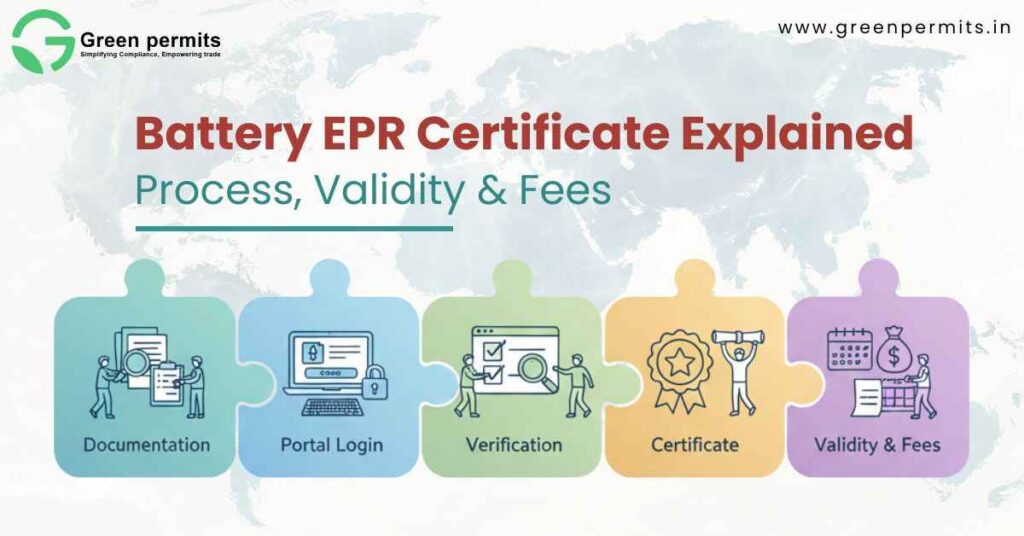
The process of obtaining your Battery EPR Certificate happens entirely through the CPCB Battery EPR Portal. Here is a simple breakdown of each step.
Visit the CPCB Battery EPR Portal and create a producer account as an importer. You’ll verify your identity through mobile OTP and email OTP.
After login, you are required to fill the application in six structured parts:
Ensure your name, address, and documents match exactly. Any mismatch may trigger queries.
CPCB typically processes applications within a fixed timeline. If any details are missing, the portal will notify you with comments. A corrected and complete application is approved, and your Registration Certificate becomes available for download.
Once registered, the portal automatically generates your EPR targets, based on:
To fulfil the target, you must purchase EPR certificates from registered recyclers.
Recyclers submit quarterly returns and generate certificates based on actual recovered metal quantities. Once generated, you can purchase these certificates and link them to your EPR obligation.
Importers must file their annual return by June 30 each year. Only then is the next year’s registration valid.
Once approved, Battery EPR Registration is valid for five years.
Before expiry, you must apply for renewal, which requires:
Timely renewal ensures your import activities continue without disruption.
The fee structure for importers is based on annual business turnover. There is no fixed cost for EPR certificates; that depends on the recycler’s certificate pricing and metal recovery type.
| Annual Turnover | Applicable Fee (₹) |
|---|---|
| Less than ₹5 crore | 10,000 |
| ₹5–50 crore | 20,000 |
| Above ₹50 crore | 40,000 |
The registration fee must be paid at the time of form submission.
The cost is based on:
There is no government-fixed rate.
Understanding how metals are recovered helps importers estimate EPR certificate requirements.
| Battery Type | Key Metals Recovered |
|---|---|
| Lithium-ion | Lithium, Nickel, Cobalt, Manganese, Iron, Copper, Aluminium |
| Lead-acid | Lead |
| Nickel-Cadmium | Nickel, Cadmium, Iron |
| Zinc-based | Zinc, Manganese, Iron |
Let’s consider an importer who brings in 1,000 kg of lithium-ion batteries.
| Battery Type | Import Qty (kg) | Target % | Metal Content | Certificates Needed |
|---|---|---|---|---|
| Lithium-ion | 1,000 | Depends on year | e.g., 10% cobalt, 20% iron, 5% lithium | Calculated based on metal weight × target × recovery factor |
This gives businesses clarity on the scale of EPR required.
Importers who skip EPR compliance expose themselves to significant consequences.
Battery EPR is now a critical compliance parameter for all import-driven businesses.
A Gurgaon-based importer shipped in smartwatches containing lithium-ion batteries but declared only the devices—not the battery details. When CPCB cross-verified the import data through customs records, they flagged a mismatch and imposed additional obligations.
The importer had to purchase certificates for multiple metals, clear outstanding targets, and update all future import disclosures. The process was long, expensive, and stressful.
Accurate reporting during registration could have prevented it entirely.
Battery EPR compliance is now an essential requirement for every importer dealing with batteries or equipment containing batteries. The EPR certificate proves that you are responsibly managing end-of-life waste in line with national rules.
By registering early, submitting accurate documents, and completing obligations on time:
If you want expert help in completing your EPR registration, understanding your targets, or getting the right EPR certificates, our team is here to support you.
📞 Call: +91 78350 06182
📧 Email: wecare@greenpermits.in