
In today’s competitive and compliance-driven market, having an ISI Mark is more than a regulatory requirement — it’s a trust badge that defines a product’s quality, safety, and market legitimacy.
In 2025, the Government of India has expanded Quality Control Orders (QCOs) across sectors like electronics, footwear, furniture, steel, and home appliances — making BIS ISI Mark certification mandatory for hundreds of new product categories.
And for businesses, that means one thing: no ISI licence, no market access.
Last year, an electronics manufacturer from Noida imported transformers worth ₹60 lakhs. The consignment was held up at Mumbai Customs because it lacked BIS ISI marking. For two months, the company paid demurrage and warehouse rent — all because the BIS licence process was initiated late.
When the licence was finally issued, the financial damage had already been done.
This story isn’t uncommon. In fact, several importers and domestic manufacturers face similar setbacks due to a lack of BIS readiness or misunderstanding of which certification applies — ISI, CRS, or FMCS.
That’s why Green Permits guides companies through India’s entire BIS and environmental compliance landscape — ensuring that your manufacturing and import journey remains smooth, lawful, and profitable.
The ISI Mark, issued by the Bureau of Indian Standards (BIS), is India’s official symbol of product conformity. It signifies that a product meets the Indian Standard (IS) — the country’s recognized benchmark for safety, quality, and performance.
BIS operates under the Ministry of Consumer Affairs, Food and Public Distribution and enforces product standards through its Compulsory Registration Schemes (CRS), Foreign Manufacturer Certification Scheme (FMCS), and ISI Mark (Scheme-I) for domestic manufacturers.
The ISI mark tells consumers that your product is made right, tested right, and trusted by the Indian government.
The compliance landscape in India is tightening — and for good reason. BIS certification helps eliminate substandard imports, supports local manufacturing, and protects consumer safety.
Here’s why you can’t ignore ISI certification this year:
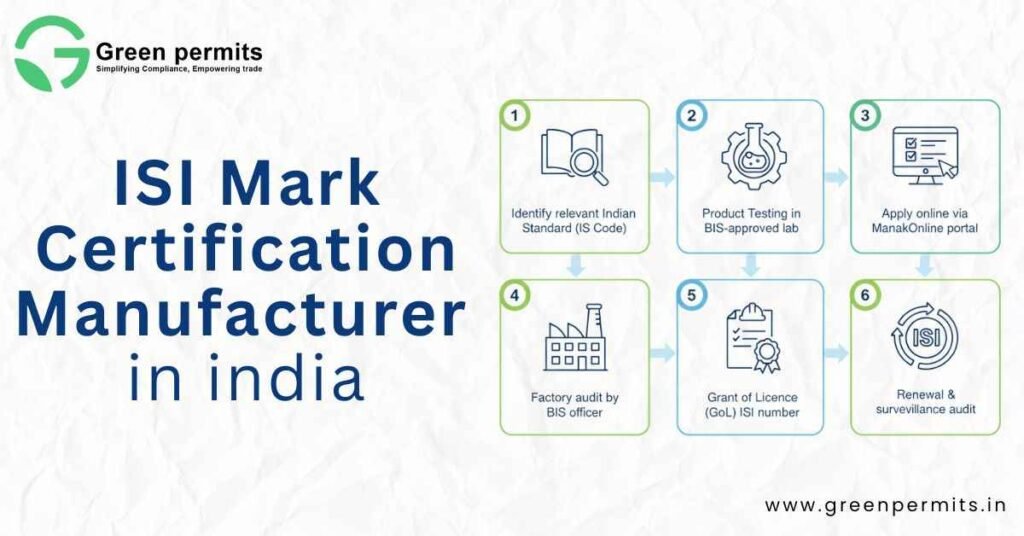
The process under the Scheme-I of BIS (as per the Bureau of Indian Standards Act, 2016) is methodical but manageable — if planned right.
Each product has a specific IS code. For example:
You’ll need to gather:
A complete and accurate document set prevents weeks of delays.
Manufacturers must register at https://www.manakonline.in or via the National Single Window System (NSWS).
After login:
You’ll receive an application ID for tracking.
Your product must undergo testing in a BIS-approved lab. The laboratory tests the sample against all applicable IS parameters — from performance to safety.
A test report is then uploaded directly to the BIS portal.
BIS officers or inspection agencies visit the manufacturing facility to verify:
This step confirms that your plant can consistently produce ISI-compliant goods.
Upon successful inspection and document review, BIS grants the Licence to Use Standard Mark for two years.
You’ll receive a unique CM/L (Certification of Manufacture Licence) number, which must appear on every product label, box, or user manual.
Example:
ISI Mark + CM/L No. 1234567
Before the licence expires, manufacturers must apply for renewal and submit performance data. BIS may conduct surveillance audits or draw random market samples to ensure ongoing compliance.
| Fee Component | Description | Typical Range |
|---|---|---|
| Application Fee | One-time filing fee | ₹1,000 |
| Processing Fee | Evaluation and audit cost | ₹25,000 |
| Annual Licence Fee | Renewal and continuation charge | ₹1,000 |
| Marking Fee | Based on production or sales volume | ₹0.50 – ₹3.00 per unit |
| Testing Charges | Laboratory testing (varies by product) | ₹10,000 – ₹75,000 |
MSMEs receive up to 80% rebate in marking fees under BIS’s latest incentive policy.
| Stage | Estimated Duration |
|---|---|
| Document Preparation | 5–7 days |
| Application & Test Sample Submission | 7–10 days |
| Lab Testing | 10–15 days |
| Factory Audit & Grant of Licence | 10–15 days |
| Total Time (Average) | 30–45 working days |
Delays usually arise from incomplete documentation or failed sample tests.
| Certification Scheme | Applies To | Jurisdiction | Key Requirement |
|---|---|---|---|
| ISI (Scheme-I) | Domestic manufacturers | BIS India | Factory inspection + lab testing |
| CRS | IT & Electronics (e.g., Laptops, Phones) | BIS India | Self-declaration after BIS testing |
| FMCS | Foreign manufacturers | BIS India | In-country testing + overseas inspection |
If your factory is in India — you need ISI.
If you import or brand foreign-made goods — you need FMCS.
If you produce IT/electronic goods — CRS is your path.
| Sector | Example Products | Relevant IS Code | QCO Implementation |
|---|---|---|---|
| Footwear | Safety & sports shoes | IS 15298 | Aug 2024 |
| Electrical Cables | PVC wires, power cords | IS 694 | Jan 2025 |
| Furniture | Metal and wooden furniture | IS 17624 | Jul 2025 |
| Helmets | Motorcycle & bicycle helmets | IS 4151 | Ongoing |
| Pressure Cookers | Domestic cookware | IS 2347 | Mandatory since 2024 |
| Steel Products | Structural & TMT bars | IS 1786 | Active QCO |
Selling, importing, or distributing products without a valid BIS licence can lead to:
Beyond the legal cost, non-compliance damages your brand reputation and supply chain partnerships.
Navigating the BIS portal, product testing, and inspection can be overwhelming for manufacturers. At Green Permits, we simplify this entire process.
Our experts assist you with:
IS code identification
Online BIS application and documentation
Coordination with BIS-approved labs
Factory inspection preparation
Renewal and post-licence compliance
We ensure that your certification is fast, accurate, and fully compliant with the latest BIS norms.
In addition to ISI certification, Green Permits helps businesses with:
The Indian market is moving rapidly toward standardization and sustainability.
Obtaining an ISI Mark Certification isn’t just about compliance — it’s about building trust, improving quality, and staying ahead of regulations.
By getting certified early, your business gains a strategic edge in tenders, exports, and consumer markets.
Remember: Compliance delayed is business denied.
Your one-stop partner for BIS Certification, EPR Authorizations, and Recycling Setup.
📞 +91 78350 06182
📧 wecare@greenpermits.in
🌐 www.greenpermits.in
Book a Consultation with Green Permits — and make your compliance journey smooth, fast, and audit-ready.