
Between 2024 and 2026, India’s solar manufacturing sector underwent a silent but powerful shift.
Earlier, businesses focused on land, machinery, and investment. Today, the focus has moved to approvals, certifications, and compliance timelines.
Plants that understood BIS certification, SPCB approvals, and EPR obligations early were able to start operations within 90–120 days. Others faced delays of 60–90 days, costing them ₹10–50 lakh every month due to idle capacity and blocked inventory.
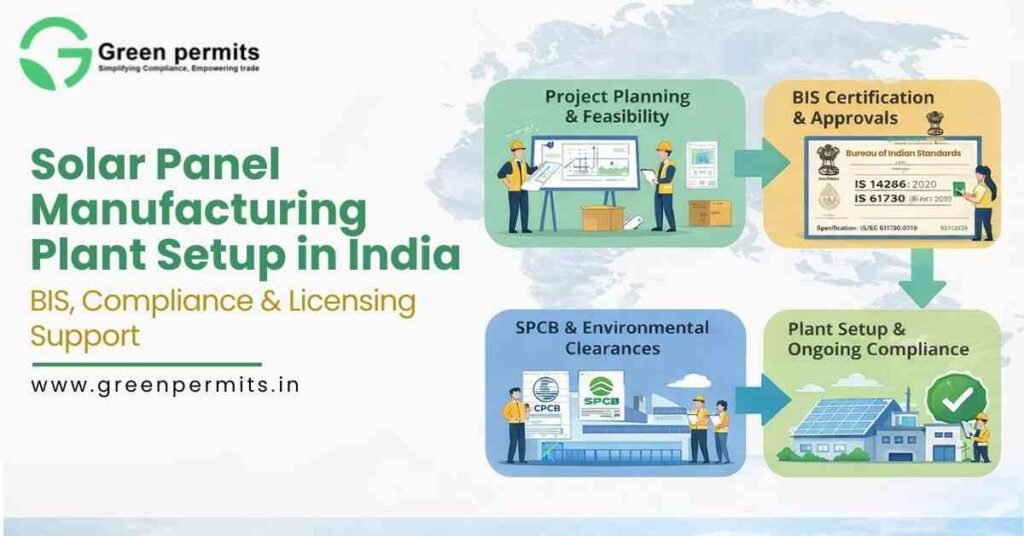
In 2026, solar manufacturing is no longer just an industrial setup—it is a compliance-driven project from day one.
India is targeting 500 GW renewable energy capacity by 2030, making solar manufacturing a high-growth sector. However, regulatory scrutiny has increased significantly.
Solar panels are classified under regulated electronic products, which means manufacturers must comply with multiple authorities before entering the market.
A typical solar manufacturing project today involves:
If compliance is not planned properly, delays of even 30–60 days can lead to losses of ₹10 lakh or more per month.
| Regulation | Key Requirement | Deadline | Applicable To | Risk if Ignored |
|---|---|---|---|---|
| BIS CRS Certification | Product certification | Before sale/import | Manufacturers | Product ban |
| SPCB CTE/CTO | Pollution approval | Before setup & operation | All plants | Shutdown |
| E-Waste Rules 2022 | EPR registration | Annual (30 June) | Manufacturers | Penalty |
| Hazardous Waste Rules | Waste authorization | Before operation | Chemical units | License rejection |
| MNRE ALMM | Market eligibility | Before supply | Solar manufacturers | Market restriction |
Solar manufacturing is a multi-layer compliance system. Missing even one approval can delay the entire project by 30 to 90 days.
Plant planning plays a crucial role in approvals. Authorities evaluate layout, capacity, and environmental impact before granting permissions.
Typical benchmarks for solar plants:
For large-scale units:
These numbers directly influence environmental clearance and SPCB approval conditions.
BIS certification is mandatory before any solar panel can be sold or imported in India.
The process is technical and requires detailed documentation.
Key steps include:
Typical timeline:
Common reasons for rejection:
Environmental approvals are required under pollution control laws.
This is required before construction begins. Authorities review:
This is required before starting production. Authorities verify:
Typical timelines:
Delays often occur when waste management systems are not properly planned.
Solar panels fall under electronic equipment, making EPR compliance mandatory.
Manufacturers are responsible for managing the lifecycle of their products, including disposal and recycling.
Key compliance requirements:
The system works on a certificate-based mechanism:
This ensures accountability and traceability in waste management.
| Step | Authority | Timeline | Documents Required | Risk Area |
|---|---|---|---|---|
| Land & DPR | State Authority | 15–30 days | Land documents | Delay |
| CTE Approval | SPCB | 30–60 days | Pollution plan | Rejection |
| BIS Certification | BIS | 30–90 days | Test reports | Market ban |
| EPR Registration | CPCB | 20–30 days | GST, PAN | Penalty |
| CTO Approval | SPCB | 30–45 days | Compliance report | Shutdown |
If approvals are done sequentially, the process can take up to 180 days. With proper planning and parallel execution, this can be reduced to 90–120 days.
Solar manufacturing generates chemical and industrial waste that must be handled carefully.
Typical waste streams include:
Mandatory compliance includes:
Improper waste management is one of the top reasons for project delays.
Non-compliance directly impacts operations and profitability.
Common risks include:
Businesses often face:
Violations fall under Section 15 of Environment Protection Act, 1986, which includes financial penalties and operational restrictions.
These challenges are already happening across the industry.
These are practical risks that every new manufacturer must prepare for.
Solar panel manufacturing in India is a high-potential sector, but it is equally compliance-intensive.
Projects that plan approvals early:
On the other hand, ignoring compliance can lead to operational delays, penalties, and lost opportunities.
In today’s regulatory environment, success in solar manufacturing depends not just on investment—but on how well compliance is executed.
📞 +91 78350 06182
📧 wecare@greenpermits.in