
A first-time entrepreneur once told us, “On paper, pyrolysis looked faster and more profitable. But every conversation with the pollution board made me nervous.”
That hesitation is becoming common across India’s waste management sector.
Choosing between tyre recycling and pyrolysis is no longer just a technology decision. It’s about regulatory comfort, long-term viability, and how much uncertainty you’re willing to live with.
This blog breaks down both models from a sustainability, compliance, and business survival perspective.
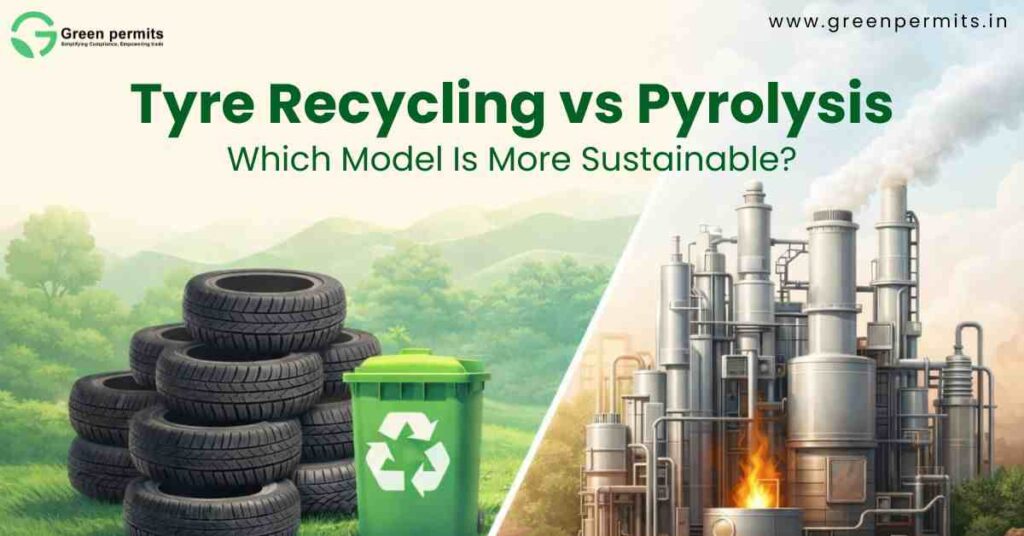
Many business owners jump into this sector after hearing success stories. But sustainability depends on how the model actually functions day to day.
Tyre recycling is a material recovery-driven operation. Instead of destroying tyres, the process focuses on converting waste into reusable industrial inputs.
The recycling chain usually includes:
The recovered materials are used in:
From a business perspective, recycling creates repeat demand, because industries constantly require these secondary raw materials.
Pyrolysis is a thermal conversion process. Tyres are heated in a closed reactor, breaking them down into oil, carbon black, gas, and steel.
While the concept is often marketed as “waste-to-energy,” the operational reality is more complex.
A typical pyrolysis setup involves:
The business becomes closely tied to fuel markets, carbon black pricing, and regulatory tolerance, which can fluctuate significantly.
Sustainability today is not a buzzword. It directly affects approvals, renewals, and investor confidence.
Tyre recycling is largely a mechanical process, meaning emissions are minimal and predictable. Most environmental focus is on dust control and safe material handling.
Pyrolysis, on the other hand, involves:
If emission systems are even slightly mismanaged, the plant can attract complaints or inspections.
For businesses, this means recycling offers a calmer operational environment, while pyrolysis demands constant vigilance.
India’s waste policy direction increasingly favors material recovery over thermal destruction.
Recycling supports:
Pyrolysis partially contributes to resource recovery but still converts material into fuels, which limits its circular impact.
From a sustainability standpoint, recycling fits more naturally into long-term environmental planning.
This is where many business models succeed or fail.
Tyre recycling plants usually require:
Once systems are in place, regulatory interaction tends to be predictable.
Pyrolysis plants require:
This difference directly impacts operational peace of mind.
A recycling unit’s compliance effort remains relatively stable year after year.
A pyrolysis unit often faces:
Many operators underestimate this burden during project planning.
Initial profits do not define a sustainable business. Stability does.
Recycling plants typically involve:
Pyrolysis plants often face:
Businesses that plan for 10–15 years usually prioritize predictability over quick returns.
Several recycling operators have expanded capacity after gaining confidence in approvals and market demand.
In contrast, many pyrolysis operators report:
The technology may work, but regulatory comfort determines growth.
When sustainability is viewed holistically — environment, compliance, finances, and scalability — tyre recycling emerges as the more balanced option.
Tyre recycling offers:
Pyrolysis may still suit specific cases, but it requires higher risk tolerance and constant regulatory engagement.
If your goal is to build a business that:
Then tyre recycling is the more sustainable and future-ready choice.
Before committing capital, understanding location feasibility, approval timelines, and compliance costs can make or break the project.
📞 +91 78350 06182
📧 wecare@greenpermits.in