
For many transporters and fleet operators in West Bengal, used tyres pile up faster than they can be disposed of. What often looks like a waste-handling headache is actually a commercially viable recycling opportunity—if done correctly. Entrepreneurs entering tyre recycling quickly realize that success depends less on machinery and more on regulatory clarity, location planning, and market alignment.
This guide explains how to set up a tyre waste recycling plant in West Bengal with a clear understanding of approvals, investment, compliance risks, and long-term profitability.
West Bengal holds a unique advantage in eastern India due to its dense urban population and transport-driven economy. The combination of passenger vehicles, freight trucks, buses, and industrial transport results in continuous generation of end-of-life tyres (ELTs).
From a business perspective, the state offers steady raw material availability throughout the year, reducing dependence on inter-state tyre procurement. This lowers logistics costs and ensures smoother plant operations.
For recyclers, proximity to industrial buyers and eastern port infrastructure adds an extra layer of commercial security, especially for oil and carbon black sales.
Selecting the right industrial zone directly affects approval timelines, operating costs, and scalability.
Kolkata and Howrah provide access to large ELT volumes from urban fleets, though land costs and compliance scrutiny are higher.
Durgapur offers a balanced mix of industrial infrastructure, land availability, and connectivity to buyers.
Asansol benefits from proximity to cement and steel industries, making it attractive for fuel oil and co-processing markets.
From a regulatory standpoint, zones already hosting red-category industries usually face fewer objections during pollution control approvals.
A consistent ELT supply chain is the backbone of any tyre recycling business. In West Bengal, sourcing is rarely the problem—structuring it legally and efficiently is.
Common sourcing channels include:
Businesses that rely on long-term sourcing agreements rather than spot purchases experience fewer operational disruptions and better cost predictability.
Tyre recycling is categorized as a high-impact industrial activity, making documentation accuracy critical.
Before installation, businesses must obtain Consent to Establish (CTE) from WBPCB. This approval is based on land use, plant layout, pollution control design, and waste handling plans.
After installation and trial runs, Consent to Operate (CTO) is required to begin commercial operations. Additional permissions include hazardous waste authorization, fire safety clearance, and factory licensing.
A common reason for application rejection is mismatch between machinery capacity and pollution control infrastructure, which signals poor planning to regulators.
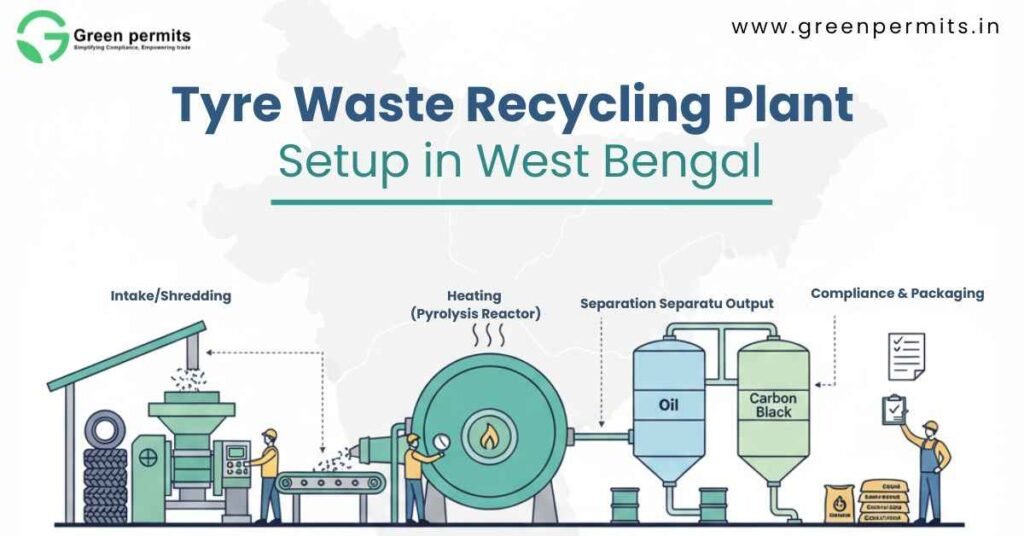
Machinery selection should align with both output goals and compliance requirements. While cost is a factor, approval authorities focus more on emission control and safety systems.
A standard setup includes:
Overloading machinery beyond approved capacity is one of the fastest ways to attract regulatory action.
Capital investment varies widely depending on scale and technology choice.
Smaller units allow first-time entrepreneurs to enter the market with controlled risk, while larger plants offer better economies of scale but demand stronger compliance systems and working capital.
Operational costs are influenced by power consumption, labour, maintenance, emission control upkeep, and transportation of finished products.
Businesses that budget realistically for compliance-related expenses face fewer financial surprises post-commissioning.
West Bengal promotes recycling and circular economy initiatives through its industrial policies. Tyre recycling units may qualify for incentives such as capital subsidies, electricity duty exemptions, and stamp duty rebates.
Eligibility depends on investment size, location, employment generation, and MSME registration status. Many units miss out on benefits simply because applications are not aligned with policy conditions.
Early incentive mapping helps improve project viability and investor confidence.
The success of a tyre recycling plant depends on reliable buyers.
Recovered oil is used by industrial furnaces and alternative fuel users. Carbon black finds demand in rubber compounding, construction materials, and pigment applications. Steel wire recovered from tyres is sold to scrap and metal processing units.
Plants that secure buyer commitments during the planning stage face fewer cash flow bottlenecks after commissioning.
Compliance does not end with approvals—it continues throughout the plant’s lifecycle.
Key focus areas include:
Failure to comply can result in show-cause notices, operational suspension, or cancellation of consent. In several cases, plants with good technology but weak compliance systems face forced shutdowns.
A structured approach reduces delays and regulatory friction.
The typical journey includes land finalization, regulatory feasibility checks, CTE approval, machinery installation, trial operations, CTO clearance, and commercial launch.
Projects managed with professional compliance support often reach commissioning faster and with fewer objections from authorities.
Tyre waste recycling in West Bengal offers genuine business potential, but only for those who treat compliance as a core strategy rather than an afterthought. Early approvals, correct documentation, and realistic planning protect your investment and ensure operational stability.
Businesses that plan responsibly save time, capital, and long-term stress.
📞 +91 78350 06182
📧 wecare@greenpermits.in
Book a Consultation with Green Permits
Get end-to-end support for approvals, compliance, and tyre recycling plant setup in West Bengal.