
Karnataka has emerged as one of India’s strongest environments for establishing organized vehicle scrapping units. With a mature automobile industry, large IT-enabled mobility operations, and a rapidly expanding transportation network, the state generates continuous end-of-life vehicle (ELV) supply. For investors and entrepreneurs, this presents a viable and scalable opportunity to build a compliant Registered Vehicle Scrapping Facility (RVSF).
This guide explains the regulatory requirements, location advantages, costs, approvals, and operational frameworks involved in setting up a scrapping plant in Karnataka.
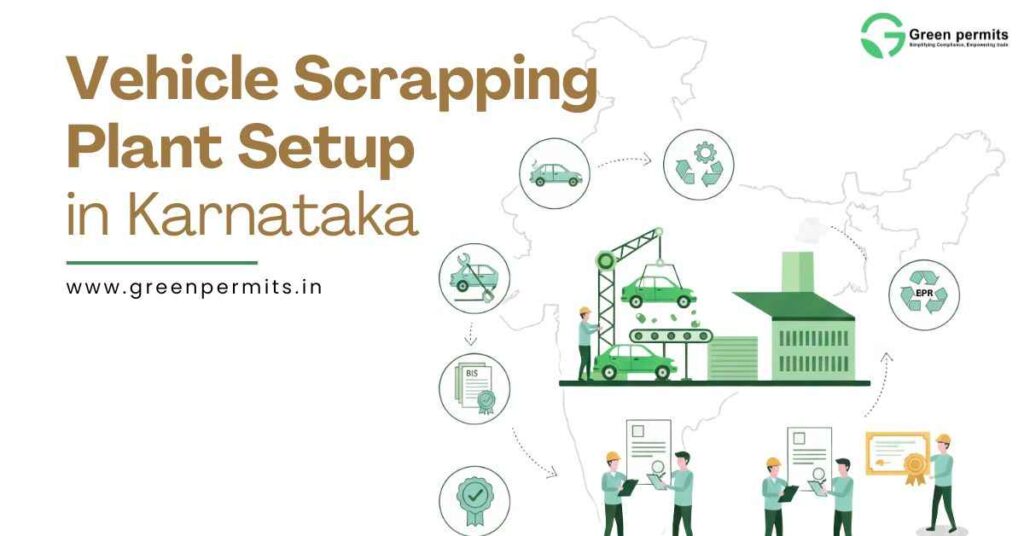
Karnataka hosts a diverse economic mix—automobile manufacturing, engineering clusters, logistics hubs, and large-scale IT campus fleets. These sectors collectively contribute to high vehicle turnover, significantly increasing ELV availability.
Karnataka stands out for:
The resulting combination ensures consistent, year-round sourcing of ELVs while creating a ready market for recycled materials, metals, and components processed through formal scrapping channels.
Selecting the right location determines the efficiency of plant operations. Karnataka’s industrial regions offer advantages in land availability, logistics convenience, and access to suppliers and buyers.
The city has the largest concentration of private vehicles and fleet operators in the state. Industrial areas like Peenya, Dobbespet, Hoskote, Devanahalli, and Bidadi are ideal for plant setup due to connectivity, labour availability, and industrial infrastructure.
This region is known for stable industrial land pricing, planned industrial estates, and a growing automotive service ecosystem. It is preferred by investors looking for lower operational costs.
This area is emerging as an auto component and engineering hub, with high metal consumption and strong connectivity to northern Karnataka and neighbouring states.
Peenya is among Asia’s largest industrial zones and supports everything from machining units to heavy fabrication. Its access to OEMs and transport networks makes it ideal for machinery-heavy facilities like scrapping units.
Choosing a location near industrial corridors or logistics routes helps in reducing vehicle transport costs and attracting consistent ELV inflow.
A scrapping facility is sustainable only when ELV supply remains steady. Karnataka offers multiple structured and predictable sources of end-of-life vehicles.
Key supply channels include:
These sources allow structured procurement planning, helping RVSFs operate at full efficiency throughout the year.
Setting up a scrapping plant requires specific environmental and operational approvals. Failing to obtain any one of them may delay commissioning or even halt operations.
Obtaining CTE and CTO from KSPCB is essential before applying for RVSF registration.
The scrapping process is structured around depollution, dismantling, shredding, and sorting. Machinery must meet environmental standards and support high-volume operations.
| Component | 1 TPD | 3 TPD | 5 TPD |
|---|---|---|---|
| Depollution Rig | ₹12–15 lakh | ₹18–25 lakh | ₹25–30 lakh |
| Dismantling Tools | ₹10–12 lakh | ₹15–18 lakh | ₹20–25 lakh |
| Shredder/Crusher | ₹35–45 lakh | ₹60–75 lakh | ₹90 lakh–₹1.2 Cr |
| Baler | ₹10–15 lakh | ₹15–18 lakh | ₹20–22 lakh |
| Civil & Infrastructure | ₹30–50 lakh | ₹70–90 lakh | ₹1–1.5 Cr |
| Total | ₹1–1.5 Cr | ₹2.2–3 Cr | ₹3.5–4.5 Cr |
Interpretation:
A mid-size 3-TPD plant offers a balance of cost efficiency and processing volume suitable for Karnataka’s vehicle density.
Operational expenses include labour wages, electricity, machinery maintenance, pollution control operations, and ELV transport logistics.
Karnataka encourages circular economy initiatives, including vehicle scrapping. Investors may be eligible for multiple financial incentives under state schemes.
These benefits significantly reduce the financial burden of establishing a plant when availed early.
Revenue generation depends on the efficient recovery and sale of processed materials.
With proper segregation and quality control, recycled materials can command competitive prices.
Ensuring compliance is essential for maintaining operational continuity and avoiding penalties.
A well-prepared compliance system ensures operational stability and long-term credibility for the scrapping plant.
The overall establishment process depends on documentation readiness, land availability, and approval timelines.
| Stage | Duration | Output |
|---|---|---|
| Land Identification | 2–4 weeks | Suitable industrial plot finalised |
| CTE Approval | 30–45 days | Permission to begin construction |
| Civil Works & Machinery Installation | 60–90 days | Facility infrastructure completed |
| CTO Approval | 30 days | Approval to commence operations |
| RVSF Registration | 30–45 days | Licensed vehicle scrapping facility |
Interpretation:
With streamlined documentation, a Karnataka-based scrapping plant can generally be commissioned within 5 to 7 months.
Karnataka offers a strong ecosystem for establishing a vehicle scrapping plant due to its industrial diversity, large vehicle population, and regulatory support for sustainable recycling. With proper planning, investment, and adherence to environmental norms, investors can build a long-term, compliant, and profitable RVSF in the state.
Early action on licensing, documentation, and machinery selection will help avoid delays and unnecessary costs. Professional guidance ensures smooth navigation through KSPCB and MoRTH processes.
For end-to-end assistance with RVSF documentation, approvals, and compliance:
Call: +91 78350 06182
Email: wecare@greenpermits.in