
A solar manufacturer finalizes a ₹25 crore EPC contract for a state government solar park. Technical approvals are cleared, pricing is competitive, and delivery timelines are aligned. However, just before execution, the order is cancelled.
The reason is simple but critical. The solar modules are not listed under ALMM.
In India, more than 70 percent of government and PSU solar projects require ALMM-approved modules. Without this listing, even technically sound and cost-effective products are rejected at the procurement stage.
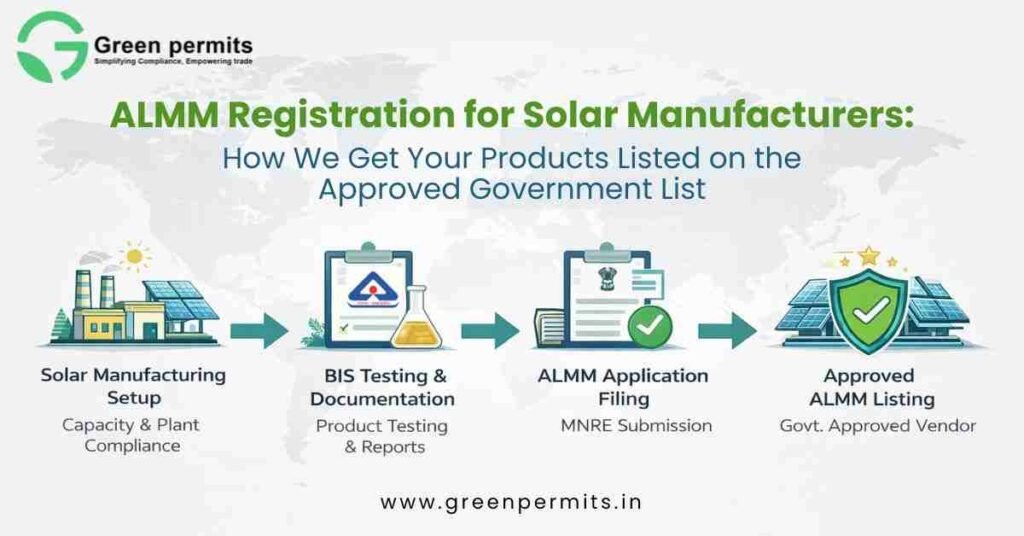
ALMM Registration for Solar Manufacturers is a regulatory requirement issued by the Ministry of New and Renewable Energy (MNRE) to ensure that only compliant and quality-tested solar modules are deployed in government-backed projects.
India is targeting over 500 GW of non-fossil fuel capacity by 2030. Out of this, solar is expected to contribute more than 280 GW. This scale makes regulatory compliance like ALMM critical for market access.
Manufacturers who fail to align with ALMM face:
The Approved List of Models and Manufacturers (ALMM) is an official government list of solar PV modules that meet quality and performance standards defined by MNRE.
The objective is to regulate the solar supply chain and ensure long-term performance of solar assets across India.
In practical terms, ALMM acts as a market filter. Only listed modules are eligible for use in government projects, subsidies, and many large private EPC contracts.
ALMM directly impacts revenue and scalability for manufacturers.
| Regulation | Requirement | Deadline | Applicable To | Risk |
|---|---|---|---|---|
| MNRE ALMM Order | Mandatory module listing | Before supply | Solar manufacturers | Tender rejection |
| BIS CRS Scheme | Product certification | Before ALMM | Manufacturers/importers | Application rejection |
| SPCB Consent | Environmental approval | Before production | Plant owners | Shutdown risk |
ALMM is not a single approval. It is a layered compliance structure.
A manufacturer must align product certification, factory compliance, and regulatory filings before even initiating ALMM listing. Missing any one requirement can delay approvals by 30 to 90 days.
The ALMM registration process involves multiple regulatory checkpoints. On average, the complete process takes between 60 to 120 days depending on readiness.
This is the foundation of ALMM approval.
Solar modules must be tested under Indian standards such as:
Testing is conducted in BIS-approved laboratories and typically takes 25 to 45 days.
Once BIS certification is obtained, manufacturers must submit detailed applications to MNRE including product and factory details.
The accuracy of this stage is critical. Even minor inconsistencies can lead to rejection or re-submission cycles.
Authorities verify:
This stage ensures that declared specifications match actual production capability.
Inspection teams evaluate manufacturing units based on:
A mismatch between declared and actual capacity is one of the most common reasons for rejection.
Once approved:
| Step | Authority | Timeline | Documents | Risk |
|---|---|---|---|---|
| BIS Certification | BIS | 30 to 45 days | Test reports | Delay in ALMM |
| Application Filing | MNRE | 10 to 15 days | BIS + company docs | Rejection |
| Inspection | MNRE | 15 to 30 days | Plant details | Non-compliance |
| Listing Approval | MNRE | 10 to 20 days | Final approval | Market delay |
A delay of even 20 to 30 days can result in missing a tender window. Since many EPC contracts are time-bound, compliance timing directly impacts revenue realization.
Proper documentation is the backbone of successful approval. Most rejections occur due to incomplete or inconsistent submissions.
Companies operating across multiple states or product lines must ensure consistency across all documentation. Discrepancies can lead to delays of 15 to 30 days.
ALMM approval is strongly dependent on technical validation and product performance.
Solar modules must meet strict criteria in terms of safety, durability, and efficiency.
A manufacturer supplying 50 MW modules loses a PSU contract worth ₹18 crore because the modules were not listed in ALMM.
A delay of 45 days in BIS certification leads to missing a government tender window, resulting in a revenue loss of ₹10 crore.
A unit declaring 500 MW capacity is found to have only 320 MW operational capacity, leading to application rejection.
Non-compliance with ALMM can result in both direct and indirect financial losses.
In extreme cases, non-compliance can trigger regulatory scrutiny under environmental and industrial laws, leading to operational disruption.
ALMM does not operate in isolation. It is closely connected with other regulatory frameworks.
A manufacturer must ensure alignment across:
This multi-layer compliance structure ensures that both product quality and environmental responsibility are maintained.
ALMM Registration for Solar Manufacturers is a strategic requirement, not just a regulatory formality.
With India’s solar market expected to cross ₹10 lakh crore in investments over the next decade, manufacturers who align early with compliance frameworks gain a strong competitive advantage.
Delays in compliance lead to:
Early planning, accurate documentation, and structured execution are critical for successful ALMM approval.
📞 +91 78350 06182
📧 wecare@greenpermits.in