
A mid-sized listed company in India recently faced investor pushback during its annual disclosures—not because of weak financial performance, but due to inconsistent ESG reporting under BRSR.
Key metrics such as energy consumption and waste generation showed unexplained year-on-year variation of nearly 18–22%, raising concerns among institutional investors. Within a quarter, the company’s ESG rating dropped, impacting its ability to access ESG-linked financing and long-term capital.
This is no longer an isolated case. Across FY 2024–25, companies are realizing that ESG disclosures are directly linked to valuation, investor confidence, and regulatory scrutiny.
With the introduction of BRSR Core and mandatory assurance, SEBI has effectively transformed ESG reporting into a data-driven compliance and financial governance system.
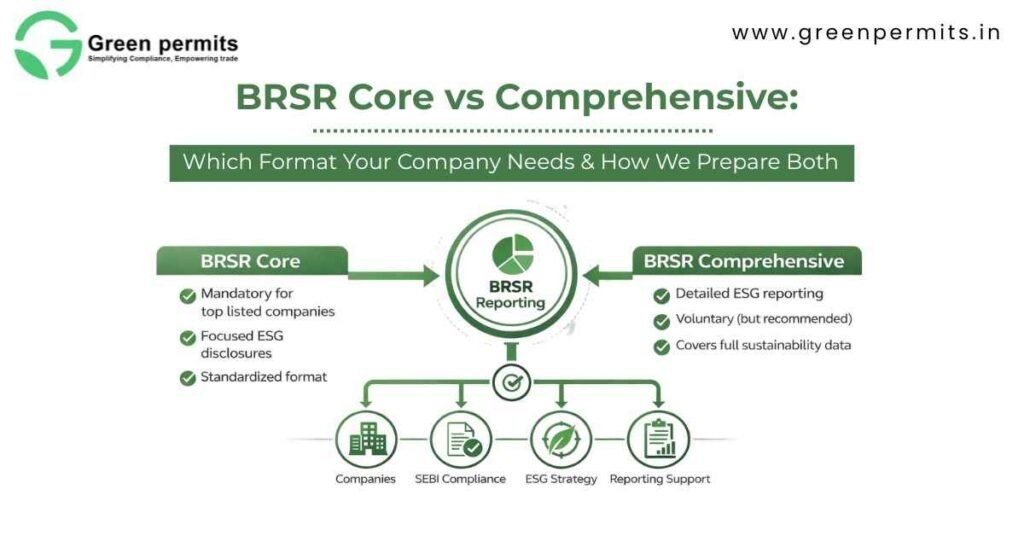
Understanding BRSR Core vs Comprehensive is therefore not just a reporting requirement—it is critical for managing business risk in 2026.
BRSR (Business Responsibility and Sustainability Reporting) is a mandatory ESG disclosure framework applicable to the top 1000 listed companies in India, as per Regulation 34(2)(f) of SEBI LODR Regulations.
The framework must be submitted along with the annual report within 120–150 days from the end of the financial year, which typically places the deadline around 30 June.
Over the last two financial cycles, BRSR has evolved from a policy-based disclosure system into a structured, metric-driven compliance mechanism.
This shift means ESG data must now be accurate, consistent, and audit-ready throughout the year, not just at the time of filing.
Understanding BRSR Core vs Comprehensive is essential because companies are required to manage both formats simultaneously, not choose between them.
The difference lies in depth, audit requirement, and purpose.
BRSR Comprehensive is the complete reporting structure that includes more than 130 disclosure points across environmental, social, and governance dimensions.
It provides a holistic view of a company’s sustainability practices and governance systems.
Because of its breadth, Comprehensive reporting requires coordination across multiple departments such as operations, HR, procurement, finance, and compliance.
BRSR Core is a focused subset of the Comprehensive framework, designed to standardize ESG reporting using measurable indicators.
It includes approximately 25–26 KPIs, all of which must be supported by verifiable data and documentation.
Unlike Comprehensive reporting, BRSR Core introduces mandatory third-party assurance, making it significantly more stringent.
Even minor inconsistencies in data can result in audit observations or qualification remarks, making preparation critical.
| Regulation | Key Requirement | Deadline | Applicable To | Risk if Ignored |
|---|---|---|---|---|
| SEBI LODR Regulation 34(2)(f) | Mandatory BRSR disclosure | Annual (~30 June) | Top 1000 companies | Filing rejection |
| SEBI Circular (12 July 2023) | Introduction of BRSR Core | FY 2023–24 onward | Listed entities | Non-compliance notice |
| Assurance Mandate | Third-party ESG verification | FY 2024–25 onward | Top 150 → 250 | Audit qualification |
The regulatory trend clearly indicates that ESG disclosures are being aligned with financial reporting standards, where accuracy, consistency, and auditability are essential.
BRSR compliance requires continuous tracking of ESG data across the financial year. However, many companies still treat it as a year-end activity, which leads to delays and data gaps.
| Step | Authority | Timeline | Documents Required | Risk Area |
|---|---|---|---|---|
| ESG Data Collection | Internal Teams | Apr–Mar | Operational ESG data | Missing metrics |
| KPI Mapping | Compliance Team | April | ESG classification | Misreporting |
| Assurance Audit | Third-party auditor | May–June | KPI evidence | Audit failure |
| Final Filing | Stock Exchange | By 30 June | Final report | Delay |
Companies that implement structured ESG tracking systems reduce compliance risks by 40–50%.
BRSR Core focuses on 9 key ESG attributes that are used to evaluate a company’s sustainability performance.
These metrics are increasingly being used by investors and rating agencies.
Failure to maintain accurate data across these metrics is one of the most common reasons for assurance failures.
The applicability of BRSR depends on market capitalization but its impact extends across supply chains.
Large corporations are now extending ESG requirements to suppliers, impacting thousands of MSMEs indirectly.
Failure to comply with BRSR requirements can have serious business implications.
Violation may also attract penalties under Section 15 of the Environment Protection Act, 1986, particularly for incorrect environmental disclosures.
These cases highlight that ESG reporting errors can directly impact financial and operational outcomes.
Preparing BRSR reports requires a structured and data-driven approach rather than last-minute compilation.
Organizations that adopt structured ESG systems reduce delays by 30–40% and improve reporting accuracy significantly.
Understanding BRSR Core vs Comprehensive is essential for companies navigating ESG compliance in 2026.
The shift toward measurable, assured ESG reporting means that businesses must treat sustainability data with the same rigor as financial reporting.
Companies that proactively build ESG systems benefit from:
On the other hand, poor reporting can lead to delays, financial impact, and reputational damage.
In today’s regulatory environment, BRSR is not just compliance—it is a reflection of how responsibly a company operates and how seriously it is taken by the market.
📞 +91 78350 06182
📧 wecare@greenpermits.in
Book a Consultation with Green Permits