
In the last two financial years, BRSR reporting has evolved from a disclosure requirement into a core regulatory compliance function. What began as an ESG transparency initiative is now directly tied to investor confidence, regulatory scrutiny, and operational continuity.
Under SEBI (LODR) Regulations, BRSR is mandatory for the top 1000 listed companies, covering nearly 80–85% of India’s total market capitalization. This means a significant portion of India’s corporate ecosystem is now under structured ESG reporting obligations.
Between FY 2023-24 and FY 2025-26, regulators and investors have shifted focus from policy declarations to data validation. Companies are now expected to provide measurable, verifiable, and auditable ESG data.
In practical terms, this means:
BRSR reporting is structured into multiple layers, but the most critical part lies in quantitative ESG disclosures, especially environmental data.
Companies are required to disclose:
The reporting is aligned with 9 principles under NGRBC, but in reality, nearly 60-70% of compliance complexity lies in environmental data accuracy.
Typical reporting expectations include:
This is where most companies face difficulty-not in writing the report, but in aligning data across departments and regulatory filings.
One of the biggest misconceptions is that BRSR is separate from environmental compliance. In reality, the two are deeply interconnected.
Environmental data reported in BRSR must match:
For example, if a company reports 1,200 MT of plastic waste generated, but CPCB filings show only 850 MT, it creates a compliance inconsistency.
Key environmental integrations include:
In sectors like electronics, FMCG, and automotive, over 50% of BRSR environmental disclosures depend on EPR compliance data.
India’s ESG reporting framework is not governed by a single law. Instead, it is a combination of SEBI regulations and environmental rules under the Environment Protection Act, 1986.
| Regulation | Key Requirement | Deadline | Applicable To | Risk if Ignored |
|---|---|---|---|---|
| SEBI BRSR Framework | ESG disclosure in annual report | Annual | Top 1000 companies | Investor scrutiny |
| E-Waste Rules 2022 | EPR compliance and reporting | Annual | Producers | CPCB rejection |
| Plastic Waste Rules 2025 | Barcode + EPR disclosure | From July 2025 | PIBOs | Financial penalties |
| ELV Rules 2025 | Recycling targets (8%-18%) | FY-based | Auto sector | Compliance failure |
The key takeaway is that BRSR acts as a reporting layer, while actual compliance happens under multiple environmental regulations.
BRSR reporting is not a one-time activity. It is a year-long process that requires coordination across departments.
A typical compliance cycle looks like this:
| Step | Authority | Timeline | Documents Required | Risk Area |
|---|---|---|---|---|
| ESG Data Collection | Internal | Jan–March | Waste, energy records | Data mismatch |
| EPR Filing | CPCB | By 30 June | GST, PAN, certificates | Rejection |
| Data Validation | Internal/Auditor | April–May | ESG metrics | Errors |
| BRSR Drafting | Company | May–June | Final disclosures | Inconsistency |
| Submission | SEBI | Annual filing | Approved report | Non-compliance |
Most companies face delays because EPR filings (due by 30 June) are not completed on time, which directly affects BRSR accuracy.
EPR targets are one of the most critical numerical components in ESG reporting.
For example, under ELV Rules:
Similarly, in e-waste:
These numbers must be reflected accurately in BRSR:
Failure to meet or report these targets can lead to:
All environmental compliance data originates from CPCB portals. Without accurate portal filings, BRSR reporting cannot be completed correctly.
Companies must maintain:
The CPCB system typically operates with:
A delay or error at this stage can cascade into BRSR reporting delays or inconsistencies.
Based on industry trends, the most common issues include:
In many mid-sized companies, ESG data is still maintained manually, leading to 15–25% data discrepancies during audits.
Compliance failures are not theoretical—they have direct financial consequences.
In one case, an importer faced shipment delays of 15–20 days, leading to demurrage losses exceeding ₹10 lakh due to missing EPR linkage.
A manufacturing company reported incorrect waste data and had to:
In another instance, an automotive company miscalculated recycling targets, resulting in:
BRSR compliance is not just about preparing a report—it is about aligning multiple regulatory systems into one accurate output.
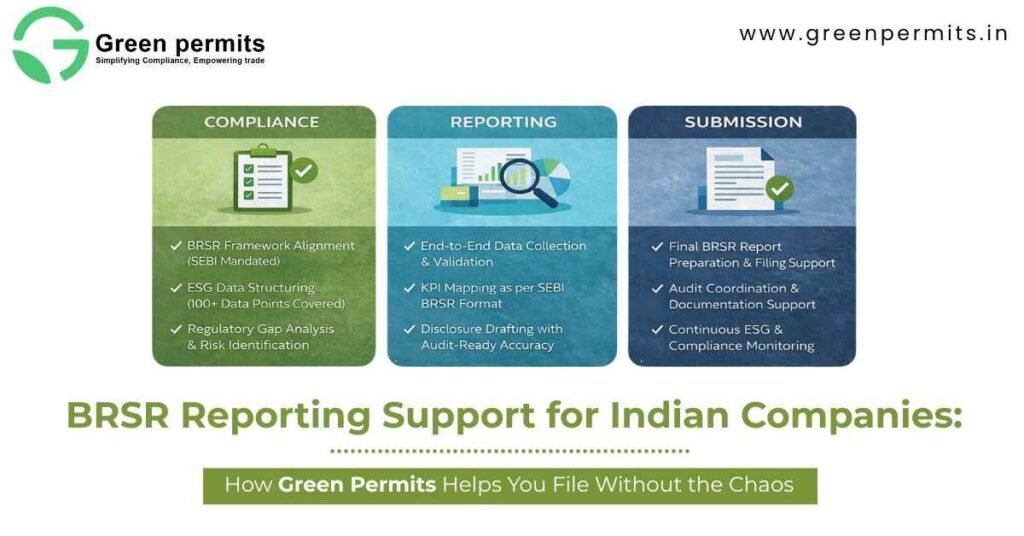
A structured approach typically includes:
Effective support ensures:
BRSR reporting in 2026 represents a shift toward data-driven regulatory compliance. It connects ESG disclosures with real operational data, making accuracy and consistency critical.
Companies that treat BRSR as a documentation exercise often face delays, penalties, and reputational risks. On the other hand, businesses that integrate compliance systems early can:
In a regulatory environment where numbers matter more than narratives, structured compliance is no longer optional—it is essential.
📞 +91 78350 06182
📧 wecare@greenpermits.in