
A mid-sized electronics manufacturer recently faced a sharp drop in its ESG rating from “A” to “BBB” within one reporting cycle. The issue was not financial performance or governance failure. The real reason was non-compliance. Their EPR returns were filed late, waste traceability records were incomplete, and CPCB portal submissions had inconsistencies.
Within 6 months, this resulted in investor queries, delayed approvals from authorities, and increased scrutiny from SPCB. The company had to spend additional resources to correct compliance gaps and regain its ESG position.
This is becoming a frequent situation in India where ESG ratings are no longer driven by sustainability reports alone. They are directly linked to regulatory compliance and real operational data.
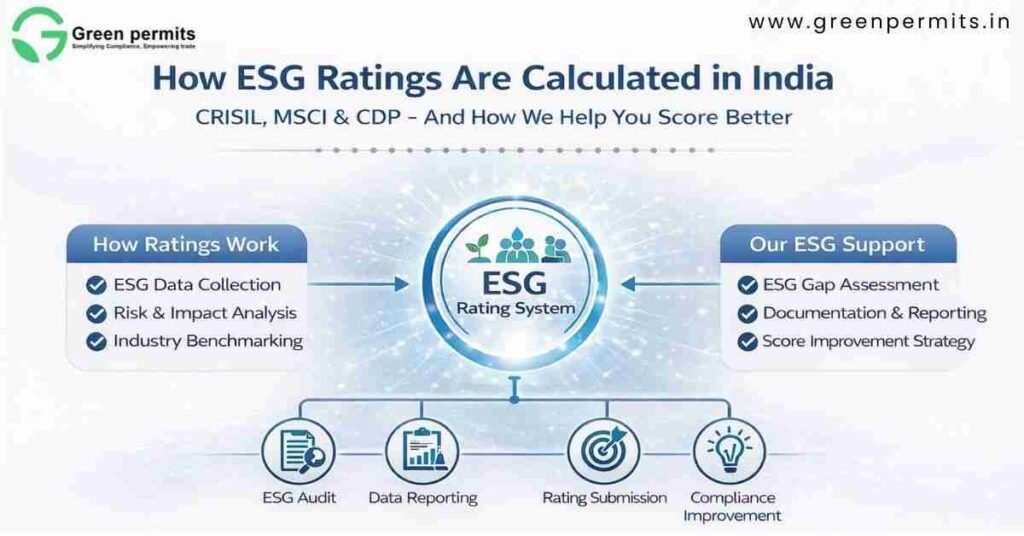
ESG ratings in India have moved from voluntary disclosures to structured, compliance-driven evaluation systems. Regulatory frameworks such as SEBI BRSR, CPCB EPR portals, and MoEFCC environmental rules now play a central role in determining ESG scores.
For most manufacturing and import-based businesses, ESG performance is now evaluated through measurable compliance metrics. Companies are expected to demonstrate real environmental performance, not just policy declarations.
The urgency has increased significantly due to regulatory and market factors:
Businesses that fail to align ESG with compliance frameworks often face score downgrades, while compliant companies gain a competitive advantage in funding and approvals.
ESG ratings are calculated using a structured scoring model across three pillars: Environmental, Social, and Governance. Each pillar is evaluated using quantitative and qualitative data, but in India, environmental compliance carries the highest weightage.
The environmental component is the most critical for industries such as manufacturing, electronics, automotive, and chemicals. It evaluates how effectively a company manages emissions, waste, and resource consumption.
In India, this pillar is heavily influenced by CPCB regulations and waste management rules. ESG agencies assess whether companies are meeting their legal obligations under frameworks like E-Waste Rules 2022, Battery Waste Rules, Plastic Waste Management Rules, and ELV Rules 2025.
Companies are expected to demonstrate actual recycling performance, emission reduction, and compliance filing accuracy. Data is often verified through portal submissions and audit records.
Key evaluation parameters include:
The social pillar evaluates how a company manages its workforce, supply chain, and community impact. While it has relatively lower weightage than environmental factors, it still plays an important role in ESG scoring.
Companies are assessed on employee safety, working conditions, and social responsibility initiatives. In industries with high labor intensity, this pillar becomes more significant.
Important factors include:
Governance focuses on how well a company manages compliance, transparency, and reporting systems. In India, governance is closely linked with regulatory filings and ESG disclosures.
Companies with strong governance frameworks tend to have consistent ESG scores because their reporting systems are reliable and audit-ready.
Key parameters include:
A detailed analysis of ESG rating methodologies shows that environmental compliance contributes the highest impact on scoring, especially in regulated industries.
CRISIL ESG ratings are widely used in India and focus heavily on regulatory compliance and risk exposure. The scoring model evaluates how well companies align with Indian environmental laws and compliance frameworks.
CRISIL assesses real compliance performance, including CPCB registrations, EPR filings, and environmental approvals. Companies with poor compliance records are assigned higher risk scores.
Key evaluation areas:
MSCI ESG ratings are used by global investors and focus on risk exposure rather than detailed regulatory compliance. The rating scale ranges from AAA to CCC.
While MSCI considers environmental performance, it does not deeply integrate India-specific compliance frameworks such as CPCB portal filings or EPR obligations.
Key evaluation areas:
CDP focuses specifically on climate-related disclosures and environmental transparency. Companies are scored from A to D based on their climate performance and reporting quality.
This model is particularly relevant for export-oriented companies and businesses with international stakeholders.
Key evaluation areas:
Each agency uses a different approach, which leads to variation in ESG scores.
For Indian companies, compliance alignment plays a decisive role in achieving consistent ESG scores across all agencies.
| Regulation | Requirement | Deadline | Applicable To | Risk |
|---|---|---|---|---|
| E-Waste Rules 2022 | EPR registration and recycling targets | Ongoing | Electronics sector | Registration rejection |
| Battery Waste Rules 2025 | EPR registration and labeling | Immediate | Battery producers | Portal suspension |
| PWM Amendment 2025 | Barcode traceability requirement | 01 July 2025 | Plastic users | SPCB action |
| ELV Rules 2025 | Recycling targets 8 percent to 18 percent | Financial year based | Automobile sector | Environmental compensation |
These regulations directly influence ESG scores because agencies evaluate whether companies are meeting their legal obligations.
Key insights:
| Step | Authority | Timeline | Documents | Risk |
|---|---|---|---|---|
| Registration | CPCB or SPCB | 30 to 60 days | GST, PAN, CIN, IEC | Rejection |
| Quarterly Filing | CPCB | Every quarter | Waste data | Suspension |
| Annual Return | CPCB | Once per year | Awareness data | Penalty |
| Certificate Purchase | Recycler or RVSF | Continuous | EPR certificates | Target failure |
A structured compliance workflow is essential for maintaining ESG performance. Companies must ensure that filings are timely, accurate, and aligned with regulatory requirements.
Key observations:
Extended Producer Responsibility is one of the most important components influencing ESG ratings in India. It directly measures how companies manage post-consumer waste and recycling obligations.
EPR compliance requires companies to register on CPCB portals, meet recycling targets, and submit regular returns. The entire process is data-driven and traceable.
How the mechanism works:
Key compliance requirements:
Important documents required:
Failure to comply with environmental regulations does not only result in penalties. It directly affects ESG ratings, investor perception, and business operations.
Major risks include:
Legal exposure:
Companies that ignore compliance often face long-term damage to both ESG ratings and operational stability.
Green Permits approaches ESG from a compliance-first perspective. Instead of focusing only on reporting, the focus is on building a strong regulatory foundation that supports ESG performance.
Our support includes:
Business outcomes:
ESG ratings in India are now deeply connected with environmental compliance and regulatory frameworks. Companies that treat ESG as a documentation exercise often face compliance failures and rating downgrades.
On the other hand, businesses that integrate ESG with CPCB compliance and EPR obligations achieve more stable and higher ratings. They also benefit from smoother operations, better investor trust, and reduced regulatory risk.
Early compliance is not just a legal requirement. It is a strategic advantage that directly impacts long-term business growth.
📞 +91 78350 06182
📧 wecare@greenpermits.in