
A 2 GW solar module manufacturer received PLI allocation but could not start operations for almost 11 months. The delay was not due to financing or technology, but due to incomplete SPCB approvals, missing environmental clearance, and improper documentation.
By the time approvals were secured, the company faced cost overruns of nearly 12–18% and lost early incentive benefits linked to production timelines.
This is not an isolated case. Across India, multiple solar manufacturers are realizing that PLI approval alone does not guarantee execution. Compliance gaps are the real bottleneck.
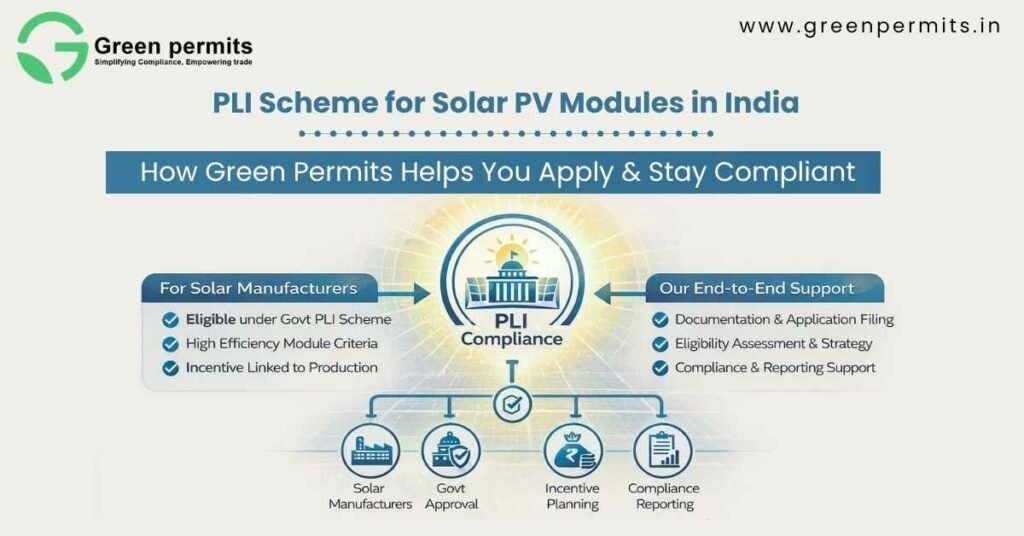
The Production Linked Incentive (PLI) Scheme for Solar PV Modules is one of India’s most capital-intensive industrial programs. With an allocation exceeding ₹24,000 crore and a manufacturing target of 50–65 GW, the scheme is designed to transform India into a global solar manufacturing hub.
However, there is a critical misunderstanding in the market. Many businesses assume that once they secure PLI approval, they can directly proceed with manufacturing.
In reality, the scheme operates parallel to a strict environmental compliance framework governed by multiple authorities. Without proper approvals, even a fully funded plant cannot legally operate.
PLI success depends on aligning financial approval with regulatory readiness.
The PLI scheme provides financial incentives to manufacturers based on their actual output of high-efficiency solar PV modules. The incentive is calculated on a per-watt basis and is disbursed over a fixed number of years.
The scheme prioritizes integrated manufacturing, meaning companies that produce upstream components such as cells, wafers, or polysilicon receive higher preference.
The government aims to reduce import dependency and increase domestic value addition, especially in high-efficiency modules.
The scheme is structured to encourage large-scale investments and long-term production commitments.
These numbers indicate that the scheme is designed for serious industrial players, not small-scale operations.
PLI operates within a broader legal ecosystem. Every solar manufacturing project must comply with environmental and industrial laws before production begins.
The Environment Protection Act, 1986 forms the legal foundation. Under this Act, any industrial activity that impacts the environment must obtain approvals and operate within prescribed limits.
State Pollution Control Boards (SPCBs) and Central Pollution Control Board (CPCB) are the key authorities responsible for enforcement.
The regulatory system ensures that industrial growth does not lead to environmental damage, especially in sectors involving chemicals, emissions, and waste.
Manufacturers must align with multiple approvals before starting operations.
Ignoring any one of these can stop the project completely.
Eligibility under the PLI scheme is not limited to financial strength. It includes technical capability, manufacturing scale, and long-term commitment.
Manufacturers must demonstrate that they can set up large-scale production facilities and maintain consistent output over multiple years.
The government evaluates applications based on capacity, technology, and financial viability.
Applicants must meet strict criteria to qualify for incentives.
The documentation process is extensive and overlaps with environmental compliance filings.
These documents are also required for CPCB and SPCB approvals, making early preparation critical.
PLI approval is only a financial commitment from the government. It does not grant permission to construct or operate a plant.
Before any production begins, manufacturers must secure environmental approvals based on plant size, capacity, and impact.
A 3 GW solar module plant typically involves chemical processing, water consumption of 100–500 KLD, and significant energy usage. These factors trigger mandatory environmental evaluation.
Without compliance, operations are considered illegal.
Manufacturers must complete multiple regulatory steps before commissioning the plant.
Each approval has its own timeline and documentation requirements.
Solar manufacturing is not just about producing modules. It also involves handling waste generated during production and packaging.
Extended Producer Responsibility (EPR) ensures that manufacturers take responsibility for managing post-consumer waste.
This includes plastic packaging, electronic components, and batteries used in solar systems.
Manufacturers must ensure that waste is recycled through authorized recyclers.
India follows a progressive target system across industries.
These targets are expected to influence solar sector regulations as well.
The CPCB portal is the central system for managing compliance in India. All registrations, filings, and tracking are done digitally.
Manufacturers must regularly update their data and submit returns to remain compliant.
Non-compliance or incorrect filing can lead to rejection or penalties.
The portal acts as a compliance backbone for all manufacturers.
Regular reporting is mandatory for all registered entities.
The biggest challenge in solar manufacturing projects is timeline management. Multiple approvals must be secured in a structured sequence.
Delays in one stage affect the entire project.
A realistic timeline for a solar manufacturing plant ranges between 18–30 months.
Even small delays can have significant financial impact.
Solar manufacturing generates multiple types of waste that must be handled carefully.
Improper disposal can lead to environmental damage and regulatory penalties.
The government has strict rules for handling industrial waste.
Different stages of manufacturing produce different waste streams.
Manufacturers must comply with multiple waste management regulations.
Each rule has separate compliance requirements and reporting obligations.
Non-compliance is one of the biggest risks in solar manufacturing projects. The penalties are not limited to fines but can impact operations and business continuity.
Under the Environment Protection Act, companies can face financial penalties and legal action.
Failure to comply can result in serious consequences.
Compliance failures directly affect production.
A manufacturer starts construction without EC approval.
Company submits incomplete returns.
Plant is ready but CTO is not approved.
Green Permits works as an integrated compliance partner for solar manufacturers. Instead of treating PLI and compliance separately, the approach focuses on aligning both from day one.
This reduces delays, avoids rejection, and ensures smooth execution.
The firm supports manufacturers across the entire lifecycle.
Integrated planning reduces risk and improves efficiency.
The PLI Scheme for Solar PV Modules is a major opportunity for manufacturers in India. However, the real challenge lies in execution.
Projects fail not due to lack of funding, but due to compliance gaps.
Manufacturers must treat PLI as part of a larger regulatory ecosystem that includes environmental approvals, waste management, and CPCB compliance.
Early planning, structured documentation, and professional guidance can significantly reduce risks and improve outcomes.
📞 +91 78350 06182
📧 wecare@greenpermits.in